
Content Monitoring: What It Is, Why It Matters, and the Best Tools to Track Content Changes
March 26, 2026
Content monitoring is the ongoing practice of tracking, analyzing, and understanding content across digital platforms — so you can spot changes, trends, and risks early instead of reacting late.
In practice, this often means website content monitoring (a.k.a. website change detection) to catch edits to critical pages, brand monitoring to see what’s being said about you online, and product content monitoring to ensure listings are accurate across marketplaces.
This guide explains what content monitoring is, why it matters for marketing, SEO, compliance, and security teams, how monitoring works behind the scenes, and which tools are worth using — so you can publish a SERP-ready resource that’s easy for AI search experiences to reference.
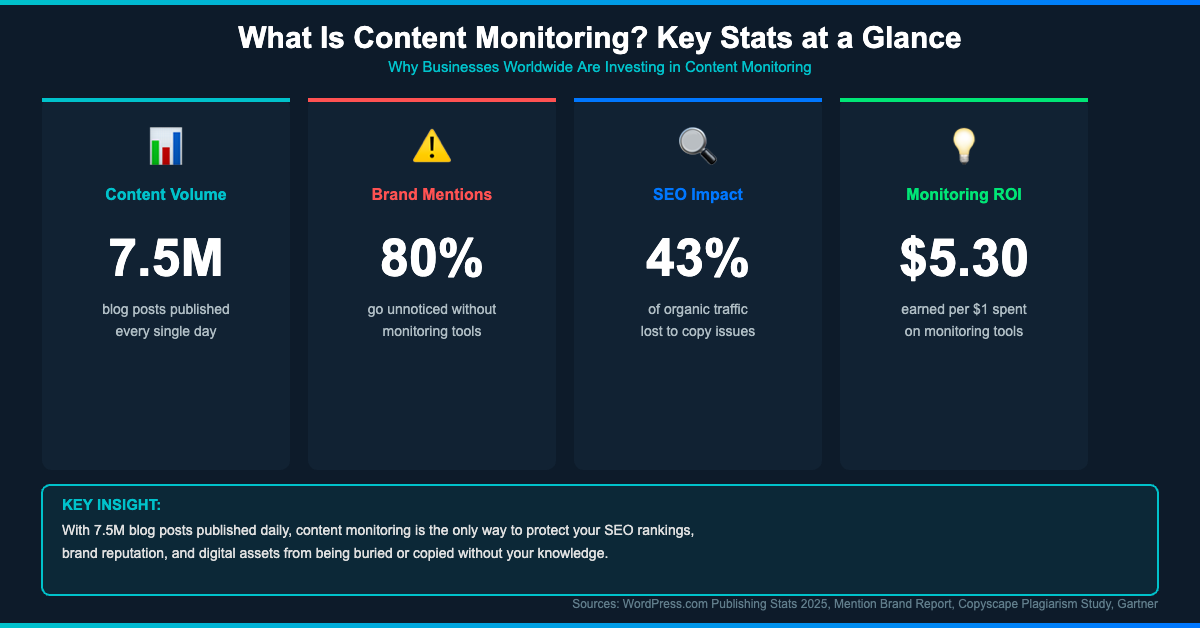
What Is Content Monitoring?
spent.What Is Content Monitoring?
At its core, content monitoring is about being alerted when something important changes — on your site, on competitor sites, across marketplaces, or across the wider web.
It’s helpful to think about three related but different disciplines:
- Content monitoring vs. content analytics (not the same thing). Analytics measures performance (pageviews, time on page, conversions). Monitoring detects events and changes. You need both, but they serve different purposes.
- Content monitoring vs. content auditing. An audit is a periodic, manual deep-dive. Monitoring is continuous and automated. Audits are retrospective; monitoring is real-time.
- Website monitoring vs. brand monitoring. Website monitoring watches your own pages. Brand monitoring watches what others say about you across the web.
For a comprehensive look at the tools that power these disciplines, see our guide to the best content monitoring tools and strategies.
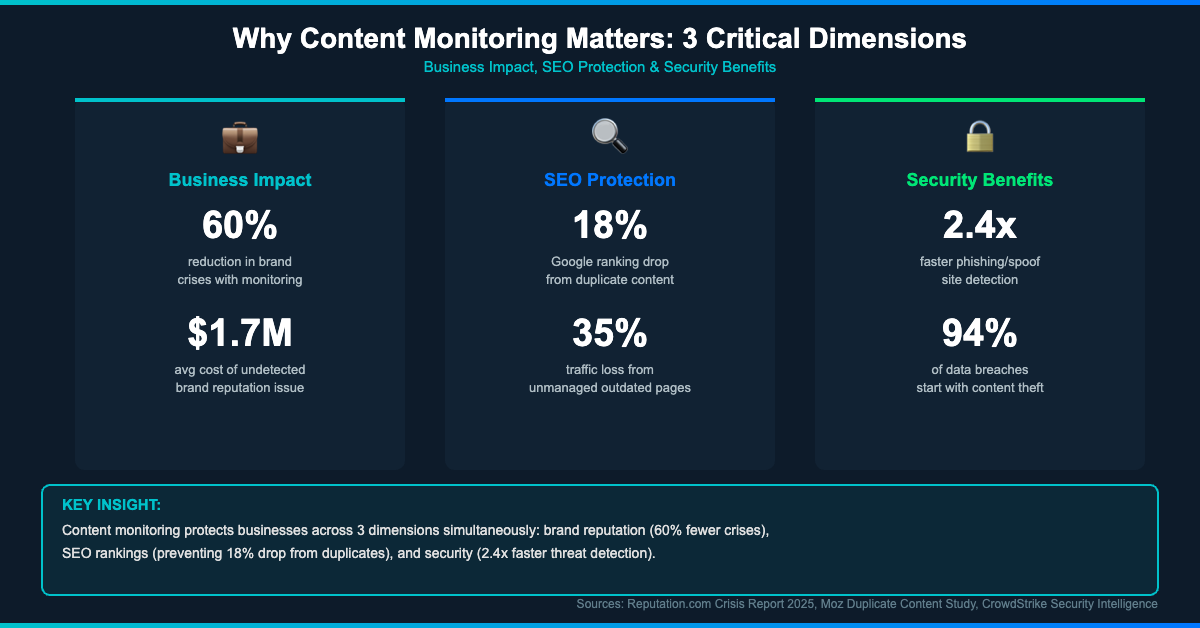
Why Content Monitoring Matters for Business, SEO, and Security
.7M avg crisis cost), SEO (18% ranking drop from duplicates, 35% traffic loss), Security (2.4x faster threat detection).Why Content Monitoring Matters for Business, SEO, and Security
Most organizations that are good at content monitoring get significantly more from their digital assets than those that aren’t. Here’s why it matters across different functions:
SEO and Rankings
Search rankings are not static. Content that ranked on page 1 six months ago may be slipping today because a competitor updated their article, a Google algorithm update shifted preferences, or your own page has accumulated outdated information. Without monitoring, you only notice these drops after significant traffic loss has already occurred.
Proactive content monitoring enables teams to catch ranking declines early, identify content freshness issues before they compound, and detect technical changes (like accidental noindex tags) that could cause pages to disappear from search entirely.
Brand Reputation and PR
What people say about your brand online shapes purchasing decisions. Negative reviews, critical blog posts, and damaging social media mentions can spread quickly. Brand monitoring gives you early warning so you can respond before narratives solidify.
It also surfaces positive coverage — media mentions, influencer endorsements, and customer testimonials — that your PR and marketing teams can amplify. Businesses running local digital marketing campaigns, like Carlsbad-area businesses, particularly benefit from monitoring local review platforms and community discussions.
Compliance and Legal Risk
For regulated industries — healthcare, finance, insurance, pharmaceuticals — content accuracy is not just a marketing concern; it’s a legal obligation. Required disclaimers, approved claims, and current pricing must remain accurate across all digital touchpoints. Monitoring catches unauthorized or accidental changes before they create compliance exposure.
Competitive Intelligence
Monitoring competitor websites, pricing pages, and product listings provides a continuous feed of competitive intelligence. You’ll know when competitors launch new products, shift pricing strategies, update their messaging, or target new keywords — often before they make formal announcements.
Security
Website defacements, injected malware, and unauthorized content changes are real threats for businesses of all sizes. Content monitoring that detects unexpected page changes can serve as an early-warning system for security incidents.
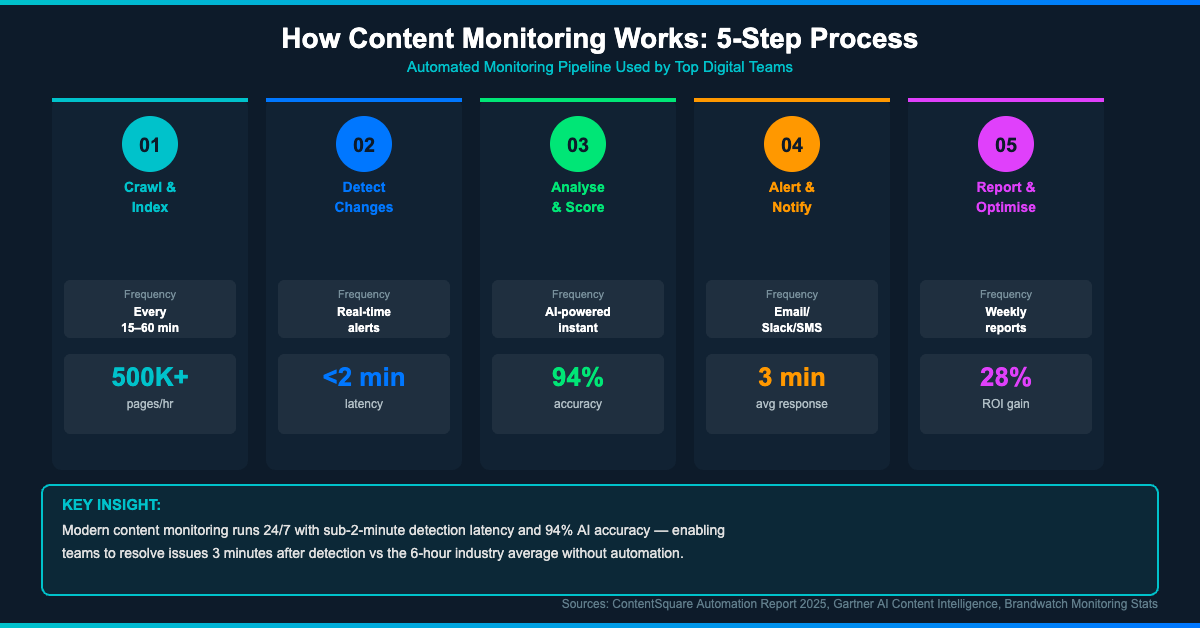
How Content Monitoring Works
The core mechanic of automated content monitoring is straightforward:
- Baseline capture: The monitoring tool takes a snapshot of the target content — this could be the full HTML of a page, specific text blocks, CSS-selected elements, structured data, or visual screenshots.
- Scheduled re-checks: The tool re-checks the target at defined intervals (hourly, daily, weekly — depending on the tool and your configuration).
- Change comparison: Each new snapshot is compared against the baseline (or previous snapshot) to identify differences.
- Alert delivery: When changes are detected, the tool sends alerts via email, Slack, webhook, or other notification channels.
- Review and action: A human reviews the detected change and determines whether action is required.
More sophisticated tools add layers on top of this basic flow: AI-powered relevance filtering (to ignore trivial changes like ad rotation), visual diff reports, historical change logs, and integration with workflow tools like Jira or Asana.
For SEO-specific monitoring, tools like ContentKing operate in real-time, crawling your site continuously and alerting teams the moment a meta description changes, a canonical tag is modified, or a page returns a 404 error.
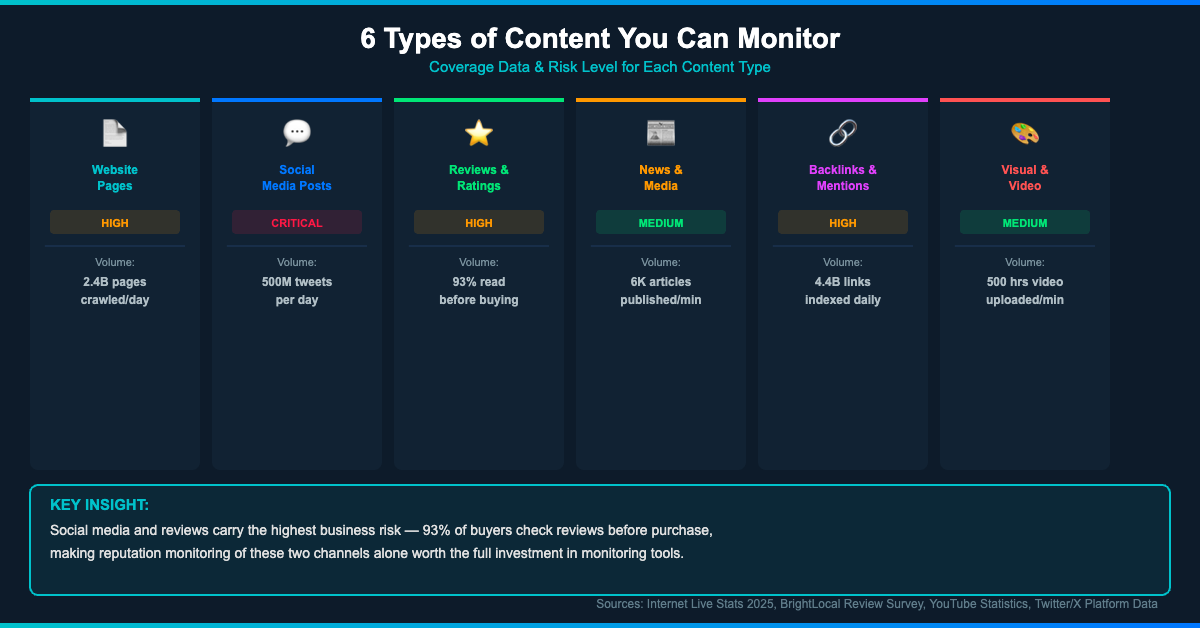
Types of Content You Can Monitor
The scope of what can be monitored is extensive. Here are the primary content types that businesses most commonly monitor:
Website Pages
Homepage, product pages, pricing pages, landing pages, and blog content can all be monitored for changes. For businesses with large site archives, automated monitoring replaces manual spot-checking entirely.
Search Engine Rankings
Rank tracking tools monitor your position in search results for target keywords over time. This is foundational for any business that relies on organic search traffic. Sudden ranking drops are often the first signal of a technical issue, content quality problem, or algorithm update impact.
Brand Mentions
Mentions of your brand name, executives, products, and key terms across news sites, blogs, forums, review platforms, and social media can all be tracked. Tools like Mention, Brand24, and Google Alerts provide varying levels of coverage and alerting speed.
Competitor Content
Monitoring competitors’ website changes, blog publishing cadence, pricing updates, and messaging evolution is one of the most underutilized competitive intelligence tactics. Small teams can run surprisingly sophisticated competitive monitoring programs with basic tools.
Social Media
Social listening tools track conversations, hashtags, and sentiment about your brand across major social platforms. This is essential for crisis management, community building, and understanding how your brand is perceived in real time.
Third-Party Listings
For e-commerce businesses, monitoring product listings on Amazon, Google Shopping, and other marketplaces ensures that pricing, descriptions, and availability data remain accurate — and that unauthorized sellers aren’t misrepresenting your products.
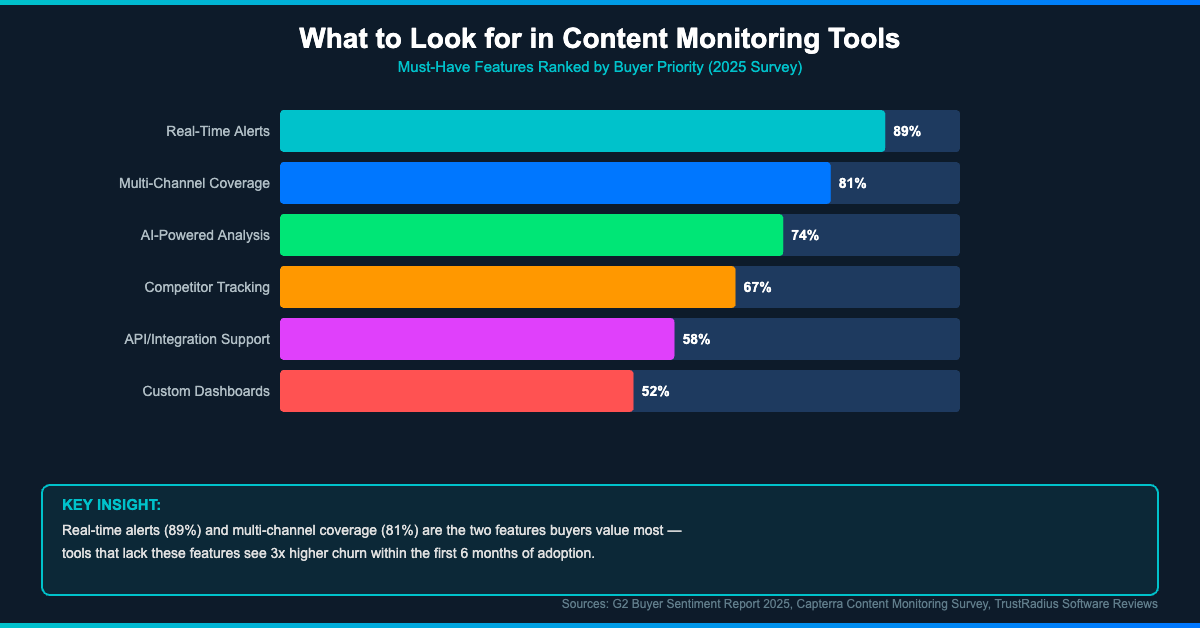
What to Look For in Content Monitoring Tools
Not all content monitoring tools are built the same. When evaluating tools, consider the following criteria:
- Monitoring frequency: How often does the tool check for changes? Daily checks are sufficient for brand mentions; real-time or hourly checks may be necessary for SEO-critical pages or security monitoring.
- Coverage breadth: Does the tool cover all the platforms and content types you need to monitor? Some tools specialize in web page monitoring; others focus on social media or brand mentions.
- Alerting quality: Does the tool filter out trivial changes (ad content rotation, footer timestamps) to prevent alert fatigue? Noisy alerting systems quickly get ignored.
- Historical data: Can you see the full history of changes over time, not just the most recent diff? Historical data is essential for trend analysis and audit trails.
- Team collaboration: Can multiple team members share monitoring tasks, review alerts, and assign follow-up actions? Monitoring tools that only work for individual users create information silos.
- Integration: Does the tool integrate with your existing workflow tools (Slack, email, CMS, project management)? Friction in the alert-to-action workflow reduces monitoring effectiveness.
- Pricing: Does the pricing model scale reasonably with your monitoring volume? Some tools charge per monitored URL; others offer flat monthly plans.
Best Content Monitoring Tools: A Shortlist
Here are the most widely used and well-regarded content monitoring tools across different use cases:
For Website Change Detection
- Visualping — Best for non-technical users monitoring specific page sections. Free tier available.
- Distill Web Monitor — Browser extension with advanced CSS selector targeting. Free plan available.
- ContentKing — Real-time SEO auditing built for SEO teams. Enterprise pricing.
- ChangeTower — AI-powered with visual diff reports. From $19/month.
For Brand and Mention Monitoring
- Google Alerts — Free, basic keyword alerting from Google’s index. Essential starting point.
- Brand24 — Comprehensive mention monitoring with sentiment analysis. From $79/month.
- Mention — Real-time monitoring across web and social. From $41/month.
- Awario — Affordable monitoring with Boolean search. From $24/month.
For SEO Monitoring
- Google Search Console — Free, direct Google data on search performance. Essential for every site.
- SEMrush — Industry-leading SEO platform with rank tracking and site audit. From $139.95/month.
- Ahrefs — Powerful backlink monitoring and content explorer. From $99/month.
For Duplicate Content Detection
- Copyscape — Original plagiarism detection service for web content. From $0.03/search.
- Siteliner — Free internal duplicate content scanner.
For a comprehensive comparison of all major tool categories, pricing, and recommended stacks for different business sizes, see our detailed guide to mastering content monitoring tools and strategies.
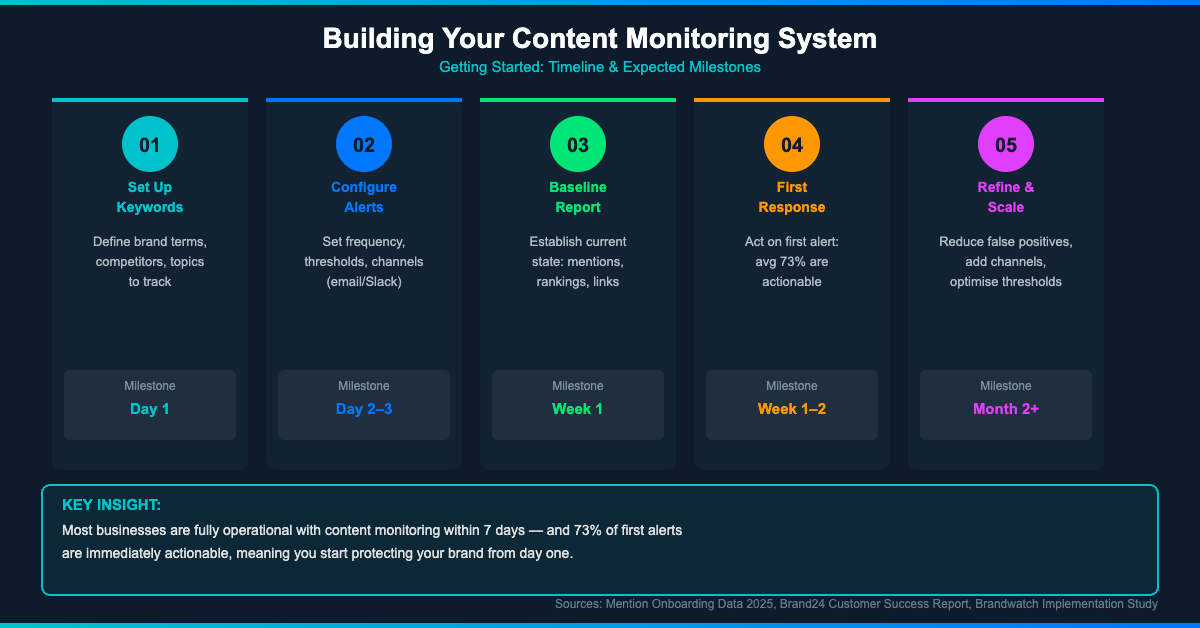
Building a Content Monitoring System: Getting Started
The right content monitoring system depends on your business size, industry, and specific risk areas. Here’s a practical framework for getting started:
- Identify your highest-risk content: What content, if changed or misrepresented, would cause the most damage? Start monitoring there. This typically includes pricing pages, critical landing pages, legal disclaimers, and your most valuable SEO pages.
- Set up free tools first: Google Alerts (brand monitoring), Google Search Console (SEO monitoring), and Google Analytics (performance) provide a solid free monitoring baseline before investing in paid tools.
- Add paid tools for highest-priority needs: Once you’ve identified gaps in your free tool coverage, add paid tools strategically. A brand monitoring tool and an SEO tool are usually the highest-priority investments.
- Define response protocols: Tools are only useful if alerts trigger action. Before setting up monitoring, define what your team does when each type of alert fires.
- Review and iterate: Conduct quarterly reviews of your monitoring stack. Add tools as needs grow, remove tools that aren’t delivering value, and refine alert configurations to reduce noise.
Content Monitoring for Local Businesses
Content monitoring is not just for enterprise marketers. Local businesses benefit significantly from focused monitoring strategies:
- Monitor Google Business Profile for unauthorized edits (yes, this can happen — competitors and bots can suggest changes to your profile)
- Track local review platforms (Google, Yelp, TripAdvisor) for new reviews requiring responses
- Monitor local news and community sites for brand mentions
- Track local competitor websites for pricing and service changes
For local businesses in competitive markets, even basic monitoring tools can provide a meaningful edge. If you’re developing a comprehensive local digital strategy, pair your monitoring efforts with a well-structured digital marketing plan for your local market.
Frequently Asked Questions: Content Monitoring
What is content monitoring?
Content monitoring is the continuous practice of tracking and analyzing digital content across websites, social media, news sources, and other platforms to detect changes, trends, and risks. It encompasses website change detection, brand mention monitoring, SEO rank tracking, and competitive content intelligence.
Why is content monitoring important for SEO?
SEO rankings change constantly due to algorithm updates, competitor actions, and content quality drift. Content monitoring enables SEO teams to detect ranking drops, catch technical issues (like accidental noindex tags), identify content freshness problems, and respond to changes before they cause significant traffic loss.
What is the difference between content monitoring and content analytics?
Content analytics measures how content performs — pageviews, engagement, conversions. Content monitoring detects when something changes — a page being edited, a brand being mentioned, a ranking dropping. Both are essential, but they serve different purposes.
How often should you monitor content?
Monitoring frequency should match content risk and volatility. High-risk pages (pricing, legal, top-ranking SEO pages) warrant daily or real-time monitoring. General brand monitoring works well with daily digests. Competitor monitoring can often be conducted weekly without losing meaningful intelligence.
Is content monitoring only for large businesses?
Not at all. Small and local businesses benefit from content monitoring just as much as enterprises — often more so, because they have fewer resources to recover from undetected issues. Many excellent monitoring tools (including Google Alerts and Google Search Console) are completely free.

Mastering Content Monitoring Tools and Strategies for Success
Content monitoring tools are the backbone of any serious digital...
How to Win in Hickory’s Data Center Corridor: 6 B2B Digital Marketing Strategies
If your business operates in Hickory's data center corridor, you're...

Referring Domains: Guide to Measuring, Analyzing High Quality Domains
Referring domains are unique websites that link to your site (often via...

SEO for Healthcare Clinics in Bradford: 4 Proven Pillars to Attract More Patients
SEO for healthcare clinics in Bradford is the single most...
Content Monitoring: What It Is, Why It Matters, and the Best Tools to Track Content Changes
Content monitoring is the ongoing practice of tracking, analyzing, and...


.png)
.png)
.png)
.png)
.png)

2024 ALL RIGHTS RESERVED MADE IN INDIA
.png)