

On this page
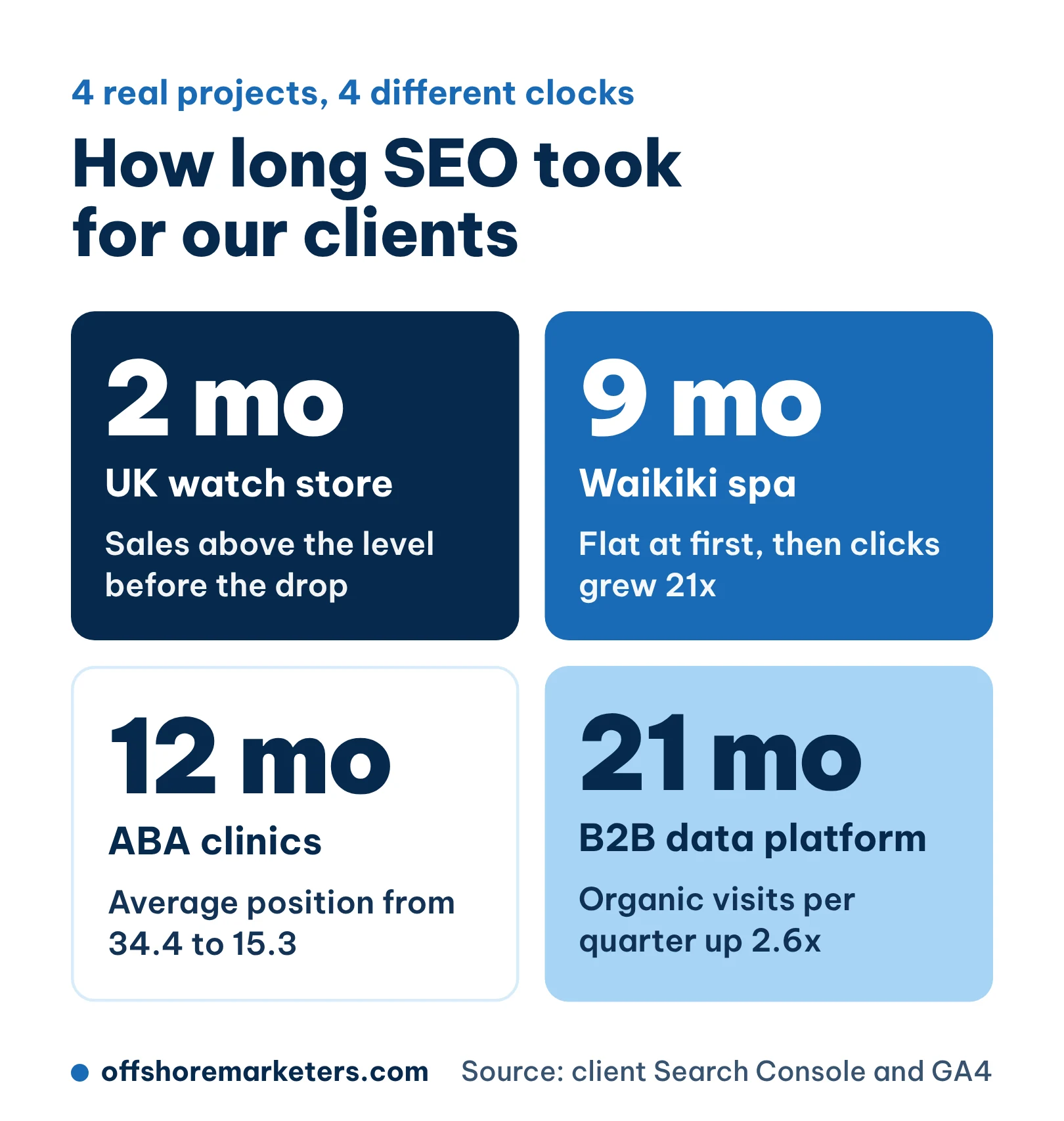
How long does SEO take? For most sites, the first real movement shows up in Search Console within 3 to 6 months, and steady growth in clicks and leads takes 6 to 12 months. That range hides a lot. One of our clients got sales back in 2 months. Another waited 9 months before anything moved, then grew 21x.
This guide shows four real timelines from our own client work, with the Search Console screenshots behind them. You will see what happens in each phase, what speeds SEO up or slows it down, and you can estimate your own timeline with the tool below.
- Technical fixes on an older site can pay off in 4 to 8 weeks.
- New content usually needs 4 to 9 months before it brings steady clicks.
- Our four clients took 2, 9, 12 and 21 months to reach their main result.
- Impressions rise first, then positions, then clicks, then leads. Judge progress in that order.
- Be wary of anyone who promises a #1 ranking. Google says nobody can guarantee it.
How long does SEO take? The short answer
SEO results arrive in layers. Some work is picked up by Google within days. Other work needs months of crawling, testing and trust before it ranks. Here is what to expect when you start SEO on a site that already exists.
| Type of SEO work | When you usually see results | What you see first |
|---|---|---|
| Fixing crawl, index or speed errors | 2 to 8 weeks | Pages return to the index, impressions recover |
| Improving pages already on page 2 | 1 to 3 months | Positions move from 11 to 20 into the top 10 |
| Google Business Profile and local pages | 1 to 3 months | More map views, calls and direction requests |
| New blog posts and guides | 4 to 9 months | Long, specific questions start to rank |
| Competitive national keywords | 9 to 18 months | Slow climb from page 3 to page 1 |
| Links and brand mentions | 3 to 12 months | Better positions across many pages at once |
Ranges from our client work and the sources cited in this article. Your site may be faster or slower.
Google itself does not publish a timeline. Its own guide on hiring an SEO suggests you ask an SEO “what kind of results do you expect to see, and in what timeframe?” before you sign. That question is the right one. A good answer names a range and explains what moves first.
What our client data shows: 4 real SEO timelines
Averages from studies are useful, but they do not tell you how a real project feels month by month. These four timelines come straight from our clients’ Search Console and Google Analytics. Three clients are not named because of NDAs.
Waikiki spa: 9 quiet months, then 21x more clicks
The Shiatsu & Massage Center in Honolulu started a blog plan with us in March 2025. We wrote posts that answer what people ask after a massage, such as why they feel tired or sick. About 7 posts went live every month.
For the first 9 months, clicks barely moved. In July to September 2025 the site had 751 clicks from Google at an average position of 27.1. Then the posts started to rank. A year later the same three months brought 16,018 clicks at an average position of 7.1.

The lesson: a content-led SEO plan often looks like it is failing right up until it works. Read the full Shiatsu & Massage Center case study for the posts that drove the growth.
UK watch store: back above the old level in 2 months
A UK online watch store lost rankings after a website update in February 2025. Monthly sales fell 22%, from £156,771 to £122,099. We found the pages that had dropped, rewrote the meta descriptions on more than 1,000 product and collection pages and fixed the on-page targeting.
By April, sales were £159,472, higher than before the drop. This is the fastest kind of SEO win: the site already had trust with Google, so fixing what broke restored it quickly.
ABA therapy clinics: from page 4 to page 2 in a year
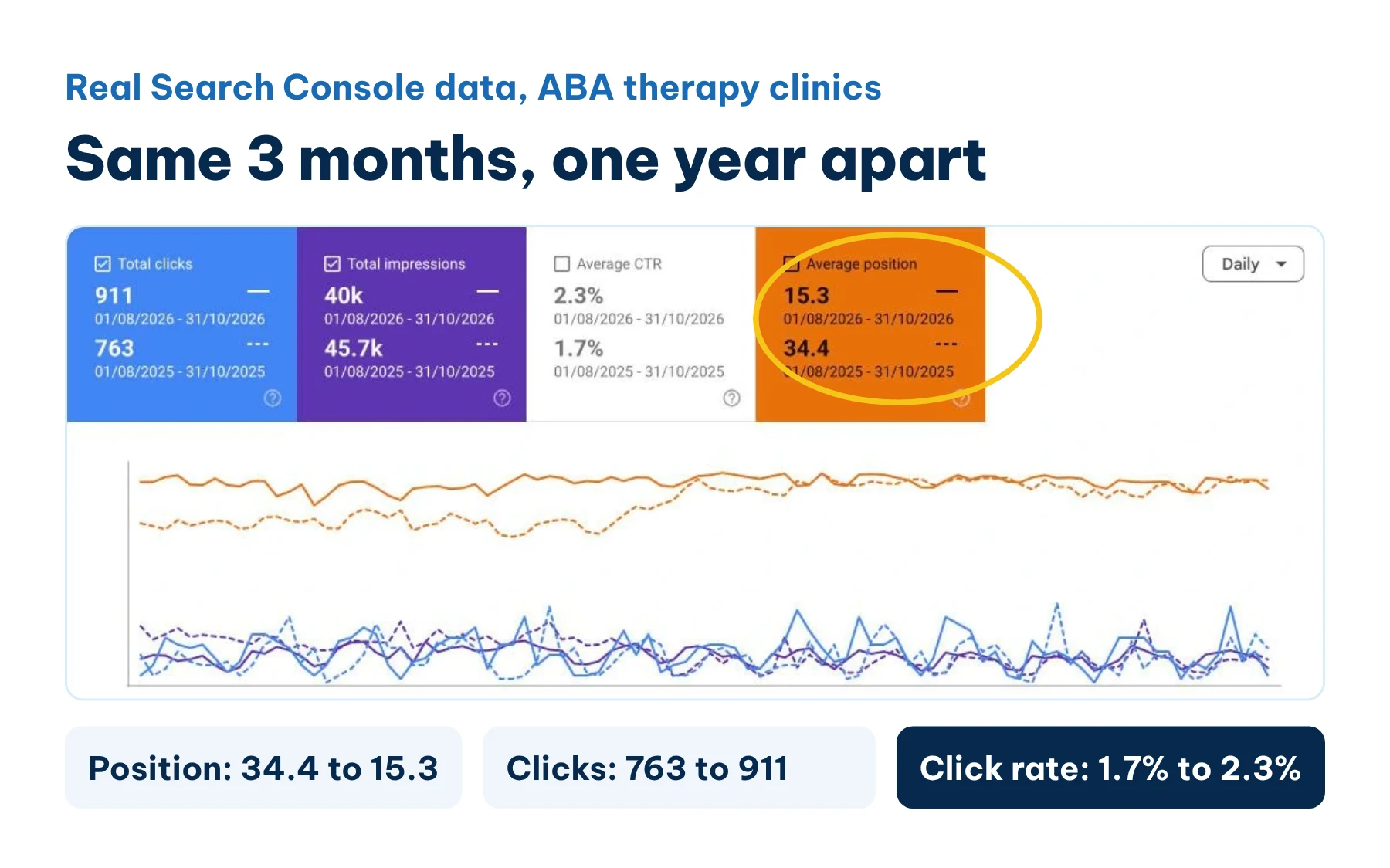
An ABA therapy provider with three clinics in South Florida runs monthly SEO and Google Business Profile work with us. Comparing August to October 2026 against the same months in 2025, the average position improved from 34.4 to 15.3 and the click rate rose from 1.7% to 2.3%.
A local search for one clinic town, “aba therapy wellington”, moved from position 5.9 to 1.4. Local terms tend to move first. Broader terms like “aba companies near me” take longer. The details are in the ABA therapy SEO case study.
B2B data platform: 2.6x organic visits in 7 quarters
A B2B platform that sells telecom data had about 8,135 organic visits a quarter in late 2023. With steady SEO work it reached 21,410 a quarter seven quarters later, about 2.6 times the starting point. Engaged organic visits doubled year on year. See the B2B data platform case study.
Estimate your SEO timeline
Answer three questions to see a realistic range for your site. The estimate updates as you click.
SEO timeline estimator
Pick the three answers closest to your site. The ranges come from the timelines in this article, not from a formula Google publishes.
Why SEO takes months, not weeks
SEO is slow because several separate steps each take time, and Google repeats some of them many times before it settles on a position.
- Crawling and indexing. Google's John Mueller has said it can take several hours to several weeks for a new or updated page to be indexed. Large or low-trust sites wait longer.
- Ranking tests. New pages often jump around for weeks while Google tests them against what already ranks.
- Site-wide quality signals. Google has said quality changes can take several months to be reprocessed. One great page on a weak site rises slowly.
- Competition. The pages you want to beat have years of links and history.
That last point is backed by data. Ahrefs' 2025 study of top-ranking pages found that 72.9% of pages in the top 10 are more than 3 years old and the average #1 result is about 5 years old. In a sample of 2 million new English pages, only 6.11% reached the top 10 within a year.
So if your new page is not on page 1 after six weeks, nothing is broken. That is normal.
What makes SEO faster or slower
Things that speed SEO up
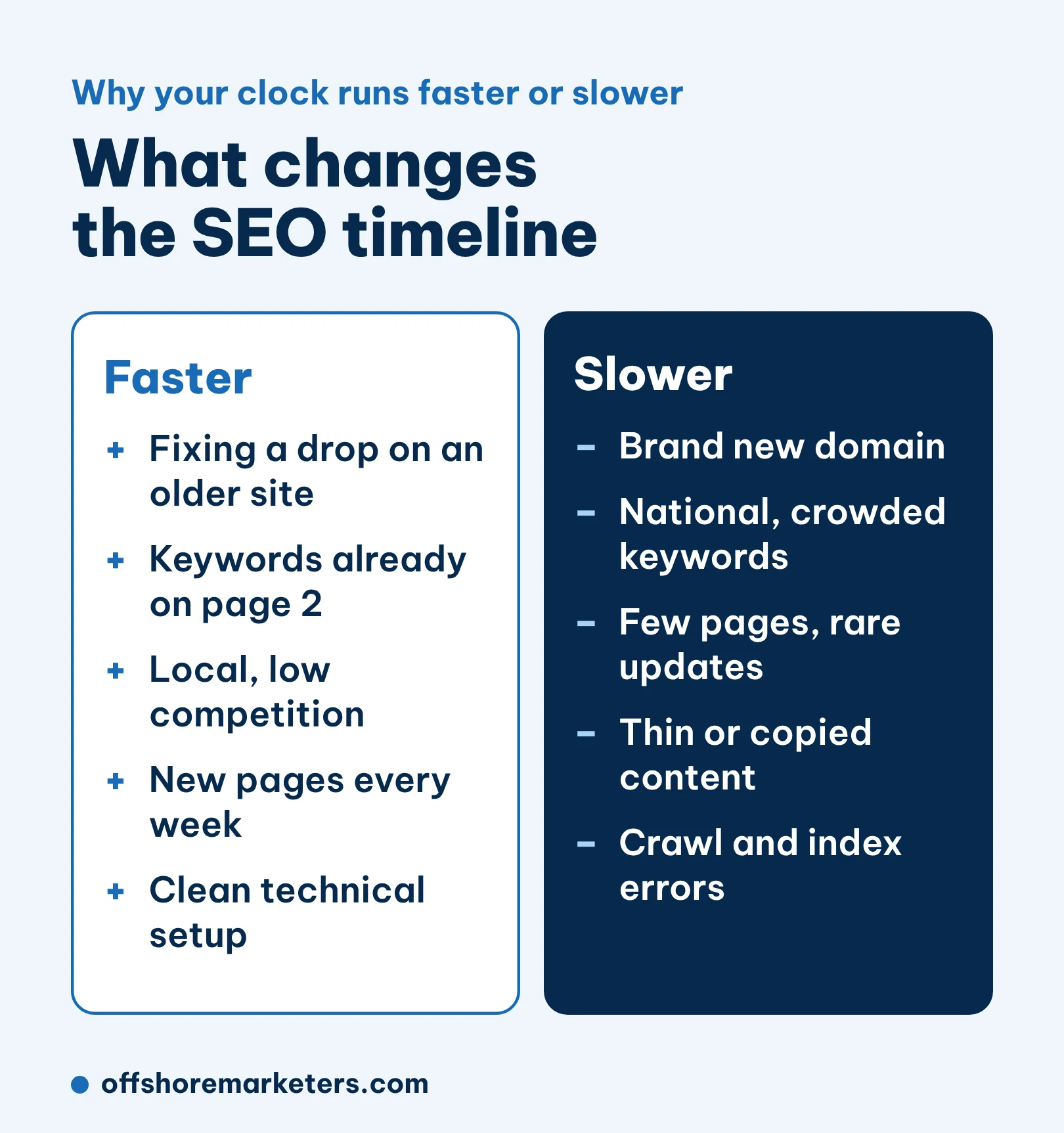
- An older site with a fixable problem. Restoring lost rankings is faster than building new ones, as the watch store showed.
- Keywords already on page 2. Pages at positions 11 to 20 need the least work to reach page 1. Find them in Search Console under Performance.
- Local or niche searches. "Plumber in Tustin" moves faster than "plumber".
- Steady publishing. The spa published about 7 posts every month. Growth came from many posts ranking together.
- A clean technical base. If Google can crawl every page easily, new work gets picked up quickly. Our technical SEO team starts every project here.
Things that slow SEO down
- A brand-new domain with no links or history.
- Crowded national keywords where big brands own page 1.
- Thin or copied content that adds nothing new.
- Index problems, such as pages blocked by robots.txt or marked noindex by mistake.
- Stopping and starting. Pausing work for months resets much of the momentum.
Month-by-month: what you should see
Here is how a typical SEO project should look from the inside, and what to check each month.
| Stage | What should be happening | What to check |
|---|---|---|
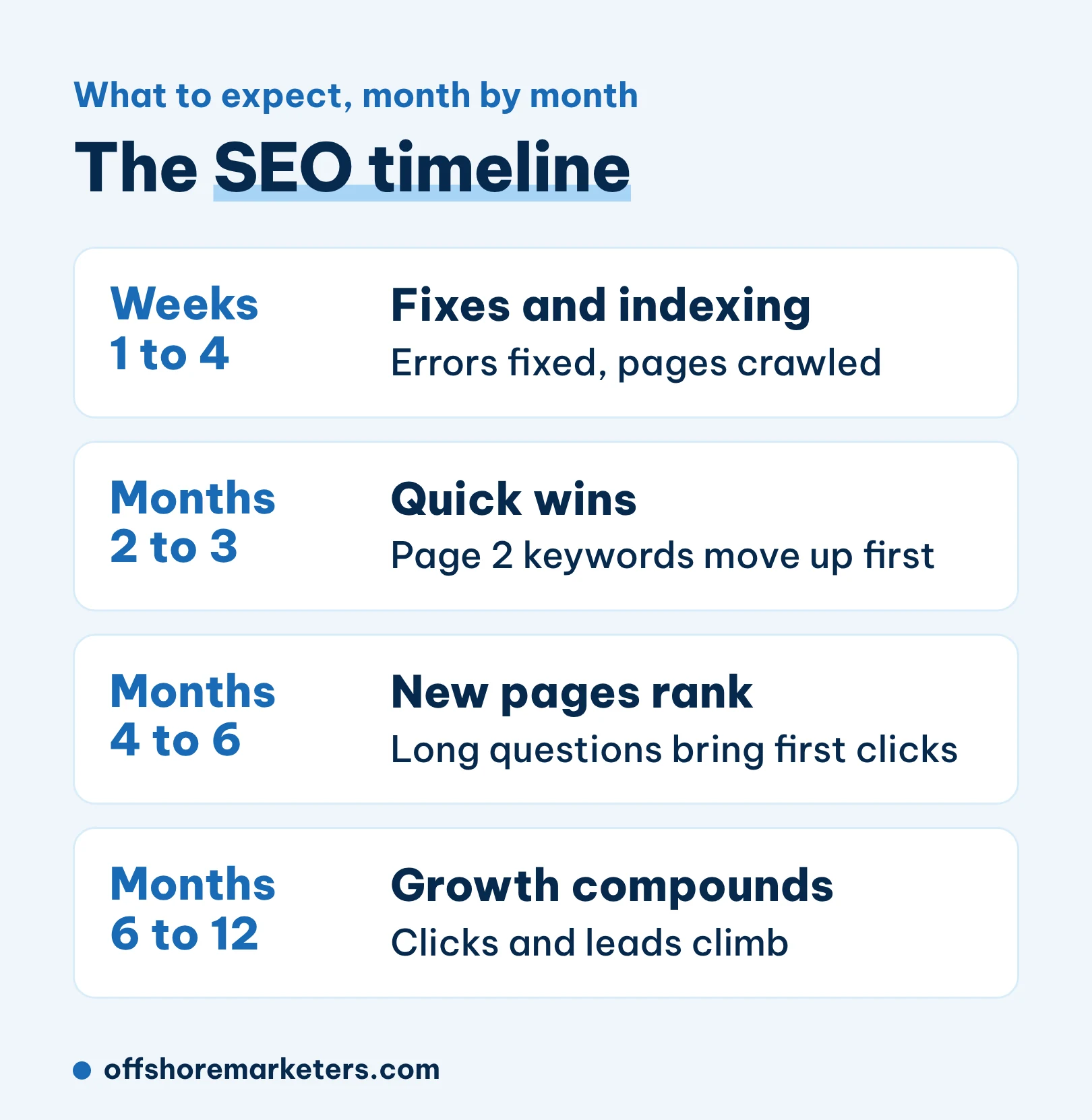
| Month 1 | Audit, technical fixes, keyword plan, first page updates | Pages indexed, errors fixed in Search Console |
| Months 2 to 3 | Updated pages climb; first new content goes live | Impressions rising, positions improving on page 2 terms |
| Months 4 to 6 | New posts start to rank for long questions | First clicks from new pages, more queries in Search Console |
| Months 7 to 12 | Rankings spread to broader terms; links build up | Clicks and leads rising year on year |
| 12 months and on | Growth compounds as the site earns trust | Revenue or leads from organic search |
Notice the order. Impressions grow first, because Google starts showing your pages lower down. Positions improve next, then clicks, then leads. If you only watch leads, the first few months will feel like nothing is happening. Our guide to SEO KPIs explains what to track at each stage.
How long does it take to show up in AI answers?
Google AI Overviews and ChatGPT search pull from pages that are already indexed and trusted. In practice, the same work that improves your rankings is what gets you mentioned in AI answers, so the timeline is similar: usually months, not days.
Two things help. Write clear, direct answers near the top of your pages, so an AI tool can quote them. And get your brand mentioned on other sites people trust. We cover this in our guide to how ChatGPT search works.
When to worry about your SEO timeline
Slow is normal. No progress at all is not. These are the warning signs that something is wrong:
- After 3 months, impressions in Search Console have not grown at all.
- Important pages are still missing from Google's index.
- Your agency cannot tell you what was done last month, in numbers.
- Someone promises a #1 ranking or results in two weeks. Google's own guide is clear: "No one can guarantee a #1 ranking on Google."
If you see these signs, ask for a written list of the work done and the Search Console data behind it. A good SEO partner will show you both without being asked.
So, how long will SEO take for you?
If you are fixing a problem on an established site, expect results in 1 to 3 months. If you have some rankings and keep improving, expect steady growth within 4 to 8 months. If you are starting from zero, plan for 6 to 12 months before SEO pays its way, and treat everything after that as compounding returns.
Our four clients took 2, 9, 12 and 21 months to reach their main result. None of them got there by luck. Each had a plan, steady monthly work and someone checking the data.



.png)


.png)
.png)
.png)
.png)

.png)
