
Referring Domains: Guide to Measuring, Analyzing High Quality Domains
March 26, 2026
Referring domains are unique websites that link to your site (often via multiple backlinks). Across competitor definitions, the shared concept is simple: one domain can send many links, but it still counts as one referring domain.
Why it matters: link-based signals remain important to search engines. Google explicitly states it uses links as a signal for relevancy and to discover new pages to crawl, and guides anchor text and crawlable links.
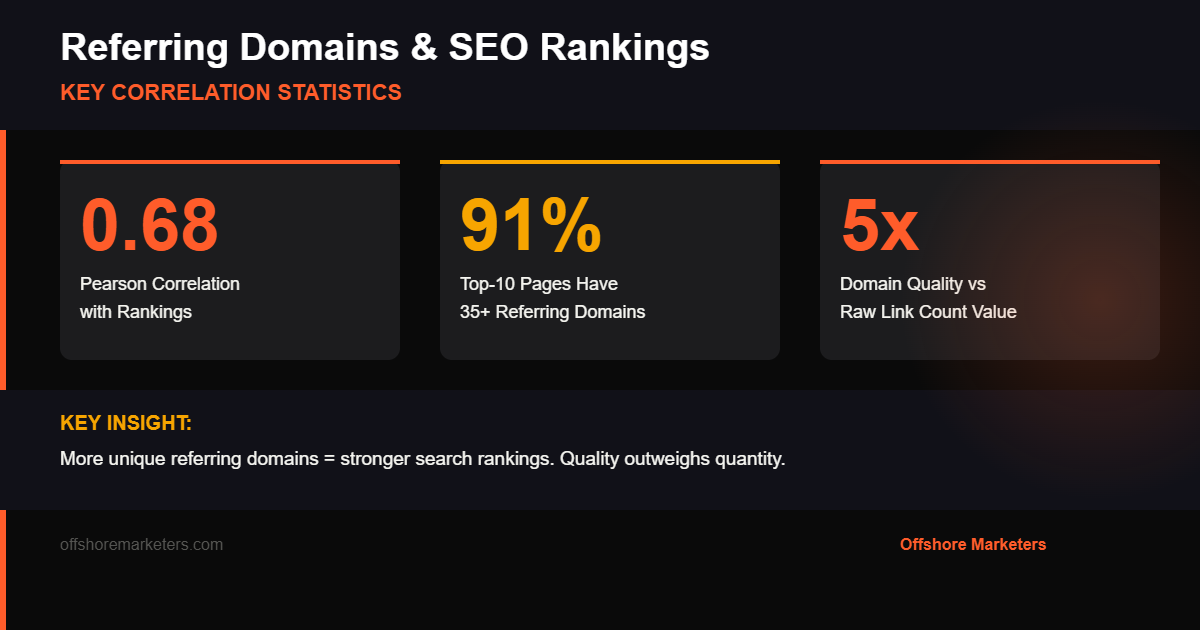
Independent industry research repeatedly finds strong correlations between more unique linking domains and more search visibility/traffic, while also emphasizing that correlation is not causation.
How to use this guide: treat referring domains as both (a) an SEO strength metric and (b) an actionable prospecting dataset—a list of relationships you can earn, keep, and expand.
Tooling matters: Google Search Console is invaluable but intentionally sampled and constrained, while specialized backlink tools add breadth (follow/nofollow segmentation, “new vs lost,” IP/subnet views, authority metrics, and richer exports).
Referring domains explained
A “referring domain” is best understood in two related ways, depending on whether you’re talking about SEO link graphs or analytics traffic.
What do referring domains mean in SEO
In SEO tooling and link analysis, a referring domain is an external website that links to your site or a specific page. If a single site links to you multiple times, you gain multiple backlinks but still one referring domain.
Referring domains vs backlinks
| Concept | What it counts | How it’s commonly used |
|---|---|---|
| Referring domains | Unique websites linking to you | Measures endorsement diversity and relationship breadth |
| Backlinks | Individual links pointing to you | Measures link volume and link placement opportunities |
Simple example (clear mental model):
- If
news-site.comlinks to your guide three times, that’s 3 backlinks from 1 referring domain. - If
news-site.com,industry-blog.com, anduniversity.edueach link once, that’s 3 backlinks from 3 referring domains.
A key nuance: backlink tools often let you analyze at the root domain, subdomain, or URL level; those choices change counts and interpretation.
What “referring domain” can mean in analytics
In web analytics documentation, “referring domain” often means the domain a visitor clicked from to reach your site (i.e., referral traffic attribution). For example, Adobe’s “Referring domain” dimension reflects domains visitors click through from, requiring both a link and a click, and can persist during a visit depending on navigation/referrer changes.
How to reconcile the two definitions:
- SEO referring domains = domains that link to you (click not required).
- Analytics referring domains = domains that sent you visitors via referral clicks.
You want both—but they answer different questions (“Who endorses us?” vs “Who sends us traffic?”).
Types of referring domains
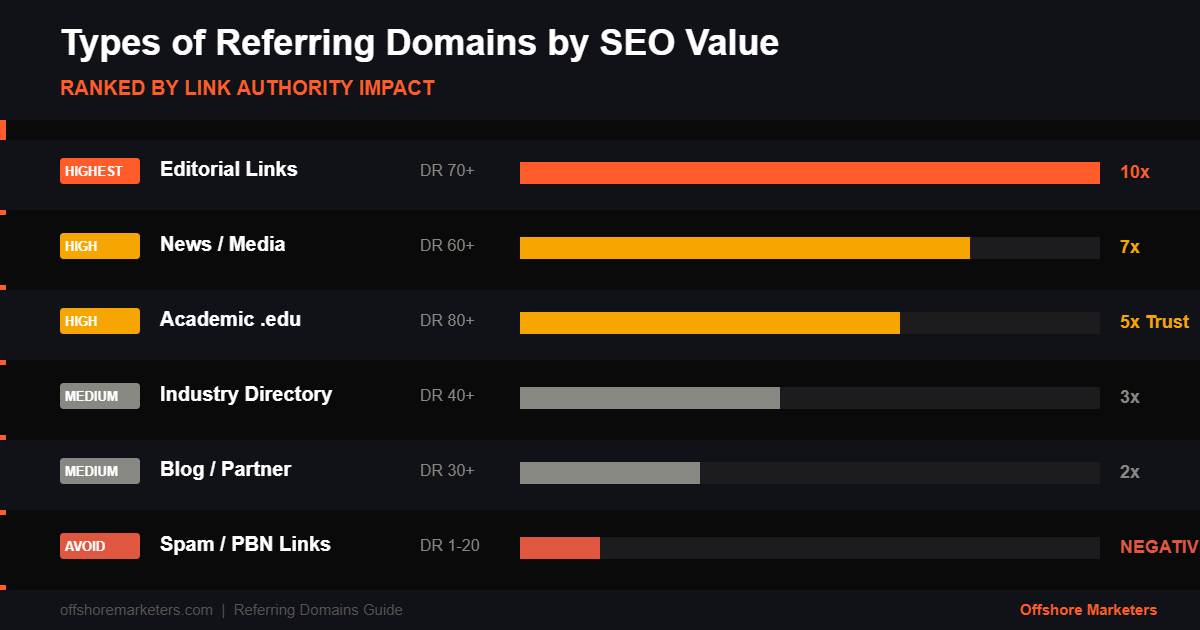
Competitors converge on a broad taxonomy: referring domains can include corporate blogs, news publishers, educational/government sites, social platforms, forums, and directories—each with different typical quality and risk profiles.
A pragmatic, SEO-focused categorization:
- Editorial content domains (news, niche blogs, research articles): often the highest value when relevant and earned.
- Resource and directory domains (industry associations, curated lists): can help discovery; quality varies widely.
- Community domains (forums, Q&A, UGC platforms): can drive traffic; must be handled carefully.
- Partner domains (integrations, suppliers, clients): often “relationship links,” stable over time.
- Owned and adjacent domains (subdomains, sister brands): useful, but don’t confuse these with independent endorsements; tools may group and normalize domains differently.
Why referring domains matter for SEO and how they influence rankings
Links Remain an Explicit Search Signal
Google’s own documentation states it uses links as a signal when determining page relevancy and to find new pages to crawl; it also stresses the importance of descriptive anchor text and crawlable link formats.
This makes the existence, context, and quality of links—and by extension the referring domains hosting those links—strategically meaningful.
To understand the intuition behind link-based ranking: link analysis models treat links as a form of “citation,” where pages become “important” when important pages link to them; classic explanations use the “random surfer” analogy.
Referring Domains Correlate with Visibility and Traffic
Competitor pages cite recurring empirical patterns:
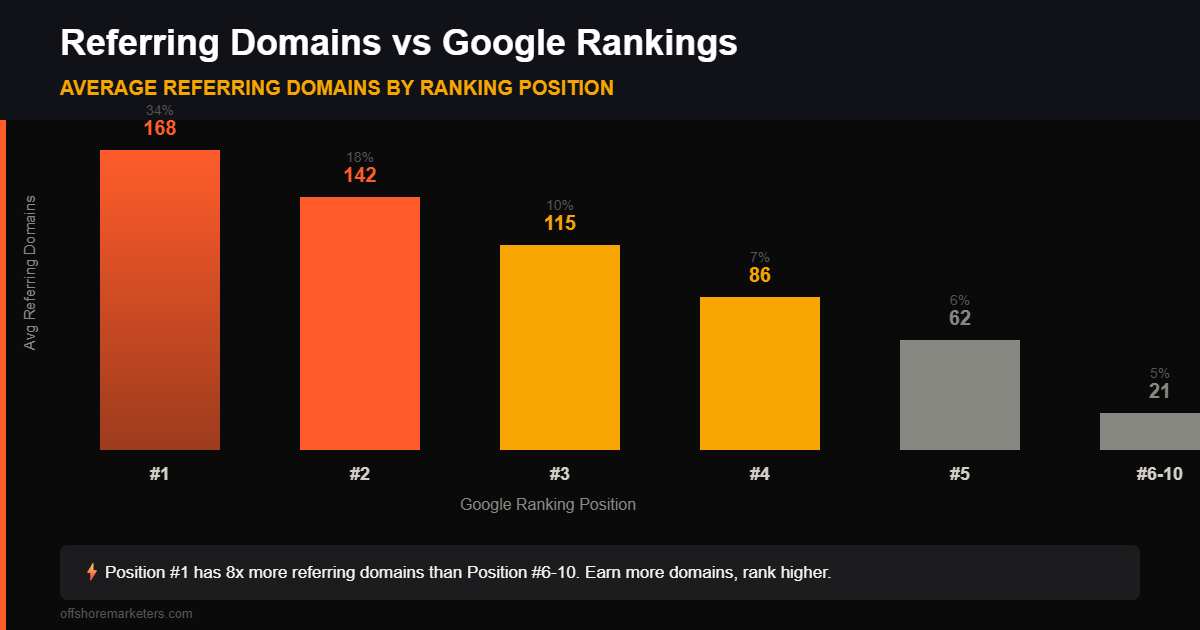
- Semrush reports pages ranking higher tend to have substantially more referring domains; in its cited ranking factors study context, it states pages ranking #1 average 200+ referring domains, while #10 averages under 80 (as reported on its referring domains page).
- Ahrefs analyzed a very large dataset (described as ~14 billion pages in its Content Explorer dataset) and reports 96.55% of pages in that dataset receive zero organic traffic from Google; it also discusses backlink/referring-domain correlations while explicitly noting correlation ≠ causation.
- Ahrefs’ own help documentation summarizes findings that pages without referring domains tend to get no Google traffic and that more unique referring domains tend to correlate with more search traffic.
How to use these claims responsibly:
Treat them as directional evidence that link diversity matters in competitive SERPs—not as a promise that “X referring domains = rankings.” Both Semrush and Ahrefs present these as studies/correlations, not deterministic thresholds.
Quality and relevance are the multiplier
Competitor pages consistently stress that not all referring domains are equal: relevant, reputable sources generally matter more than low-quality or spammy sources.
Operationally, “quality” tends to mean a combination of:
- Topical relevance (same or adjacent niche).
- Reputation/strength (as estimated by tool-specific authority metrics, and by qualitative review).
- Link context (editorial placement vs footer/sidebar/sitewide).
Diversity, IP/subnet signals, and why SEOs monitor them
Google does not publish “referring IP diversity” as a direct ranking factor. However, multiple tool ecosystems treat IP/subnet clustering as a risk-detection and pattern-analysis lens for link networks.
- Referring IPs report explicitly frames IP analysis as a way to spot possible black-hat patterns (e.g., many domains on a single IP sending an unusually high number of backlinks).
- Ranking’s backlink API documentation includes referring IPs and subnets as first-class metrics, showing the industry appetite for network-level link analysis.
- Majestic includes IP address and geo/language views and encourages analysis of backlink profile surges and unnatural patterns.
Practical takeaway: IP/subnet analysis is best used as a triage heuristic—to identify clusters you should manually review (PBN-like footprints, templated directories, replicated sitewide placements), not as a “score” Google must be using.
Link attributes and policy compliance
Google provides explicit guidance on link attributes:
rel="nofollow"for links you don’t want Google to associate with or crawl, andrel="sponsored"/rel="ugc"to qualify paid or user-generated links; multiple values can be combined.
Google also documents link spam enforcement:
- Unnatural link patterns intended to manipulate rankings can trigger manual actions, and paid links/link schemes are highlighted as policy violations.
If you’re dealing with spammy inbound links, Google states most sites won’t need the disavow tool because it can assess which links to trust, and recommends disavow mainly for manual-action scenarios with significant spammy/artificial links.
How to check and analyze referring domains
This section follows a “triangulate and reconcile” approach: start with Google Search Console, then add third-party backlink indexes to widen coverage and add diagnostics (follow/nofollow, new/lost, IP/subnet, authority metrics).
Step-by-step in Google Search Console
Google Search Console’s Links report is the closest thing to “Google’s own view,” but it is not a complete link index; it’s a sampled, normalized report intended to help you understand your link profile.
Key limitations and behaviors to internalize before you export anything:
- It’s a sample, not a comprehensive list; tables are limited to 1,000 rows and may be truncated.
- It groups by canonical URL, dedupes duplicate links, and normalizes some parameters.
- “Sites” are grouped by root domain (protocol/subdomain stripped), which can confuse when you’re comparing to tools that differentiate subdomains.
- It does not specify whether a link is marked
nofollow. - It can include links Google found over time that may have since been removed.
How to check referring domains in GSC (high-signal path):
- Open Links report → External links → Top linking sites.
- Click MORE to expand beyond the initial list.
- Click a domain to see your most linked pages from that site (useful for relationship mapping and reclamation).
- Export:
- Use the export option to download up to 100,000 rows for “Latest links” or “More sample links,” depending on your scale and need.
What to analyze from GSC exports:
- “Top linking sites” for obvious spam vs recognizable brands (Google explicitly suggests you can remove/disavow if necessary).
- “Top linking text” for anchor text anomalies (spammy anchors, misleading anchors).
The subset of newest links (via “Latest links”) for sudden spikes you didn’t earn (possible negative SEO or scraper syndication).
Step-by-step in Semrush
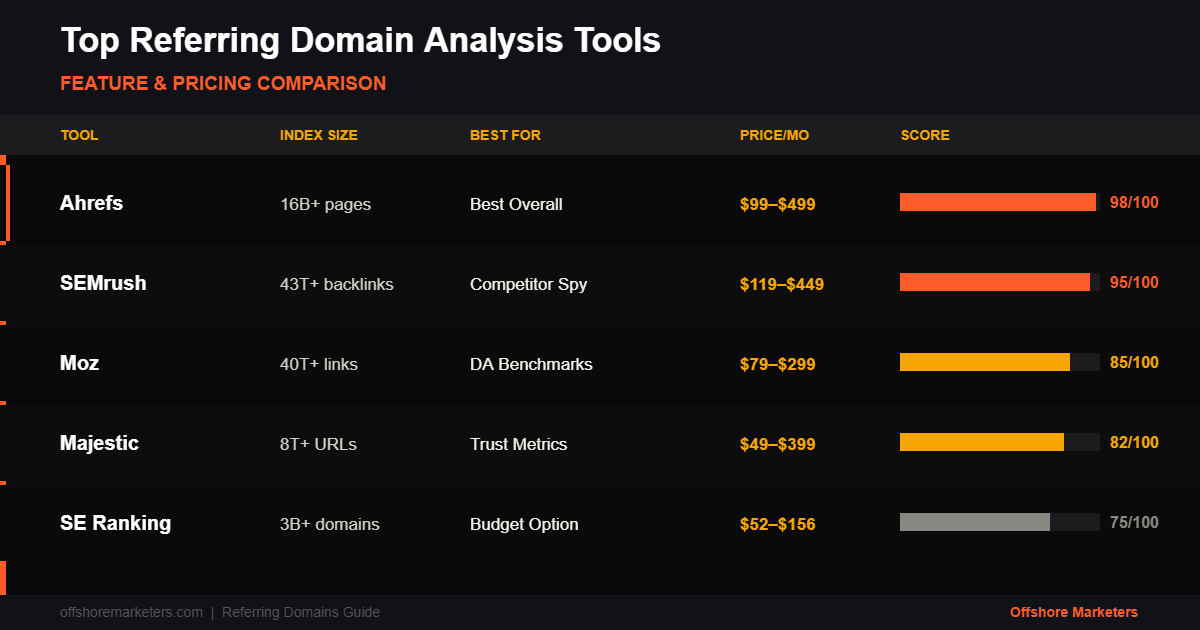
Semrush’s Referring Domains report is explicitly designed to list domains linking to a target and supports segmentation by active/new/lost and follow/nofollow, plus sorting by Authority Score.
Workflow:
- Open the Referring Domains report for your domain (or a competitor).
- Use quick filters:
- All / Active / New / Lost (Semrush defines “new” as appearing within the past 30 days, and “lost” as lost within the past 6 months).
- Follow / Nofollow to focus on link equity patterns and make outreach more efficient.
- Sort:
- By Authority Score to prioritize domains likely to matter more (Semrush defines Authority Score as a compound metric based on link power, organic traffic, and spam factors).
- By First Seen / Last Seen to identify long-term partners vs brand-new placements (useful for retention and PR timing).
- Export filtered datasets for:
- “High-authority, high-relevance” prospects
- “Lost high-authority” for reclamation
- “Suspicious clusters” for review
When to use Referring IP analysis: if you suspect networks or unnatural patterns, Semrush’s Referring IPs report shows IPs and how many domains are hosted there, and explicitly notes that unusual concentration can indicate link networks/PBN-like patterns.
Step-by-step in Ahrefs
Ahrefs defines referring domains as domains from which the target page/site has one or more backlinks, and shows the classic “two links from the same domain still = one referring domain” example.
Workflow:
- Paste a domain, URL, or subfolder into Site Explorer.
- Open the Referring domains report to view unique linking domains.
- Use Domain Rating (DR) as a comparative indicator of backlink profile strength (Ahrefs defines DR as a 0–100 metric relative to others in its database).
Where Ahrefs contributes a unique research context: its own studies discuss large-scale organic traffic distribution (e.g., the “96.55% get zero traffic” claim in its dataset and its discussion of why pages fail to get traffic), and discuss how competitive topics often require backlinks.
Step-by-step in Majestic
Majestic’s Referring Domains tool emphasizes “high-level evaluation” plus forensic segmentation: root/subdomain/URL views, trust metrics, link context, inbound link types, and geo (language/IP) signals.
Workflow:
- In Site Explorer, choose analysis level: root domain, subdomain, or URL, depending on whether you’re auditing a whole property or a specific asset.
- Navigate to Referring Domains and sort/filter by:
- Trust Flow / Citation Flow and topical affinity to prioritize likely-quality domains.
- Large backlink counts from a single domain, which Majestic notes can indicate “run of site” or lower-quality placements (sitewide-like patterns).
- Use the GEO tab (language/IP) and inbound link statuses (live/deleted, follow/nofollow, redirect types) for deeper diagnostics and cleanup.
Majestic also explains the intended interpretation of its flow metrics: Trust Flow as authority, Citation Flow as popularity, and their delta/ratio as a spamminess heuristic.
Step-by-step in Mangools
Mangools’ educational content provides an accessible operational bridge between GSC and analytics:
- It shows how to see “Top linking sites” inside GSC and suggests using referral reporting in analytics to understand traffic impact from referring domains.
- Its LinkMiner guide enumerates practical metrics (referring domains, referring IPs, trust/citation flow) and notes LinkMiner’s data is based on Majestic, plus it adds a composite “Link Strength” metric.
Step-by-step in SE Ranking
SE Ranking positions referring domains as an audit and competitor-analysis input, highlighting “pace of acquisition,” anchor text, homepage vs deep-linking splits, and geographic distribution.
If you operate programmatically or at scale, SE Ranking’s Backlinks API explicitly supports:
- aggregated metrics (backlinks, referring domains, IPs, subnets),
- new/lost/cumulative change tracking,
- anchor texts, TLDs, and countries,
- and notes monthly data refresh.
Metrics to evaluate referring domains
Below is a compact “what to measure” set that aligns well with what major tools expose and what Google’s own docs emphasize (links, anchor text, spam policy compliance).
| Metric | What does it tell you | Why it matters |
|---|
Authority Score (Semrush)Composite estimate of domain/page qualitySemrush defines it as link power + organic traffic + spam factors; use for sorting and triage
Domain Rating (Ahrefs)Relative strength of the backlink profileAhrefs defines DR on a 0–100 scale relative to its database; a useful comparator
Trust Flow / Citation Flow (Majestic)Authority vs popularity modelMajestic defines Trust Flow as authority and Citation Flow as popularity; delta can flag spam risk
Backlinks per referring domainConcentration vs diversityHigh concentration may indicate sitewide/run-of-site patterns; Majestic explicitly discusses these risk patterns
Anchor text distributionHow the web describes your pagesGoogle explicitly states that anchor text helps people, and Google understands linked pages; keyword stuffing is discouraged
Follow/nofollow (and link attributes)Potential ranking equity vs traffic-only linksGoogle documents nofollow, sponsored, ugc; many backlink tools segment by follow/nofollow
Referring to IPs and subnetsNetwork clustering and footprint riskUsed for forensic analysis, Semrush and SE Ranking expose these metrics for pattern detection
How to earn more referring domains
Earning more referring domains is not “collecting links.” It’s building repeatable reasons for independent sites to cite you, plus running a disciplined outreach + relationship workflow.
A prioritization model that prevents wasted outreach
The biggest operational failure in link building is treating all prospects as equal. Use a simple scoring model to focus on domains that are likely to be relevant, trusted, and editorially achievable.
Referring-domain prospect score (example):
| Factor | Score guide | Notes |
|---|---|---|
| Topical relevance | 0–5 | Strong overlap with your topic cluster tends to outperform random links |
| Evidence of editorial linking | 0–5 | Look for outbound links to third-party sources in similar content (Majestic explicitly frames this as an “editorial ambition” cue). |
| Authority proxy | 0–5 | Use AS/DR/TF depending on tool; treat as heuristics, not ground truth |
| Link placement likelihood | 0–5 | Resource page, “best tools,” “statistics,” broken link replacement typically higher yield than cold “please link” emails |
| Risk | 0–5 (inverse) | High IP clustering, obvious PBN footprint, spammy anchors → deprioritize |
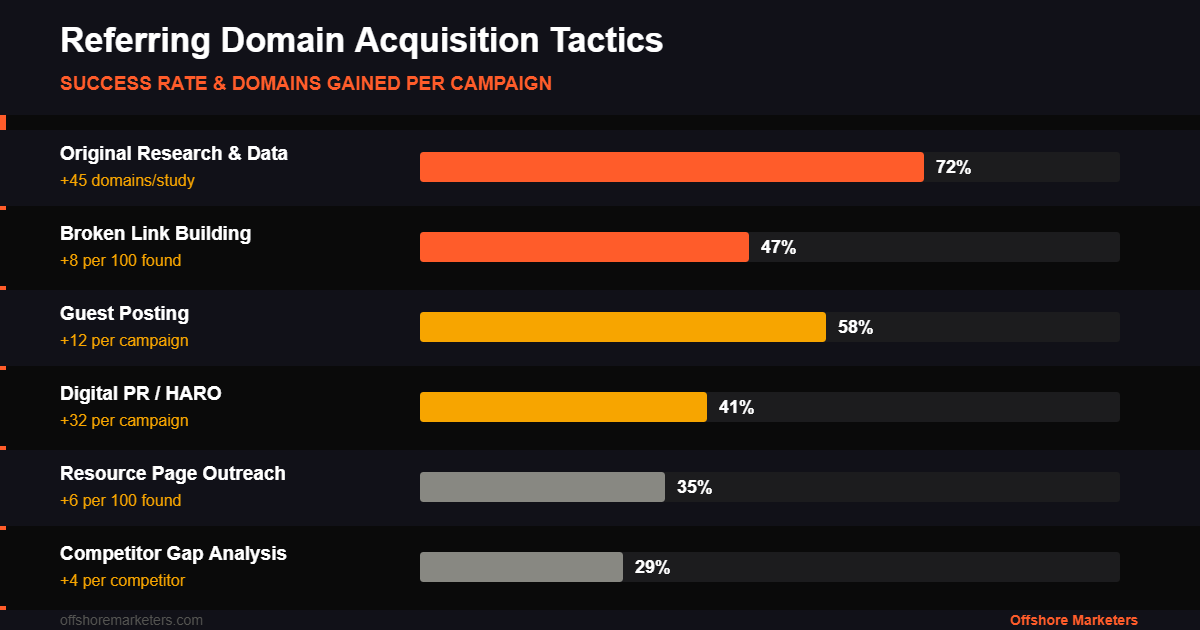
High-leverage strategies mapped to competitor coverage
The tactics below are chosen because they appear repeatedly across competitors and align with what backlink tools enable you to execute at scale.
Guest Posting and Contributor Relationships
Guest posting remains effective when it’s relationship-driven and editorially relevant (not templated, paid, or exchanged at scale). Competitors recommend guest blogging as a growth tactic, but it must be executed within spam-policy boundaries.
Quick execution steps:
- Identify sites already publishing contributor content in your niche (prospecting via competitor referring domains lists).
- Pitch a topic that improves their content library (original data, unique method, or missing subtopic).
- Earn an editorial link in context (avoid sitewide, footer, or templated author bio stuffing).
Digital PR and Becoming a Source
Semrush explicitly lists “becoming a source” and unlinked mentions as tactics to earn links from reputable publications and creators.
A practical framing: PR-driven referring domains are often the fastest path to high-trust editorial domains, but only if you provide:
- data,
- credible expertise,
- or uniquely useful resources.
Linkable Assets: The Asset-First Approach
Competitors repeatedly emphasize “linkable assets” and “link-worthy content,” and Ahrefs’ research discussion highlights that competitive topics typically require backlinks, encouraging content that adds something new to the conversation.
Linkable assets that consistently earn new referring domains:
- Original datasets and studies (benchmark reports, industry surveys)
- Definitive glossaries/explainers (like this topic) that become a citation target
- Tools/calculators/templates (especially if embeddable with attribution)
Broken Link Building (Replacement Strategy)
Broken link building shows up across competitors as a reliable, value-forward outreach angle: you help a site fix a broken resource and offer a better replacement.
Process (tight version):
- Find pages in your niche with outbound broken links.
- Rebuild or publish a superior replacement resource.
- Outreach with the exact broken URL + suggested replacement.
Competitor Backlink Mining (Gap Tactics)
Competitors repeatedly recommend analyzing competitors’ referring domains to identify where links already exist in your niche. Semrush’s Referring Domains and Backlink Gap positioning explicitly supports the “find domains that link to competitors but not you” approach.
Two concrete approaches:
- Intersect approach: domains that link to multiple competitors are likely “category linkers” (high probability).
- Partner replication: identify “top partnerships” and look for adjacent opportunities (same category, same editorial format).
Resource Pages and Curated Lists
Many referring domain gains come from curated resources, directories, and “best of” lists—valuable if they’re topical and editorially maintained. Competitors explicitly mention web directories/resource pages as a diversification source, while warning that quality matters.
 toxic links, lost links, PBN penalties, and lack of metric tracking” class=”wp-image-165809″/>
Outreach templates that match your strategy
Use templates as scaffolding, not automation. Over-automation increases rejection and can push you toward link-scheme behavior.
| Use case | Subject line | Email body (short template) |
|---|---|---|
| Broken link replacement | “Quick fix for a broken link on [Page Title]” | Hi [Name]—I noticed your page [URL] links to [Broken URL], which returns [404/timeout]. We published a current replacement covering [topic] with [unique value]. If helpful, you can swap in: [Your URL]. Either way, thanks for the great resource. |
| Resource page inclusion | “Suggestion for your [topic] resources page” | Hi [Name]—Your resource list on [URL] is one of the better collections I’ve seen for [topic]. If you update it, this might fit: [Your URL], because it includes [proof: data/template/tool]. Happy to share a short summary blurb if useful. |
| Guest post pitch | “Idea for your readers: [specific angle]” | Hi [Name]—I’m [who you are]. I liked your piece on [specific article]. I can contribute an in-depth article on [proposed title] with [outline bullets kept minimal: 2–3 points]. It would include original screenshots/data from [method] and practical steps. If you’re open, I can send a draft or a tighter outline. |
| Unlinked mention conversion | “Thanks for mentioning [Brand]—small request” | Hi [Name]—Thanks for mentioning [Brand/page] in [Article URL]. Would you consider linking the mention to [Your URL] so readers can find the exact resource? Here’s the best destination link: [URL]. |
(Where competitors align: broken link building + unlinked mentions + linkable assets + competitor analysis appear repeatedly as recommended tactics).
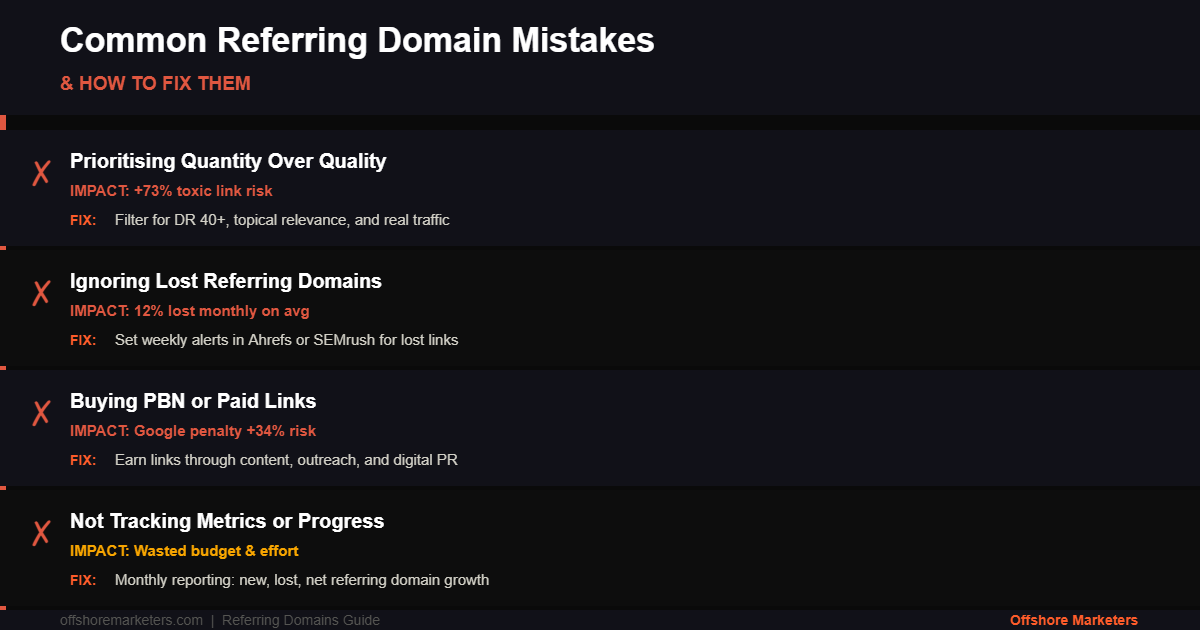
Common mistakes and how to avoid them
Treat these as “avoid at all costs” unless you’re deliberately operating in gray areas (which increases risk).
- Buying links / participating in link schemes: Google explicitly documents manual actions for unnatural inbound/outbound links and frames buying links/link schemes as spam-policy violations.
- Large-scale link exchanges: Often labeled as manipulative; proceed with extreme caution and avoid patterns that look like schemes.
- Anchor text manipulation: Google explicitly advises descriptive, natural anchor text and warns against keyword stuffing (a spam policy violation).
- Chasing volume over diversity/quality: Multiple competitor pages emphasize diversity and quality; for example, Semrush and others argue more high-quality referring domains can improve outcomes, while warning low-quality domains may have little impact or create risk.
- Disavowing everything “just in case”: Google states most sites won’t need disavow and recommends it primarily for manual-action scenarios; misuse can harm performance.
Monitoring, reporting, benchmarks, and a sample profile
Monitoring new and lost referring domains
You want monitoring that is frequent enough to catch:
- sudden link spikes (risk review),
- sudden losses of high-value domains (reclamation),
- and gradual diversification progress (strategy validation).
Tool-supported “new vs lost” concepts:
- Semrush explicitly includes new/lost reporting in Referring Domains and defines those time windows (new within 30 days; lost within 6 months).
- Google Search Console offers exports including “Latest links” and “More sample links,” but it does not label “lost,” and it may include links found over time that were removed.
- SE Ranking’s API supports new/lost/cumulative tracking and mentions monthly refresh, which affects how “fresh” monitoring can be using that dataset.
Work with SEO Experts to Build Your Referring Domain Profile
Earning high-quality referring domains requires a strategic, sustained approach—the right content assets, targeted outreach, and deep knowledge of link evaluation. If you want a proven digital marketing partner to accelerate your referring domain growth, Offshore Marketers delivers measurable results backed by client reviews. Explore what our clients say on Trustpilot and Clutch, review our agency rankings on GoodFirms, and learn about our team on Glassdoor.
FAQ
What Is a Referring Domain?
A referring domain is an external website that links to your site or page; one domain can send multiple backlinks but still counts as one referring domain.
What’s the Difference Between Referring Domains and Backlinks?
Backlinks are individual hyperlinks pointing to your site; referring domains are the unique websites hosting those backlinks.
Are Referring Domains Important for SEO?
They’re widely treated as important because Google uses links as a relevancy signal and for discovery, and multiple studies find strong correlations between more unique referring domains and higher visibility/traffic (with correlation caveats).
How Do I Check My Referring Domains for Free?
Google Search Console’s Links report → “Top linking sites” provides a free view, but it’s sampled and grouped by root domain and doesn’t include nofollow labeling.
Why Do Different Tools Show Different Counts?
Because data sources differ: GSC is sampled, normalized, and grouped by root domain; third-party tools have independent crawlers and their own indices, and may expose follow/nofollow, “new/lost,” IP/subnet, and other metadata not surfaced in GSC.

Mastering Content Monitoring Tools and Strategies for Success
Content monitoring tools are the backbone of any serious digital...
How to Win in Hickory’s Data Center Corridor: 6 B2B Digital Marketing Strategies
If your business operates in Hickory's data center corridor, you're...

Referring Domains: Guide to Measuring, Analyzing High Quality Domains
Referring domains are unique websites that link to your site (often via...

SEO for Healthcare Clinics in Bradford: 4 Proven Pillars to Attract More Patients
SEO for healthcare clinics in Bradford is the single most...

Content Monitoring: What It Is, Why It Matters, and the Best Tools to Track Content Changes
Content monitoring is the ongoing practice of tracking, analyzing, and...



.png)
.png)
.png)
.png)
.png)

2024 ALL RIGHTS RESERVED MADE IN INDIA
.png)