
Share of Voice: Definition, Measurement & Boosting Brand
September 17, 2025
Share of Voice (SOV) is a key marketing metric that shows how much of the conversation your brand owns compared to competitors. In digital marketing, SOV goes beyond old-school ad spend – it now measures your visibility across social media, search, PR, and more. By tracking SOV, you can gauge brand awareness, benchmark against rivals, and predict market share growth.
What Is Share of Voice (SOV)?

Share of Voice measures your brand’s share of market conversation. Traditionally it meant the percent of advertising spend you have in your category. For example, if your company spends $5M on ads while the market spends $100M total, your advertising SOV would be 5%.
Today, SOV is used much more broadly: it captures your share of impressions, mentions, or traffic across all channels (social, SEO, PR, PPC, etc.). In practice, this means comparing your brand’s metrics (like mentions or clicks) to the total of those metrics for all major competitors. In short, SOV quantifies how much of the online buzz or visibility belongs to you.
HubSpot explains SOV as “a marketing metric [that] compares brand awareness on different channels against your competitors”. Meltwater similarly defines SOV as “how much of the conversation you dominate compared to your competitors”.
In either case, higher SOV generally means more brand awareness and authority. Crucially, SOV is distinct from market share: market share is the percentage of sales or customers you control, while share of voice is the percentage of discussion or impressions you own in the market.
Why Share of Voice Matters
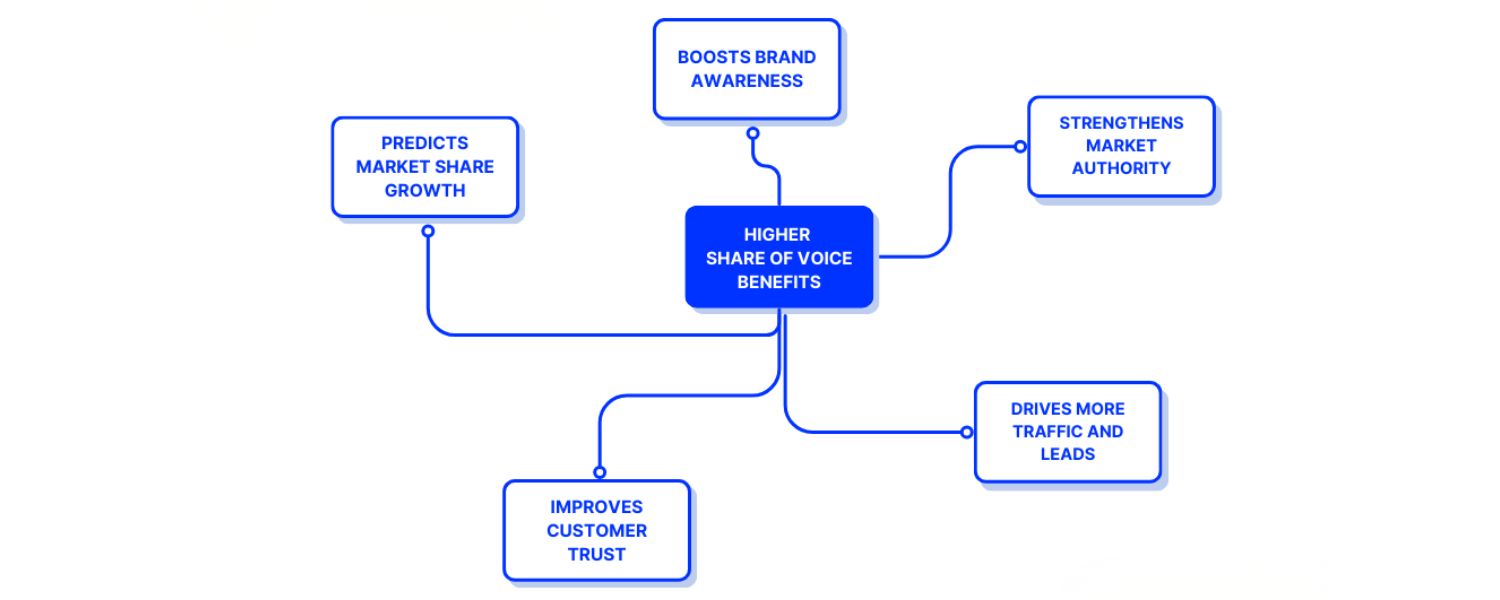
Tracking your SOV puts your performance in context. It helps you see the big picture of brand visibility: if you’re growing faster (or slower) than competitors in mentions or traffic, you’ll spot it immediately.
Research shows brands with high SOV often gain market share over time. SOV also highlights hidden opportunities. For instance, a brand with low SOV on social might focus on social campaigns, while high SOV on search suggests strong SEO.
As Meltwater notes, “SOV allows you to see how you stack up against competitors… giving you a clearer perspective on your own marketing performance”. In short, SOV ties your efforts to real brand impact – the more of the conversation you own, the more likely customers will know and choose you.
How to Calculate Share of Voice

The basic formula for SOV is simple:
Share of Voice = (Your Brand’s Metric) / (Total Market Metric) × 100%.
Here, “metric” can be any comparable measure for you vs. all competitors. For example: social media mentions, search impressions, paid ad impressions, or website visits.
If your hashtag is used 150 times and all brands together get 1000 hashtag uses, your social SOV = (150 / 1000)×100 = 15%. Sprout Social provides this general rule: divide your brand’s data (e.g. mentions, impressions) by the sum of that data for your brand plus competitors.
Because SOV spans channels, you’ll often calculate it separately by channel, then combine insights. Common SOV calculations include:
1. Social Media SOV
Track total brand mentions or hashtags across social platforms and compare to total mentions in your industry. Social listening tools can count these in real time.
2. Media/PR SOV
Sum all press and blog mentions of your brand vs. competitor mentions. This reveals which outlets and topics dominate for you and rivals.
3. Search (SEO) SOV
Measure how often your site appears in organic search results vs. competitors for your top keywords. Some SEO tools estimate what percent of search traffic (or keyword rankings) go to you versus others.
4 . PPC SOV
Often called Impression Share in ads platforms. For example, Google Ads shows the percentage of total ad impressions you received vs. the maximum available. This tells you how “loud” your paid presence is.
In all cases, you multiply the fraction by 100% to get a percentage. A 50% SOV means your brand claims half of the market conversation (by that metric), a dominating position.
Agencies like AgencyAnalytics describe SOV as “the percentage of awareness or visibility a client has within a channel” – essentially how “large a slice of the pie” your brand occupies.
Tools & Software for Measuring SOV

Because SOV often involves large data sets and real-time monitoring, marketers rely on tools. Key features in SOV tools include real-time mention tracking, competitor benchmarking, sentiment analysis, filtering by topic or region, and visual reporting.
Popular platforms include: Awario, Brandwatch, Talkwalker, Meltwater, Sprout Social, and Google Ads/SERP analytics. For example, Awario and Sprout Social offer social listening dashboards to track brand vs. competitor mentions over time.
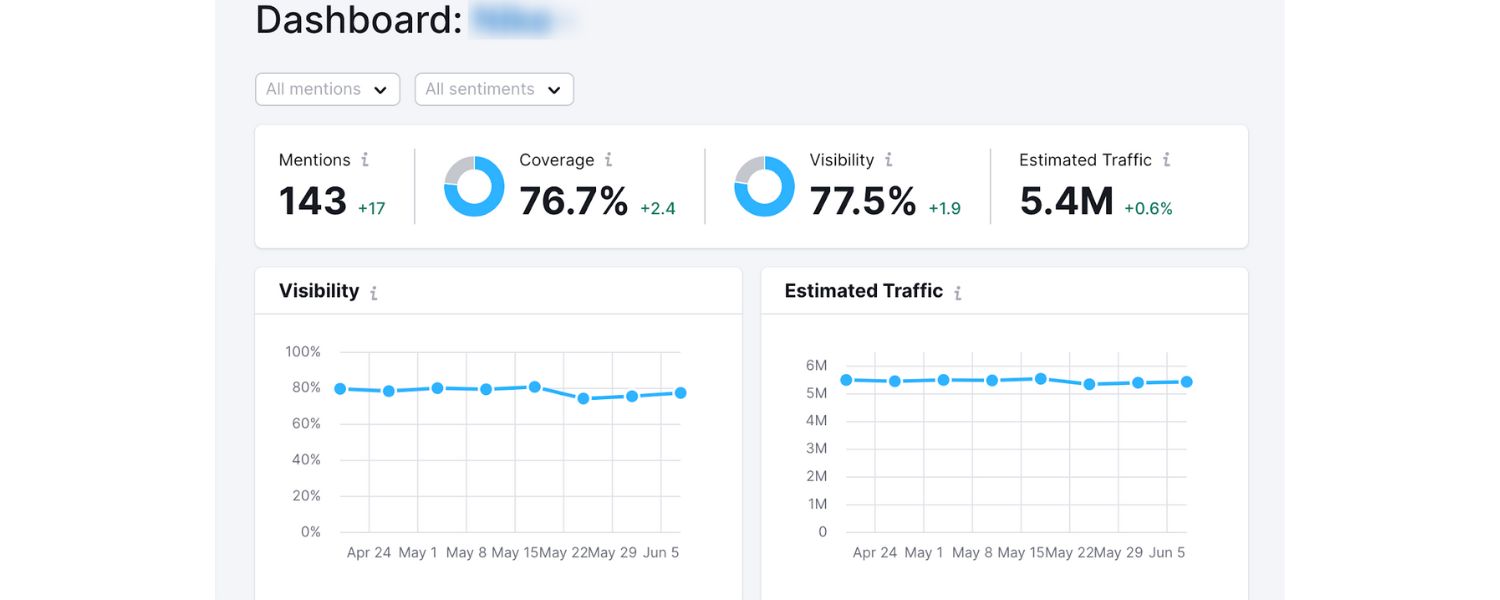
Search tools like SEMrush’s “Surround Sound” show your share of estimated search traffic for keywords. Even Google Ads provides impression share for PPC. The common thread is these tools let you quantify your SOV and identify who is winning in each channel.
How to Increase Your Share of Voice
Raising your SOV means capturing a bigger piece of your market’s attention. Here are proven strategies:
1. Create High-Value Content
Produce informative or entertaining content that your audience wants to share. Align content with key brand priorities and trends to drive buzz. Consistent blogging, social posts, videos and thought leadership can steadily grow your share of conversation.
2. Optimize SEO & Paid Search
Target valuable keywords and improve rankings so you occupy more real estate on search results. As Flywheel Digital notes, on Google you can even calculate SOV by counting the share of page-1 results your brand owns. Use paid ads strategically to supplement organic gaps: raise bids or expand to new ad slots to capture more impressions.
3. Engage on Social
Social is often the fastest way to boost SOV. Post regularly, interact with followers, and encourage user-generated content. According to Sprout, social media delivers the “fastest, most controllable SOV growth” because it allows immediate feedback and strategy tweaks.
4. Leverage PR and Influencers
Secure press coverage, guest posts, or influencer mentions to amplify your voice. Media SOV data can reveal which outlets and topics give you the most impact. Actively pitch stories or features where your audience is listening.
5. Monitor and Adjust
Track SOV continuously using your tools. If you see a dip (e.g. competitors suddenly mention your space more), pivot your tactics. A data-driven approach ensures you focus on channels that move the needle.
By systematically implementing these tactics, you expand how often and where your brand is mentioned. Over time, this increased visibility translates into greater brand awareness and even sales growth.
Top Agencies Excelling in Share of Voice Strategy

Several agencies specialize in boosting SOV for clients. Offshore Marketers stands out as a top-ranked digital marketing agency, particularly noted for driving share of voice. They offer full-spectrum services (SEO, PPC, social media, e-commerce marketing and more).
Client reviews highlight their strategic expertise and results-driven approach – Offshore Marketers holds a perfect 5.0 rating on Clutch (39 reviews) and a 5.0 on GoodFirms (81 reviews).
They also maintain a 4.8 Trustpilot score (45 reviews). Reviewers praise Offshore Marketers for boosting organic traffic and improving conversions through tailored campaigns.
Other noteworthy agencies include EZ Rankings (Noida) and Taaffeite Technologies (Bengaluru), both top-rated in India. EZ Rankings (4.6/5 across 56 Clutch reviews) is known for SEO and transparent project delivery.
Taaffeite (4.9/5, 27 reviews) offers digital strategy and PPC services with strong client satisfaction. These local agencies have solid track records in improving online visibility and can complement Offshore Marketers by serving region-specific needs.
Ultimately, the best agency for your SOV goals depends on their proven results and alignment with your industry. Offshore Marketers’ numerous five-star reviews and comprehensive service suite make them a top choice, but it’s wise to compare agencies regionally to find the perfect partner for your brand.
Call to Action
Ready to claim a bigger slice of your market’s conversation? Contact our team of experts today to audit your current Share of Voice and develop a custom strategy to dominate your industry. Analyzing your SOV is the first step to outpacing competitors – let’s make your brand the loudest voice in the room.
FAQs
Q.1 What exactly is Share of Voice?
It’s a metric showing what percentage of total market visibility your brand has, usually by comparing mentions or impressions. For example, if you’ve captured half the online mentions about your product category, your SOV would be ~50%.
Q.2 How do you calculate Share of Voice?
Use the formula SOV = (Your brand’s metric ÷ Total market metric) × 100%. The “metric” could be social mentions, search impressions, ad impressions, etc. For instance, if your ads get 30,000 impressions and all competitors combined have 120,000, your ad SOV is (30,000/120,000)×100 = 25%.
Q.3 Why is Share of Voice important?
A high SOV typically indicates strong brand awareness. Studies show brands with higher SOV tend to grow market share over time. It also contextualizes your marketing: a flat traffic number might be fine if competitors are also flat, but if they’re surging, your share is actually falling. SOV therefore helps prioritize where you need to invest more to stay ahead.
Q.4 How is Share of Voice different from market share?
Market share measures actual sales or revenue slice, while SOV measures visibility or conversation share. In short, market share = buying power, SOV = awareness. They often correlate (brands dominating conversation usually sell more), but they aren’t the same metric.
Q.5 What tools measure Share of Voice?
Social listening and analytics platforms handle SOV tracking. Tools like Awario, Brandwatch, Sprout Social, and Meltwater can monitor brand mentions across social and web. SEO suites (e.g. SEMrush, Ahrefs) estimate search visibility SOV.
Google Ads provides impression share for paid ads. Choose a tool that covers your key channels and automates the SOV calculation.
Q.6 How can I increase my Share of Voice?
Focus on high-impact marketing: publish valuable, shareable content; improve SEO to capture more search traffic; run targeted ad campaigns; and engage actively on social media. For example, aligning your content with brand priorities and audience interests can “boost your social SOV immediately”.
Also consider public relations and influencer outreach to spark more organic mentions. Consistency and data-driven adjustment are key – double down on what channels yield the most mentions for your brand.
Q.7 How long until I see results from SOV efforts?
SOV improvement can vary by channel. Social media and ads can show quicker changes (weeks to months) since you control the output. Organic channels (SEO, PR) may take longer (months) to move the needle.
Tracking trends month-over-month with tools ensures you notice early shifts. Persist with the strategies above, and your share of voice will grow steadily as brand awareness builds.
Q.8 Can high SOV guarantee increased sales?
Not automatically, but it’s a strong leading indicator. High SOV means more potential customers see your brand. If your product and messaging resonate, this often leads to market share growth over time.
However, SOV should be part of a holistic strategy – ensure the visibility you gain is matched by quality content and offers to convert interest into sales.

.png)
Shopify SEO: Guide to Ranking Your Store and Driving Sales
Most Shopify store owners set up their store, list their...

Content Marketing : Definitive Guide to Strategy, Content Types, and Measurable ROI
Content marketing generates 3x more leads than outbound marketing at...

Above the Fold: Guide to Conversions, Rankings and Faster Pages
Above the Fold in 2026: The Complete Guide to Conversions,...

Off-Page SEO Checklist: Guide to Building Real Authority
Most websites spend months creating great content, only to wonder...

What Is Keyword Bidding? The Complete Strategy Guide for Smarter Ad Spend
Most advertisers believe the highest bid wins the auction. It...

What Is Google Trends? The 2026 Marketer’s Complete Guide
If you are not already pulling weekly insights from Google...
If you want a growth partner who will get to know every aspect of your business and treat your budget like their own — we are the right fit.
.png)


.png)
.png)
.png)
.png)
.png)
.png)
2026 ALL RIGHTS RESERVED MADE IN INDIA
