
15 Cold Email Templates: (Proven Examples to Boost Replies)
September 5, 2025
Introduction: Why Cold Emails Still Work
Cold emailing remains one of the most effective ways to generate leads, but only when done right. The reality is that most unsolicited emails see dismal response rates of just 1–5%. Busy prospects are bombarded with messages, and anything generic or dull gets ignored (or worse, marked as spam).
The good news? With the right approach and template, your email can stand out and spark genuine interest. In fact, some well-crafted cold emails have achieved open rates above 50% and double-digit reply rates.
Hook: Imagine converting a cold prospect into a warm lead with a single email. It’s possible, and this guide will show you how. Below, we share 15 battle-tested cold email templates and the principles that make them successful.
Each template is backed by 25+ years of marketing experience (and real data), so you can confidently use and adapt them to get more replies and meetings.
How to Write an Irresistible Cold Email
Before we jump into the templates, let’s cover the key ingredients of a great cold email. No matter which template you use, make sure to apply these best practices to maximize your success:
1. Craft a Compelling Subject Line
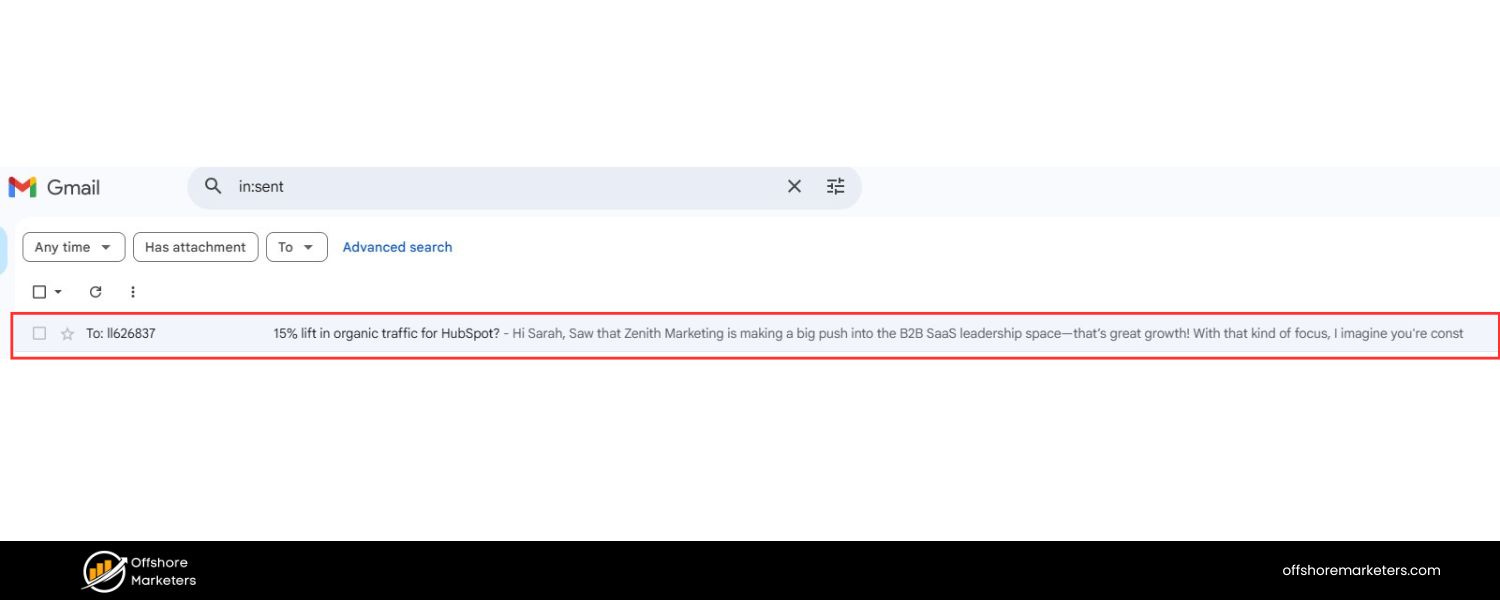
Your subject line is the gatekeeper of your email. A boring or spammy subject means your email will never be opened. Aim for a short, intriguing line that piques curiosity or promises value.
For example, mention a specific benefit or ask a question related to the prospect’s pain point. Avoid clichés like “I hope this finds you well”, they scream mass email and will turn readers off.
Instead, personalize the subject when possible (e.g. include the prospect’s name or company). Personalized subject lines are 26% more likely to be opened than generic ones. The best subject lines hint at something the recipient cares about, compelling them to find out more.
2. Focus on the Prospect (Not Yourself)
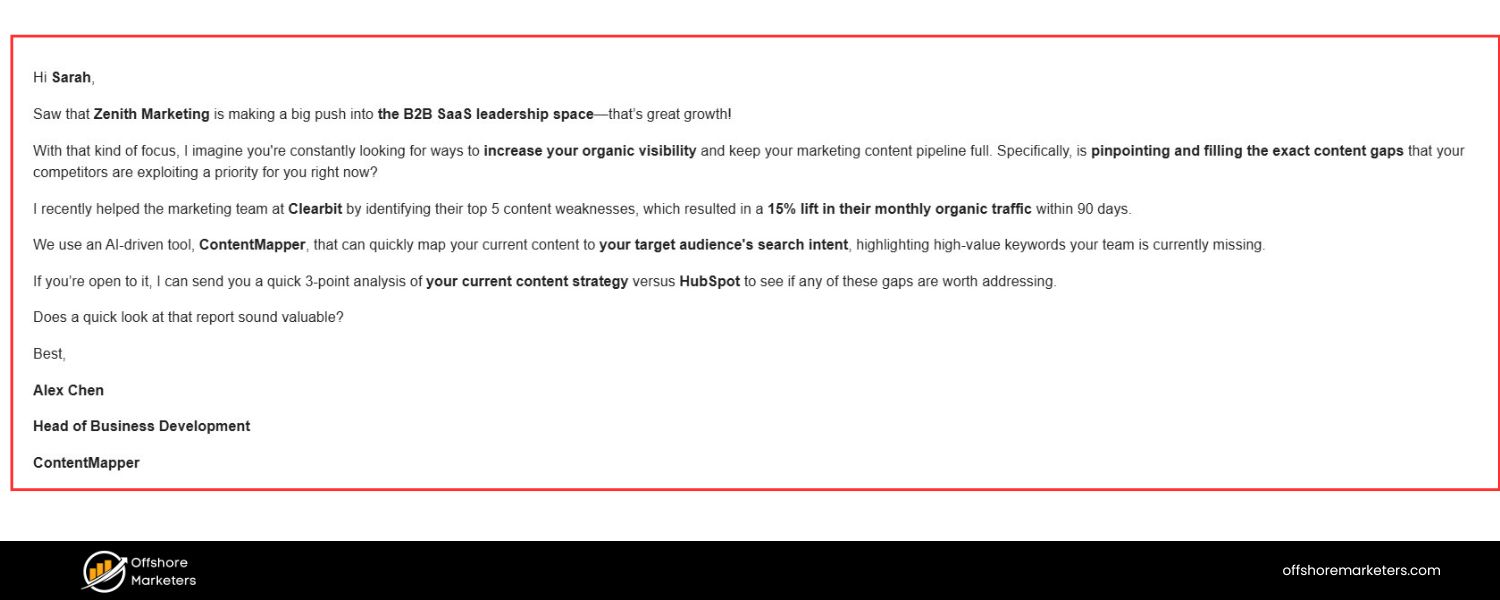
A common mistake is writing emails that start with “I”, I am writing to introduce…, My company does… etc. Cold emails should be all about the recipient. In fact, top sales coaches recommend a 2:1 ratio of “you” to “I” in your message.
Show that you understand their business or problem. Highlight their pain points or goals right up front. By demonstrating that you’ve done your research and truly care about their needs, you’ll grab their attention much more effectively than a self-centered pitch.
3. Offer Value or Insight Upfront

Give your prospects a concrete reason to respond. This could be a unique insight, a solution to a problem, or an enticing benefit. For instance, reference a statistic or result that addresses a challenge they face.
What’s in it for them? Make it clear early in the email. Providing social proof (like a quick result you achieved for a similar client) or offering a free resource can also boost credibility.
The goal is to convey a compelling value proposition in as few words as possible – something that will make the reader think, “Hmm, this could actually help me.”
4. Keep It Short and Human
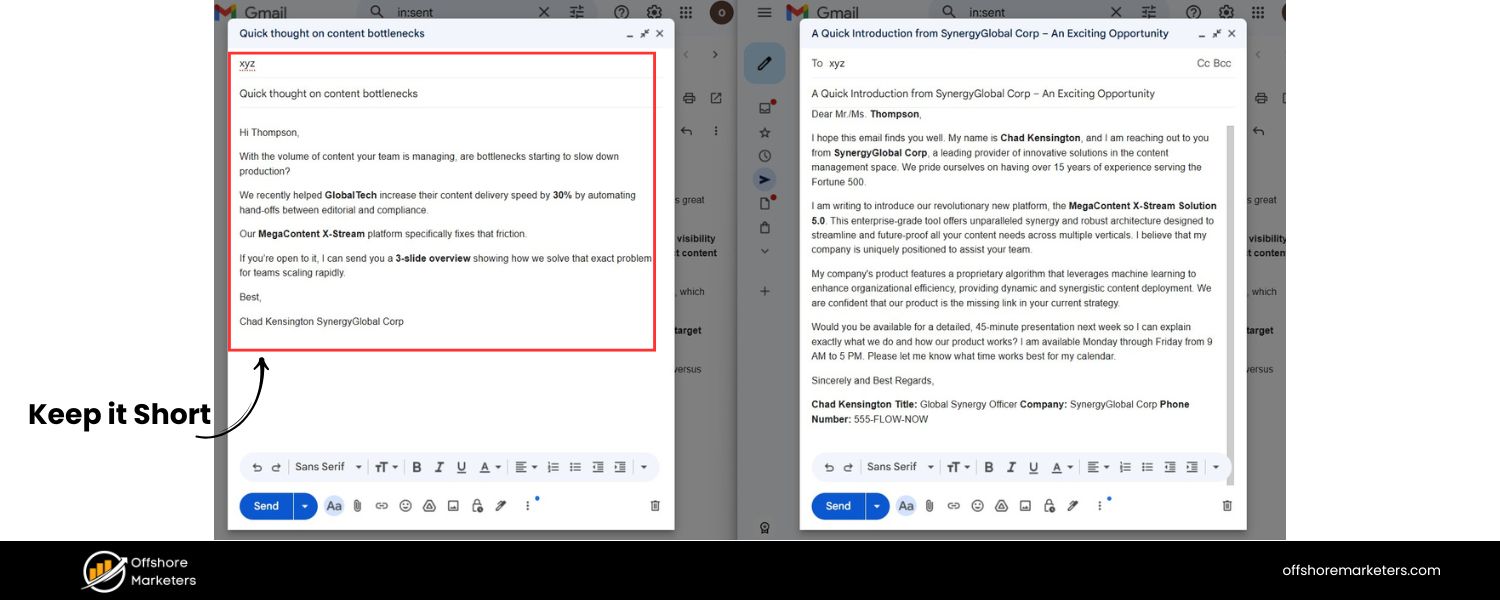
Nobody has time for a novel in their inbox. Respect your prospect’s time by keeping your cold email concise and skimmable. A good rule of thumb is to aim for 3–5 brief sentences or < 200 words for the body.
Use simple, conversational language as if you were talking to a colleague. Writing at about an 8th-grade reading level is ideal for clarity. Also, inject a bit of personality – sounding too formal or like “corporate speak” can hurt your response rates.
It’s okay to be friendly and even sprinkle in a light touch of humor if appropriate (just keep it subtle and appropriate to the context). The bottom line: write like a real person, not a template robot.
5. Back Up Your Claims with Proof
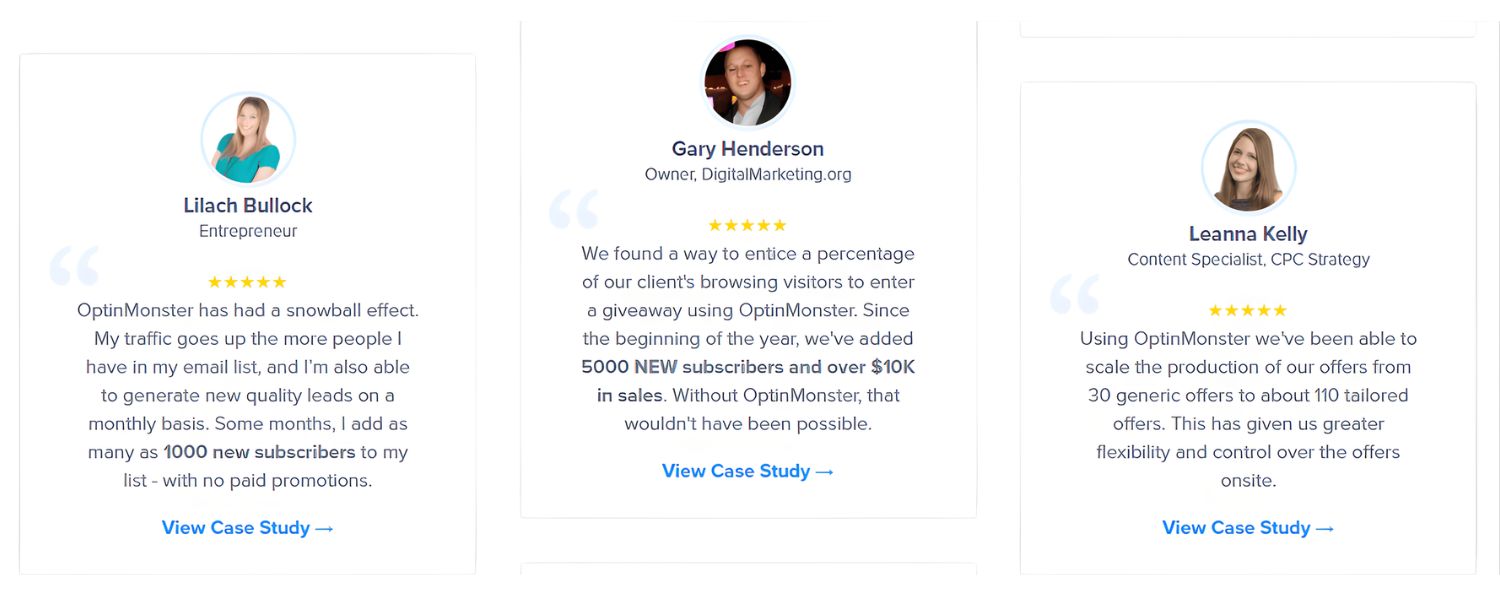
If you mention a benefit or result, try to include a number, example, or brief case study to make it credible. For example, don’t just say “we can improve your conversion rate” – say “we helped Client X boost conversions by 32% in 3 months”.
Citing specific results or naming happy customers adds instant legitimacy. Social proof lowers the prospect’s risk in engaging with you.
If you have no direct client results yet, reference industry stats or a relevant success story. The more you prove your claims, the more trust you build in a few short lines.
6. Have One Clear Call-to-Action
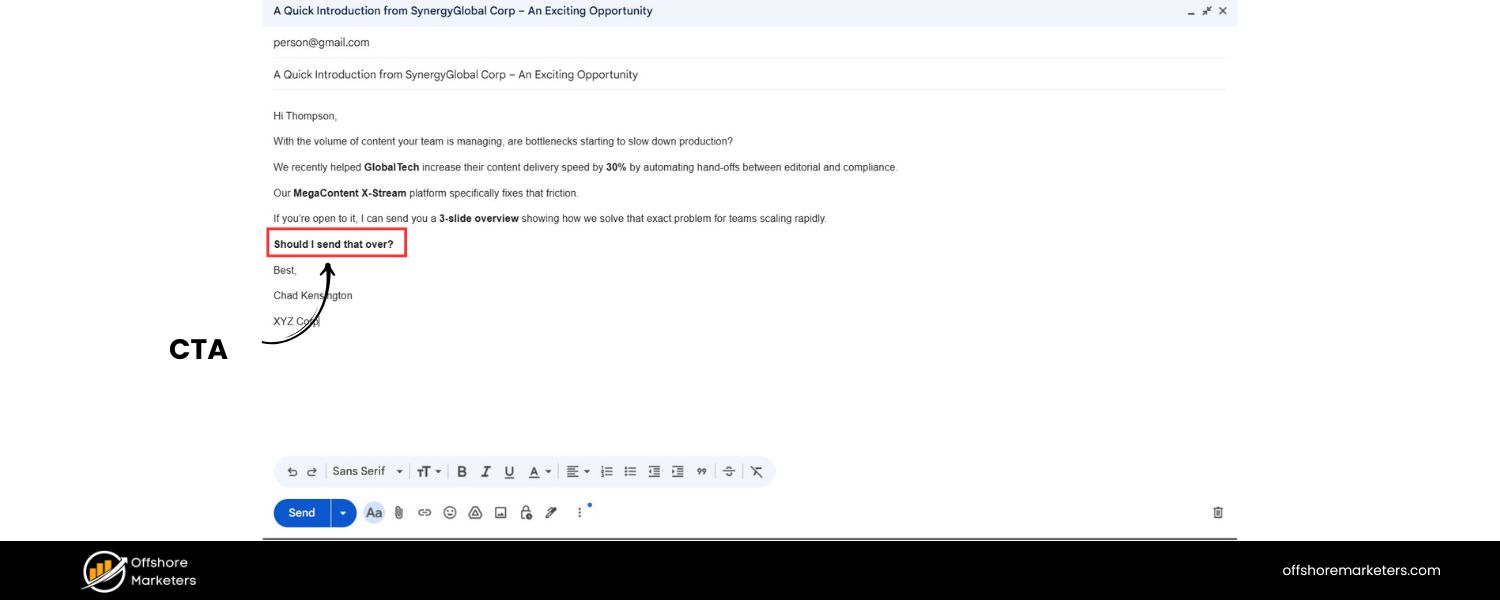
Every cold email should conclude with a single, easy-to-fulfill call-to-action (CTA). Do you want them to schedule a call? Download a resource? Reply with feedback? Pick one and make it explicit.
For instance: “Do you have 15 minutes next week for a quick call?” or “Reply with ‘YES’ and I’ll send over the full case study.” Avoid overwhelming the reader with multiple requests – multiple CTAs actually reduce response rates.
Also, make sure the ask is low-friction for a first contact. Jumping straight to “Would you like to buy?” is too much; asking for a short call or offering to send more info is more realistic. A clear, specific CTA gives your email purpose and tells the reader exactly what to do next.
7. Personalize Wherever Possible
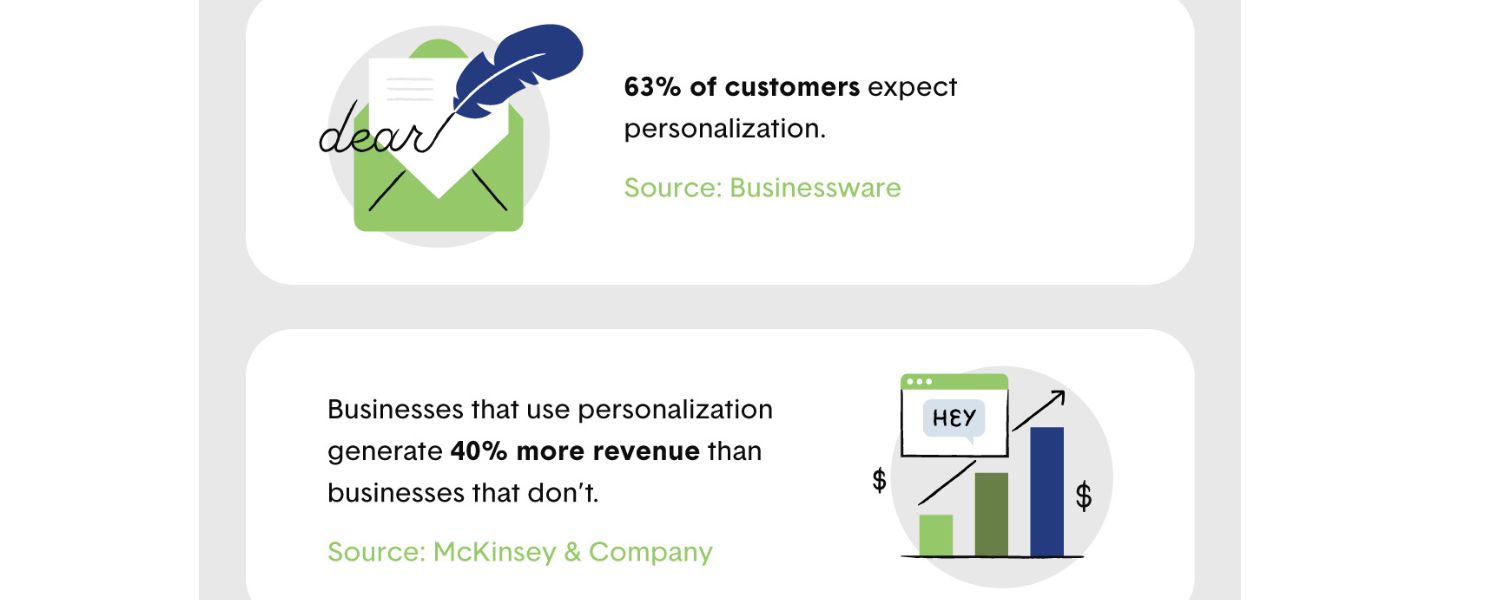
People can sniff out a mass email in seconds. To improve your chances, personalize the email content in a meaningful way. This goes beyond just using their name – reference their company, industry, a recent news about them, or a mutual connection.
Even a small detail (“I noticed you were hiring sales reps, congrats on the growth!”) shows that your email isn’t a generic blast.
Effective personalization can dramatically improve engagement, in fact, cold emails that feel personalized can boost open rates by around 29% on average. Use templates as a starting point, but always tailor them to fit each prospect’s situation and interests for best results.
8. Send at the Right Time (and Follow Up)
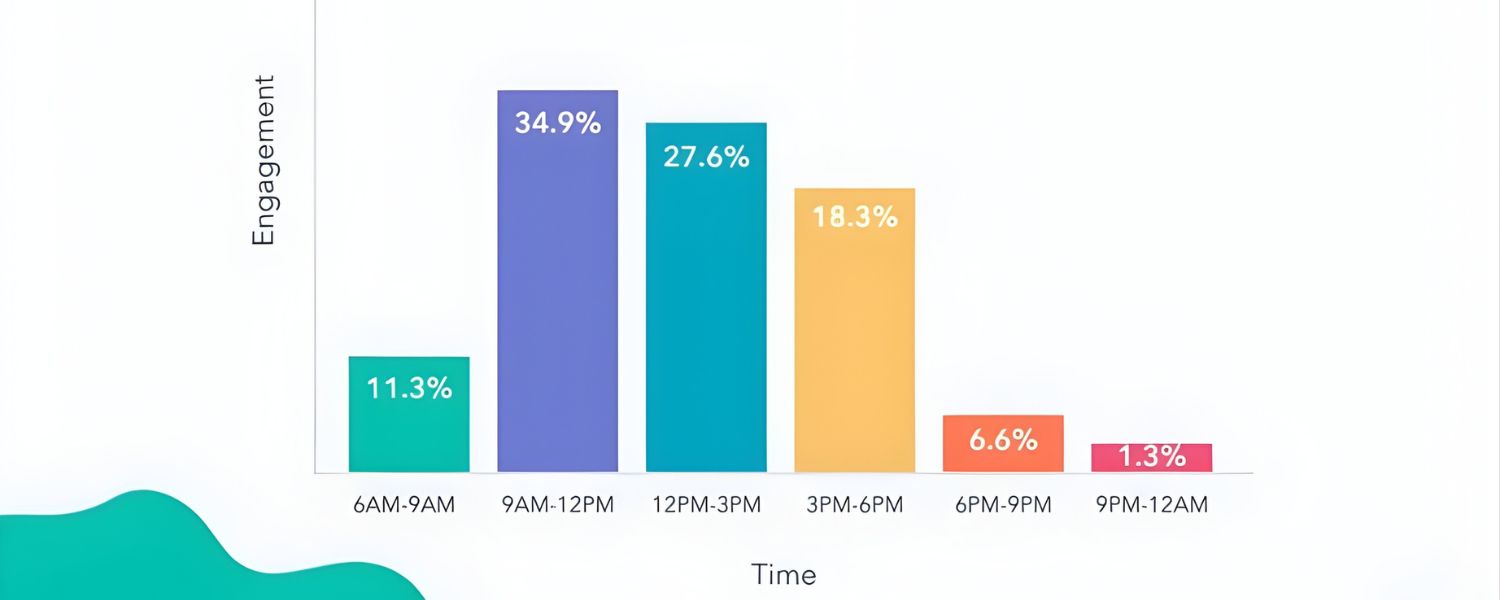
Timing can impact whether your email gets noticed. Generally, sending emails early in the workday (e.g. between 6–9 AM) early in the week yields better results, one study found Monday mornings achieved the highest reply rate for cold emails.
However, optimal timing can vary by audience, so test different send times if possible. Equally important is having a follow-up plan. Most responses often come from the 2nd or 3rd touch in cold outreach.
If you don’t hear back in a few days, send a polite follow-up (we’ve included a template for this below). Just remember to space out your follow-ups and keep them friendly, persistence pays, but pestering kills deals.
9. Mind the Details (Formatting, Tone, Compliance)
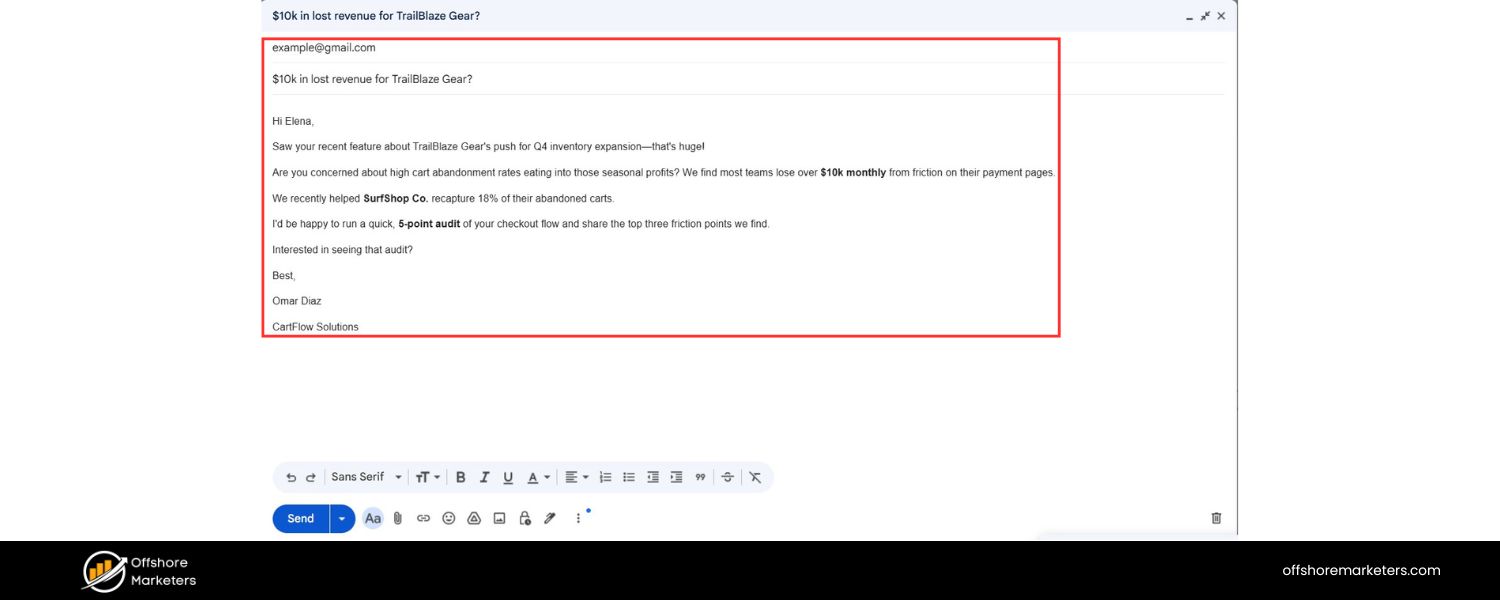
Little things can make a difference. Use short paragraphs or bullet points to break up text for easy reading on screens. Avoid spam trigger words (like “FREE!!!”) and excessive punctuation or emojis, they can trip filters and hurt deliverability.
Always include a simple email signature with your name, title, and company. And don’t forget to comply with email laws, for example, include an unsubscribe option or statement if required in your region.
(Certain countries regulate cold emails strictly; some even ban them unless specific criteria are met.) Maintaining a professional yet approachable tone and a clean format shows respect for the prospect and increases your chances of a positive response.
With these guidelines in mind, let’s dive into the cold email templates. Each template below illustrates a different scenario or strategy, from classic sales formulas to creative outreach approaches.
Pro tip: Don’t just copy-paste these – take the time to fill in the blanks and tweak the language so it sounds like you and fits your recipient. These templates are proven frameworks, but personalization is the key to turning a template into a reply!
15 Proven Cold Email Templates (With Examples)
Below you’ll find 15 cold email templates that have been tested in real-world scenarios. For each template, we explain when to use it and why it works. Feel free to adjust the wording to match your voice and the specifics of your offer.
The primary goal is to spark a conversation, not to close a deal in one email, so think of these as conversation-starters that warm up cold prospects.
1. “Congrats on the Big News” (Recent Event Outreach)
Use this template when your prospect or their company has recently achieved something notable, a funding round, product launch, promotion, award, etc. It starts with genuine praise and uses that event as a segue into how you can provide value.
Subject: Congrats on {{recent event}}, {{Name}}!
Hi {{Name}},
I saw the news about {{recent accomplishment or event}}, congratulations! That’s an exciting milestone for you and the team.
Usually after something like this, {{prospect’s industry}} companies start thinking about {{related challenge or opportunity}}.
With things probably moving fast at {{Prospect Company}}, I’d love to share a quick idea on {{main benefit you offer}} to ride the momentum.
Do you have 15 minutes next week to chat? I’ll make it worth your time.
Thanks,
{{Your Name}}
{{Your Company}}
Why it works: This email shows the prospect you’ve done your homework and aren’t blasting everyone with the same pitch. By tying your outreach to a specific trigger event, it feels personalized and timely.
As Mailshake’s team notes, referencing a prospect’s recent achievement signals that you’re paying attention and not just mass emailing.
The friendly congratulatory tone warms the reader up, and then you subtly transition to how you can help them capitalize on their success.
The CTA is a low-pressure invite for a chat, which is appropriate since you’ve established context. Overall, this template leverages flattery (in an authentic way) and timing to grab attention.
2. “AIDA” Formula Email (Attention-Interest-Desire-Action)
AIDA is a classic copywriting formula that works wonders in cold emails. Use this structure to lead the reader from a pain point to a solution in a logical flow. It’s great for a general sales outreach where you want to highlight a big benefit and include a mini case-study or testimonial.
Subject: Struggling with {{Key Problem}}?
Hi {{Name}},
Most {{prospect’s role}} I speak with find it tough to {{problem you solve}} – it’s a common challenge in the industry. Does that sound familiar?
We developed {{Your Product}} to solve exactly this. In fact, one of our clients {{Similar Company}} saw a {{X% improvement}} in just {{Y months}} using our approach. {{(Quick one-sentence relevant testimonial or result.)}}
If you’d like to achieve something similar, let’s talk. Would you be open to a 10-minute call to see if this could fit {{Prospect Company}}?
Looking forward to hearing from you,
{{Your Name}}
Why it works: This template follows the proven Attention → Interest → Desire → Action sequence. It opens by grabbing attention with a question or statement about a pain point the prospect likely has.
Then it builds interest by introducing a solution (your product/service) and backing it up with a specific result or testimonial, which builds desire for that outcome. Finally, it ends with a clear CTA asking for a short call (action).
The tone is empathetic – “you’re not alone, others face this problem too and we helped them” – which can lower defenses.
By showing evidence of success (social proof), you make it more credible and enticing. This structured approach ensures your email is concise yet persuasive, touching all the points needed to nudge a prospect toward replying.
3. “PAS” Problem-Agitate-Solution Email
The PAS formula (Problem-Agitate-Solution) is another powerful framework. You state the prospect’s problem, agitate it by highlighting the pain or consequences, then offer your solution. This template is effective when you know a specific pain point the prospect is struggling with.
Subject: Frustrated with {{Problem}}?
Hey {{Name}},
Does {{Prospect Company}} struggle with {{problem or pain point}}?
If so, you’re not alone – this is a pain many companies face, and it often leads to {{insert a relevant consequence or statistic to emphasize the pain}}. It’s frustrating (and costly), to say the least.
The good news: Our {{Product/Service}} is designed to eliminate this exact problem. We help companies stop {{pain}} and start {{positive outcome}} – so you can focus on more important things
I’d love to share how we do it. When would be a good time for a quick chat to see if we can help?
Regards,
{{Your Name}}
When to use: Use PAS when you want to tap into a strong pain point that your solution fixes. By first agitating the issue, reminding the prospect of why the problem hurts, you create urgency.
As one sales expert puts it, people make decisions to either avoid pain or gain pleasure, and avoiding pain is often the stronger motivator.
This email works because it follows that psychology: it forces the reader to acknowledge the pain (“yes, this is a serious headache for us”) before presenting relief.
The tone remains helpful, not pushy. After agitating, you offer a remedy (your solution) and quickly convey the benefit of using it. The ask for a call is natural because you’ve set up a clear rationale for why a conversation would be valuable to them (to relieve their pain).
4. “Before-After-Bridge” (Painting the Dream)
This template uses the Before-After-Bridge (BAB) formula to get the prospect imagining a better future with your solution. First you describe the “Before” (the current pain or situation), then the “After” (how great life could be once the pain is gone), and finally the “Bridge” (how your product/service gets them there).
Subject: What if you could {{Desirable Outcome}}?
Hi {{Name}},
Before: I know {{prospect’s role}} like you are swamped with {{current challenge}} – it’s a huge time drain and frustration.
After: Imagine if those hassles disappeared and you freed up hours each week to focus on strategic work. How much more could you get done with that extra time?
Bridge: That’s exactly what {{Your Solution}} helps with. We’ve helped leaders at companies like {{Client A, Client B}} reclaim their schedules – saving them 10+ hours a week on average. I’d love to show you how we can do the same for you. Do you have 15 minutes next week for a quick demo?
Best,
{{Your Name}}
Why it works: This approach is powerful because it taps into the prospect’s imagination. You’re painting a vivid before-and-after picture: first, you validate their current struggle (showing empathy that you “get it”), then you present a compelling vision of life without that struggle.
By doing so, you create desire – who wouldn’t want that “After” scenario? The bridge (your offering) is positioned as the enabler of that better future.
The example even calls out a concrete metric (saving 10 hours a week) and name-drops recognizable figures or companies who benefited, adding credibility.
This template, courtesy of Buffer’s copywriting tips, works especially well for productivity or efficiency solutions. It invites the reader to see the value for themselves, making the CTA (a short demo) very appealing to learn how to achieve that vision.
5. “Straight to the Point” (3-Sentence Pitch)
Sometimes less is more. This ultra-lean template (inspired by Sujan Patel’s 3-sentence format) is ideal for busy executives. It cuts out all fluff and delivers your value proposition in a blink. Use this when you have a very succinct pitch or when reaching high-level prospects who appreciate brevity.
Subject: Quick idea for {{Prospect Company}}
Hi {{Name}}, my name is {{Your Name}} and I’ll keep this quick.
We have a {{product/service}} that helps {{prospect’s role or company type}} {{solve XYZ problem}} – saving about {{X hours or X%}} each week.
If you’re open to it, could we grab 10 minutes next week for a demo? I think you’ll love what you see (so do folks like {{Notable Customer 1}} and {{Notable Customer 2}}).
Thanks,
{{Your Name}}
Why it works: In just a few lines, you’ve introduced yourself, stated a clear value proposition with a quantifiable benefit, and asked for a minimal commitment (10 minutes).
This brevity shows you respect the prospect’s time – a trait busy decision-makers appreciate. In fact, shorter cold emails often perform better on mobile and for executives scanning their inbox.
The casual promise “I think you’ll love what you see” adds a confident yet friendly tone. By mentioning notable customers or even industry figures (if relevant) in passing, you drop social proof without elaboration – enough to intrigue but not derail the brevity.
This template is all about efficiency: it delivers the core message in ~3 sentences, which can yield excellent reply rates when your value prop is truly compelling.
6. “Are You the Right Person?” (Finding the Decision-Maker)
Use this template when you suspect you may not be contacting the correct person, or when you deliberately reach out to a high-level contact to get referred down to the right stakeholder. It politely asks for directions to the appropriate contact within the organization.
Subject: Can you point me to the right person?
Hi {{Name}},
I’m trying to find the person at {{Prospect Company}} who handles {{area of concern}}. I wasn’t sure if it’s you, but I thought I’d start here. (If not, I’d appreciate if you can forward me to the appropriate contact!)
By the way, we help companies like yours with {{one-liner of what you solve}}. In fact, we’ve worked with {{Industry Peer 1}} and {{Peer 2}} on this and delivered great results.
If you are the right person to talk to, please let me know – I’d love to briefly discuss how we could help {{Prospect Company}} as well. And if not, any guidance on who I should reach out to would be much appreciated!
Thank you,
{{Your Name}}
Why it works: This “right contact” approach is a gentle way to open doors. It’s widely used because it’s low-pressure and respectful. By asking “are you the person who handles X?” you allow the recipient an easy out if they’re not responsible – and people often reply to point you in the right direction if they know.
The email still includes a mini-pitch (“we help companies with X, e.g. we helped Peer1 and Peer2”) to establish credibility and context. Notably, sending this to a high-level executive (like a CEO) can work in your favor: if the CEO forwards your email internally, it comes with an implicit endorsement.
As the Close.com sales team observes, having a CEO pass your email down the chain gives you instant credibility and name recognition when you eventually talk to the right person. In summary, this template is effective for navigating organizations – it’s polite, succinct, and leverages internal referral dynamics to your advantage.
7. “Competitor Comparison” Approach
This template is useful when you know the prospect is currently using a competitor’s product or a solution similar to yours.
The idea is to acknowledge what they use and politely suggest a conversation about how you’re different (and potentially better). It works best if you have a clear unique selling point (USP) that differentiates you from that competitor.
Subject: How’s {{Competitor Product}} working out for you?
Hi {{Name}},
I noticed on your website that you’re using {{Competitor Product/Service}}. How are you liking it so far?
I run {{Your Company}}, and we offer a similar {{product/service}} – except **{{key differentiator: e.g. “it’s 2x faster” or “with {{Unique Feature}}”}}. Many companies have switched from {{Competitor}} to us and saw improved {{metric or outcome}}.
If you’re open to it, I’d love to get your feedback on our approach and see if it might be a better fit for {{Prospect Company}}. Would {{Specific Day/Time}} work for a quick call? If not, I’m flexible – let me know what suits you.
Regards,
{{Your Name}}
Why it works: Prospects already using a competitor have a demonstrated need for what you offer, the market education is done. This email smartly acknowledges their current solution (showing you did your research) and then highlights your USP in direct comparison.
The tone is curious and helpful rather than aggressive – you’re not trashing the competitor, just asking how it’s going and offering an alternative. By mentioning that others have switched and seen better results, you leverage social proof and FOMO (fear of missing out): nobody wants to stick with an inferior solution if a better one is available.
The CTA is framed as getting their feedback on your approach, which makes the call sound less like a sales pitch and more like a mutual evaluation.
Overall, this template turns a competitor’s presence into an opportunity: since they’re already spending time/money on a solution, you position yourself as a possibly better choice worth considering.
8. “Providing Value First” (Offering a Useful Resource)
In this template, you lead by giving something of value to the prospect with no immediate ask. It could be a free tool, audit, whitepaper, or any resource relevant to their business. This approach triggers the reciprocity principle – by helping them first, they may feel inclined to respond or engage.
Subject: A free resource for you, {{Name}}
Hi {{Name}},
In our work with other {{prospect’s industry}} companies, we put together a {{brief description of resource – e.g. “marketing playbook” / “tool”}} that I thought you might find useful. It’s free and actually tailored for {{Prospect Company}} (I included your name on it!).
Here’s the link: {{link to the resource or attachment}} – no strings attached. It should give you some actionable ideas on {{area of value}}.
If you find it helpful, I’d love to hear your thoughts. And if you’re open to chatting, I can also share how we’ve helped others implement these ideas to get results. Feel free to grab a time on my calendar: {{calendar link}}.
Enjoy,
{{Your Name}}
Why it works: People appreciate free, relevant value. By giving before asking, you tap into the reciprocity effect, the prospect is more likely to respond or at least view you favorably since you’ve provided something useful upfront.
This template works well for nurturing cooler leads or when you have a strong piece of content/tool that speaks to a known need. The email clearly states that the resource is free and even personalized (which increases curiosity to check it out).
According to sales psychology, offering a helpful resource positions you as a trusted advisor rather than just a salesperson, warming up the relationship.
The CTA is gentle: initially just “hear your thoughts,” with an optional invite to talk more if they’re interested. Even if the prospect doesn’t reply immediately, they may save the resource or remember your helpful gesture, making follow-ups easier. It’s a longer-term play that can yield high-quality conversations with prospects who value insight and expertise.
9. “Following Up After a Call/Voicemail”
If you’ve already left a voicemail or had a brief call attempt with no response, this email reinforces your outreach and provides the details in writing. It’s a friendly nudge that combines phone and email touchpoints for a one-two punch.
Subject: Sorry I missed you (following up)
Hey {{Name}},
I tried calling earlier and sorry we didn’t connect, I mentioned in my voicemail that I will try again {{Next Attempt Day}} at {{Time}}. Of course, you can reach me anytime before then at {{Your Phone}}.
I know schedules get hectic, so I wanted to follow up here to make it easy. I have a quick idea about {{solving X problem}} for you, and it should only take 10 minutes to discuss.
Looking forward to connecting soon! Let me know if there’s a better time that works for you.
Cheers,
{{Your Name}}
When to use: Send this after a failed call attempt or voicemail in a cold outreach sequence. Why it works: It’s polite, brief, and shows persistence without being pushy. You remind them of your call and clearly state when you’ll call next (which sets expectations).
This dual-channel approach (call + email) can improve contact rates – some prospects may ignore an unknown call but respond to an email, or vice versa. By saying “I know things get hectic” you display understanding of their busy schedule, which humanizes the interaction.
HubSpot found that combining a voicemail with an immediate email follow-up can yield up to an 80% response rate within 24 hours in some sequences. The key is you’re making it as convenient as possible for them to respond (they can just reply to the email with a better time).
This template assures the prospect that you’re actively trying to connect, not an automated spammer, which can increase the likelihood of a callback or reply.
10. “Just Checking In” – The Gentle Nudge
This is a simple follow-up email to send when a prospect hasn’t responded to your initial email. It’s short, polite, and serves as a reminder without guilt-tripping the recipient. Use it 3–7 days after your first email if you got no reply.
Subject: Checking in, {{Name}}
Hi {{Name}},
I hope you’re doing well. I wanted to follow up on my previous email about {{quick summary of your offer}}. I know things get busy, so no rush – just wanted to make sure it didn’t get buried in your inbox.
If {{Problem/Pain Point}} is still something you’d like to fix, I’d be happy to chat or send more info. Even a quick “Not interested” is okay – I appreciate any update.
Thanks for your time, and have a great day!
Sincerely,
{{Your Name}}
Why it works: This follow-up strikes a balance between persistence and respect. It’s often said that a majority of deals are made in the follow-up, yet many people hesitate to send them. By keeping the tone light (“just checking in”) and acknowledging the prospect’s busyness, you come across as considerate.
The line inviting even a “Not interested” response gives the reader an easy out, which can paradoxically increase replies (people may respond to confirm they’re not interested or, if they are interested, they’ll appreciate the low-pressure approach).
This template avoids the bland “Just checking in, did you see my last email?” and instead reminds them of the core value you’re offering in case it’s still relevant.
Sales experts often recommend including a gentle reminder of the pain point or goal in follow-ups to re-engage interest. If the prospect meant to reply but got busy, this email brings you back to the top of their inbox in a friendly way.
Many recipients actually appreciate follow-ups, it shows diligence, as long as you don’t overdo it. One or two polite nudges like this can significantly improve your overall response rates.
11. “Break-Up Email” (Final Attempt)
When you’ve sent multiple follow-ups with no response, a break-up email can be your last touch. It conveys that you won’t keep pestering them, and often it induces a response (either out of guilt or genuine interest resurfacing). Use a friendly, sometimes even slightly humorous tone to leave a positive last impression.
Subject: Should I stay or should I go?
Hi {{Name}},
I’ve reached out a few times but didn’t hear back, which tells me one of a few things:
– You’re not interested and I should stop bothering you.
– You’re interested but crazy busy (aren’t we all!).
– You intend to respond but it slipped through the cracks.
If it’s the first, I totally understand – just let me know and I won’t reach out anymore. If it’s one of the latter two, I’d love to chat when you have a moment. Otherwise, I don’t want to be a nuisance, so I’ll close your file after this email.
Thank you for your time, and I wish you all the best with {{Prospect Company}}.
Cheers,
{{Your Name}}
Why it works: The break-up email plays on a bit of psychology. By humorously listing the possible reasons for silence, you make it easy for the prospect to identify their situation.
This particular format (sometimes called the “1-2-3 email”) even invites the prospect to just reply with a number (1, 2, or 3) – making it almost effortless for them to respond. It shows you’re respectful of their decision either way.
Paradoxically, many prospects reply to break-up emails with something like, “Sorry, I was swamped – let’s talk,” because the impending “closing of the file” creates a gentle sense of urgency.
You’re essentially saying this is the last you’ll hear from me, which can prompt a reaction from those who were interested but busy. And if they truly aren’t interested, giving them permission to say so allows both parties to move on.
Win-win. This template often leaves a good final impression – you come across as professional and understanding, not desperate. If there’s any chance of re-engaging the prospect later, you’ve kept the door open by ending on polite terms.
12. Cold Email for Recruiting a Passive Candidate
Cold emails aren’t just for sales – they’re also powerful in recruitment. Use this template if you’re a recruiter or hiring manager reaching out to a candidate who hasn’t applied (a passive candidate). It highlights why you chose them and what opportunity you have for them.
Subject: Opportunity at {{Your Company}} ({{Role}} opening)
Hi {{Name}},
I came across your profile on {{platform or reference}} and was really impressed by your experience in {{field/skill}}. Given your background in {{mention something specific from their profile}}, I thought you might be a great fit for an opening we have on our team.
{{Your Company}} is looking for a {{Role}} – someone who can {{key responsibility or exciting project}}. From what I’ve seen of your work (e.g. {{specific accomplishment or project of theirs}}), you seem like you’d hit the ground running and make a big impact.
Even if you’re not actively looking, I’d love to connect and tell you a bit more about this opportunity. Would you be open to a brief chat sometime this week? We’re a fast-growing {{industry}} company and could offer {{one enticing benefit: e.g. “remote-friendly culture,” “chance to lead a new initiative,” etc.}}.
Let me know if you’re interested – I understand if now isn’t the right time, but I had to reach out. Your talent really stood out!
Thank you,
{{Your Name}}
{{Your Position}}, {{Your Company}}
Why it works: This recruiting email is personalized and flattering without feeling spammy. You immediately reference the candidate’s specific experience and achievements, which shows this is not a mass mailing.
According to recruiting experts, personalization in outreach to candidates dramatically improves response rates, candidates are far more likely to reply when it’s clear you’ve read their profile/resume and see a genuine fit.
The email then pitches the role at your company, focusing on why it’s exciting and how it aligns with the candidate’s background. By acknowledging they might not be actively job-hunting, you reduce pressure and show respect.
The tone is enthusiastic and a bit flattering (“your talent stood out”), which can be very encouraging to a passive candidate. Even if they’re content in their current job, such an email often prompts a reply out of curiosity or flattery.
Ending with understanding (“I understand if now isn’t right, but had to try”) leaves a positive impression. This approach has proven effective for cold recruiting – it’s how many top companies source great candidates who weren’t even looking until the right email came along.
13. Cold Email Template for Job Application (Job Seeker to Employer)
If you are the one reaching out cold for a job or internship, for example, emailing a manager or HR person at a company of interest, this template can help. It positions your email as a value proposition to the employer, not just a plea for a job.
Subject: {{Name}}, experienced {{Your Role}} interested in {{Company}}
Dear {{Hiring Manager Name}},
I hope this note finds you well. My name is {{Your Name}}, and I’m a {{X years}} experienced {{Your Profession}} specializing in {{key skill or domain}}. I was excited to see the innovative work {{Company}} is doing in {{mention something specific}}, and I would love to contribute my skills to your team.
Here’s why I might be a great fit: In my previous role at {{Past Company}}, I {{brief accomplishment – e.g. “led a project that {{result}}”}}. I also have experience with {{relevant tools/technologies}} that I know are valuable in our field. (Attaching my resume for more details.)
If there’s an opening for a {{Desired Role}} now or in the near future, I’d be thrilled to discuss how I can help {{Company}} continue to {{goal or mission}}. Even if not, I truly admire what your team is doing – keep up the great work!
Thank you very much for your time and consideration. I hope to connect soon.
Sincerely,
{{Your Name}}
{{Your LinkedIn or Portfolio URL}}
Why it works: As a job seeker, a cold email can differentiate you if done right. This template focuses on what value you bring rather than just “please hire me.” By referencing the company’s work and aligning your skills with their needs, you demonstrate genuine interest and research, qualities hiring managers appreciate.
Mentioning a specific accomplishment with a result (e.g. improved X by Y%) gives evidence of your capabilities, making your case stronger. Including a resume or portfolio link is helpful, but the email itself should entice them to look.
The tone is professional and polite, as expected, but also shows enthusiasm for the company’s mission. By acknowledging there might not be an immediate opening, you ease the pressure and show respect for their situation, while planting the seed for future consideration.
Many candidates have landed interviews (and even jobs) by sending thoughtful cold emails like this to target employers, it shows initiative and can bypass the standard job-application pile. The key is personalization and clarity on how you can contribute to their success.
14. Partnership/Collaboration Outreach
Use this template when you want to partner with another business or individual (for co-marketing, joint venture, content collaboration, etc.). It highlights mutual benefit and why the collaboration makes sense.
Subject: Partnership idea between {{Your Company}} & {{Prospect Company}}
Hi {{Name}},
{{Your Name}} here from {{Your Company}}. I’ve been following {{Prospect Company}} for a while, really impressed with {{specific thing like their content, product, mission}}. We actually serve a similar audience, but in complementary ways: you do {{what they do}} and we do {{what you do}}.
I have a collaboration idea that could benefit us both. What if we {{brief description of partnership idea}}? This would help {{Prospect Company}} {{benefit to them}}, and it would allow us at {{Your Company}} to {{benefit to you}}, all while delivering more value to our shared audience.
For example, we could {{specific proposal: e.g. co-host a webinar, cross-promote on newsletters, integrate our services for a joint offer, etc.}}.
Would you be open to discussing this? I really believe a partnership could be a win-win. If it sounds interesting, let’s chat! If not, no worries at all – I appreciate your time.
Best,
{{Your Name}}
{{Your Title}}, {{Your Company}}
Why it works: This email clearly outlines a mutually beneficial proposition. By demonstrating that you understand the prospect’s business and how a partnership could benefit them, you avoid the mistake of many generic partnership emails that only talk about “we’d like to promote our product to your users.” Instead, you frame it as helping each other and the audience.
The specific idea (or ideas) you mention shows you’ve put thought into it – you’re not just saying “let’s partner” without a plan. That specificity, combined with highlighting complementary strengths, makes the proposal concrete and credible.
Companies often receive vague collaboration emails, so a well-researched one stands out. The tone remains friendly and not overly salesy.
By giving an easy opt-out (“if not, no worries”), you reduce any pressure, which ironically can encourage a response (people often reply when they don’t feel forced).
In the context of cold outreach, partnership emails can have decent success if the synergy is obvious, you’re essentially solving a problem for the prospect (e.g. how to reach more customers, create more content, etc.) with a combined effort. This template works because it’s specific, respectful, and aligned with both parties’ goals.
15. Founder-to-Founder / Peer Outreach
This template is for when you, as a founder or executive, reach out directly to a peer (another founder, CEO, or high-level leader). It leverages the kinship of being in similar positions and often works to initiate high-level business discussions or networking.
Subject: Fellow founder reaching out – {{Quick Note}}
Hi {{Name}},
I’ll be brief: I’m the founder of {{Your Company}}, and I came across {{Prospect Company}} recently. As a fellow founder, I know your time is precious, but I was really intrigued by {{something specific about their company/product}}. We’re both in the {{broad industry}} space, and I see some potential overlap in our missions.
Even though our companies aren’t direct competitors, I think there’s a lot we could learn from each other or even ways to collaborate. At the very least, it’s always good to connect with others navigating similar challenges in growing a business!
Would you be open for a short founder-to-founder call sometime? I’d love to exchange insights, for example, we recently figured out {{one insight or accomplishment}}, and I’d be happy to share any tips. Likewise, I’m curious how you tackled {{something they did}} at {{Prospect Company}}.
If now’s not a good time, no worries. Wishing you continued success!
Sincerely,
{{Your Name}}
Founder & CEO, {{Your Company}}
Why it works: When reaching out at a peer level, flattery and respect go a long way. This email acknowledges the recipient’s achievements and implies a camaraderie (“fellow founder”). It’s not a direct sales pitch; it’s more of a networking/brainstorming invitation. High-level people are more receptive to such approaches, especially if you reference something specific you admire or want to ask about, it shows you’re genuine.
By offering to share an insight of your own, you provide immediate value, which can pique their interest. This template comes off as collegial and curious rather than transactional, which is key for peer outreach.
Founders and executives often enjoy connecting with peers for knowledge-sharing, even if no immediate business deal is on the table. The mention of a potential collaboration is tentative, not assumed, which is appropriate at this stage.
Overall, this works because it’s personal, peer-to-peer, and value-driven, a welcome departure from the many generic pitches leaders receive. Even if they decline the call, you’ve made a positive impression by recognizing their work.
Conclusion & Next Steps
Cold emailing may seem daunting, but with the right template and strategy, it’s a channel ripe with opportunity. The templates above are proven to spark conversations, but remember to customize them, plug in your specifics, add personal touches, and adjust the tone to sound like you.
Test different approaches and see which resonates best with your audience. Track your open and reply rates, and don’t be afraid to tweak subject lines or messaging based on feedback.
Most importantly, always aim to deliver real value in your outreach. When prospects feel you understand their needs and can help them, they’re far more likely to respond positively.
Whether you’re booking sales meetings, seeking a job, or proposing a partnership, a well-crafted cold email can open doors that were previously shut.
Now it’s your turn: pick one of these templates, tailor it to your next prospect, and hit “send.” With a bit of creativity and persistence, you’ll turn cold emails into warm leads, and maybe even into lasting business relationships. Good luck, and happy emailing!
Call to Action: Ready to supercharge your cold outreach? Take these templates and make them your own. Start sending a few personalized cold emails this week and monitor the results. You might be surprised at the opportunities that land in your inbox. Here’s to higher reply rates and new connections, you’ve got this!
FAQs about Cold Email Templates
Q1: Can I use these cold email templates as-is, or should I personalize them?
You should always personalize your cold email templates. Think of these templates as a starting framework. Fill in the placeholders with specifics (names, company details, relevant references) and adjust the wording to match your voice and the prospect’s context.
Emails that feel templated or generic are likely to be ignored. Even simple tweaks – like mentioning a recent news about the prospect’s company or a mutual connection, can dramatically improve your response rates by showing the recipient the email was crafted just for them. In short, use the templates for structure, but personalize for substance.
Q2: Do cold emails actually work in 2025?
Yes – when done correctly. While it’s true that people are inundated with emails (the average person gets dozens of unsolicited emails a week), a well-targeted and well-written cold email can absolutely still break through. Remember that many businesses continue to generate significant leads and sales via cold outreach.
The key is quality over quantity: highly personalized, relevant emails will outperform spam blasts. Also, be mindful of regulations (like GDPR or CAN-SPAM) and best practices (opt-out options, etc.).
But overall, cold email remains a powerful channel, it allows you to reach decision-makers directly, and when your message resonates, it can turn a stranger into a prospect or partner overnight.
Q3: How many follow-up emails should I send if I don’t hear back?
A general rule of thumb is to send about 2–3 follow-ups after the initial email, spaced a few days apart. For example, you might send your first follow-up 3 days later, a second one a week after that, and perhaps a final “break-up” email a week or two later.
Studies show that a large portion of replies come from follow-up touches, not the first email. The key is to remain polite and provide value in follow-ups, maybe share a new insight or resource, or simply remind them of the benefit they stand to gain.
Don’t send daily nagging emails (that can annoy prospects), but don’t give up after just one try either. Two to three well-timed nudges can significantly boost your chances of a response. If you still get silence after the final follow-up, it’s usually best to step back; you can maybe try again in a few months with a fresh approach.
Q4: What’s the ideal length for a cold email?
Aim to keep your cold emails short and to the point, roughly 50 to 200 words is a good range. That usually comes out to a few brief paragraphs or about 3–5 sentences in the core body (not counting any signature or list of bullet points).
Busy professionals often scan emails on mobile devices or between meetings, so you want your message to be digestible at a glance.
If you find your draft is getting lengthy, ask yourself: What’s the single most important thing I want them to know? Focus on that and cut the rest.
There are exceptions (for example, a highly personalized story might run longer and still work), but in general brevity wins in cold outreach. Hook their interest quickly, give just enough info to intrigue, and end with a clear CTA.
Q5: Should I use AI tools to write cold email templates?
AI writing tools can be a helpful starting point, for example, to generate ideas or draft variations, but you shouldn’t rely on them exclusively for your final email.
Generative AI can quickly produce a template based on prompts, which might save you time brainstorming. However, AI content often needs human editing to ensure accuracy, tone, and true personalization. Remember, a great cold email feels authentic and specific.
If you do use AI, treat the output as a rough draft. Edit it to add personal touches, correct any awkward phrasing, and insert real research about your prospect. Also be cautious to fact-check anything AI produces (it might accidentally hallucinate details).
When used wisely, AI can assist your writing process, for instance, suggesting subject line ideas or different ways to phrase a value prop, but the best results come from a human-crafted message that AI maybe helped outline. Think of it as your assistant, not your replacement.

Why Roseville Startups are Choosing Offshore Marketers to Scale Smarter
Roseville is no longer just a quiet suburb of Sacramento;...
What Is PPC? A Practical Guide to Pay‑Per‑Click Advertising
Pay‑per‑click (PPC) is the “pay only when someone clicks” branch...

Google Search Issues Affecting Results in Some Regions
Google has confirmed a problem with one of its data...

Keyword Counts Dropped After Google’s num=100 Change
In September 2025, Google stopped supporting the &num=100 parameter. This...

Image SEO: Optimize Images for Higher Rankings & Traffic
Introduction Images make your website more engaging, but they can...


.png)
.png)
.png)
.png)
.png)

2026 ALL RIGHTS RESERVED MADE IN INDIA
.png)