
SEO Content Writing: The Ultimate Guide for Beginners
June 17, 2025
What Is SEO Content Writing?
SEO content writing (also known as “writing for SEO”) is the process of planning, creating, and optimising content with the primary goal of mastering seo ranking in search engines like Google.
In simple terms, it’s about crafting high-quality content that searchers want to read, while also ensuring that search engines can easily understand and index it.
This can apply to various content types – from blog posts and articles to product pages, guides, and even videos – essentially any web content created to attract organic search traffic.
Figure: The equation of SEO content writing – combining great content with on-page SEO results in content that can rank.
In practice, this means an SEO content writer will:
- Research keywords and topics: Identify the terms and questions that your target audience is searching for.
- Create valuable content: Write an informative and engaging piece that addresses the audience’s needs (solving a problem, answering a question, etc.) more effectively than competing pages.
- Optimise on-page elements: Incorporate relevant keywords naturally, use proper headings, meta tags, and URLs, and ensure the content is structured for easy crawling and a good user experience.
SEO Writing vs. Regular Content Writing
It’s helpful for beginners to understand the differences between SEO writing and general content writing. While content writing in general focuses on creating engaging and informative content for readers, SEO content writing adds the goal of improving website ranking on search engines.
An SEO writer deliberately incorporates relevant search terms (keywords) and follows optimisation best practices so that search engines can clearly identify what the content is about.
In contrast, a standard content writer might prioritise storytelling or brand voice without considering search demand or keyword placement as much.
That said, SEO writing isn’t about “tricking” search engines or cramming pages with keywords. It’s about aligning your content with what people are searching for and how search algorithms work.
In essence, SEO content writing involves creating content that appeals to both human readers and search engine crawlers.
Why Is SEO Content Writing Important?
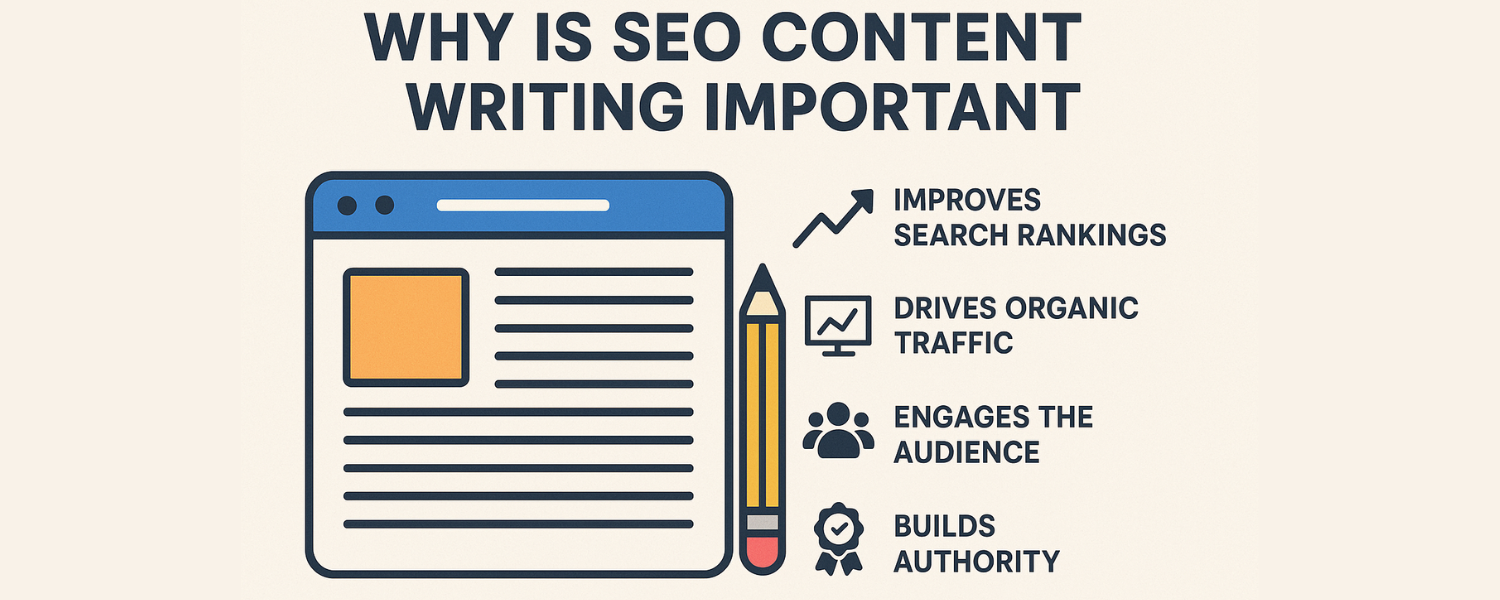
If you invest time in content creation, you naturally want people to find and read it. SEO content writing is the vehicle that makes your content discoverable.
Consider that 68% of all online experiences begin with a search engine – when potential customers or readers have a question or need, they often turn to Google or Bing first.
If your content is not optimised for search, it’s likely to remain invisible on those all-important search results pages.
Getting on the first page of Google is critical. Studies show that the first page captures the vast majority of clicks, while anything beyond page two might as well be invisible.
In fact, about 75% of searchers never go past the first page of results. Furthermore, the top result alone gets around 28% of all clicks for a given query. This means that higher rankings directly translate into more traffic.
Keyword Research: Laying the Foundation

Successful SEO content writing begins with keyword research. Think of keywords as the bridge between what people are searching for and the content you create.
By identifying the words and phrases your target audience uses in search queries, you can tailor your content to match their interests and needs.
In the SEO context, keywords refer to the search terms people enter into Google or other search engines when seeking information.
They can be single words (e.g. “copywriting”) but more often are multi-word phrases or questions (e.g. “tips for SEO content writing” or “how to write SEO friendly blog posts”). There are a few types of keywords to know about:
- Primary (Focus) Keyword: The main term you want your content to rank for. Every page or post should target a primary keyword that closely reflects its main topic.
- Secondary Keywords: Related terms or variations that support the primary keyword. These might include subtopics or more specific queries.
- Long-Tail Keywords: Longer, more specific phrases (usually 3+ words) that often have lower search volume but indicate clear intent. For example, “best digital marketing company in India” is a long-tail keyword.
How to do keyword research? Start by brainstorming topics relevant to your niche or business. Put yourself in your audience’s shoes: what would they search for that your content can answer?
Once you have some seed ideas, use keyword research tools to expand and refine them. Popular tools include:
- Google Keyword Planner: A free tool to get search volume and keyword suggestions from Google data.
- Semrush Keyword Magic Tool: Enter a topic, and it generates a comprehensive list of related keyword ideas, including metrics such as volume and difficulty.
- Ahrefs Keywords Explorer or Moz Keyword Explorer: Paid tools that provide keyword ideas along with SEO difficulty scores and click data.
- AnswerThePublic and AlsoAsked: Tools that visualise questions people ask about a topic (great for finding those long-tail, question-based keywords).
- Google autocomplete and “People also ask”: Simply start typing a query in Google and note the suggested completions, or look at the related questions Google shows – these are direct clues to user interests.
When evaluating keywords, consider three key factors: relevance, search volume, and competition.
- Relevance: The keyword should accurately reflect the content’s subject matter. It needs to match the intent of searchers. Ask: if someone searches this term, will my content thoroughly answer their query? Targeting irrelevant keywords just because they’re popular won’t help in the long run – Google will favour content that directly addresses the search intent.
- Search Volume: This refers to the average number of searches a keyword receives per month. Higher volume means more potential traffic, but don’t be blinded by volume alone. A very high-volume keyword like “SEO” is extremely competitive and broad. Often, a moderately popular keyword that’s very relevant to your niche is better.
- Competition/Difficulty: SEO tools often provide a difficulty score estimating how hard it is to rank for a keyword (usually based on the current top results’ authority). If you’re just starting out, you’ll want to target lower-competition keywords where you have a fighting chance to rank. Long-tail keywords usually fall into this category.
A smart approach is to choose a primary keyword that balances decent search volume with attainable competition, and then gather a set of related secondary keywords.
Suppose you run a pet care blog and discover that “dog behaviour training” is a good primary keyword: it’s relevant, gets a few thousand searches per month, and isn’t dominated by unbeatable competitors.
Don’t forget search intent. Search intent refers to the reason behind a query, and it’s crucial for keyword selection. Common intents include: informational (seeking an answer or how-to), navigational (looking for a specific website), commercial investigation (researching products), and transactional (ready to buy or take action).
Actionable tip: Create a simple keyword strategy sheet for each content piece. In one column, list your primary keyword, then list a handful of secondary keywords and common questions related to the topic. This will serve as a reference as you write, ensuring you touch on the subtopics your audience cares about.
For example:
- Primary keyword: “seo services for small business”
- Secondary keywords: “build email list, email newsletter ideas, open rate improvement, best time to send emails”
- Common questions: “How often should a small business send emails?”, “What makes a good email subject line?”
By doing this homework upfront, you set a solid foundation. Effective keyword research guides your writing so that you’re not shooting in the dark – you know exactly what terms to incorporate and what information to include to meet readers’ needs.
Content Planning and Topic Research

With your keywords in hand, the next step is content planning – deciding what exactly you will write and how to organise it.
Effective planning enables you to create content that is focused, comprehensive, and user-friendly. It bridges the gap between a list of keywords and a finished, high-quality article or page.
Start with your audience and their questions. SEO content writing is ultimately about helping the reader. A powerful approach to planning is to list out the questions your target readers have about your topic.
For example, if your topic is “SEO content writing,” questions might include: “What does SEO writing mean?”, “How do I research keywords?”, “How long should an SEO article be?”, “What are common SEO writing mistakes?”, etc.
Research existing content (and find content gaps). Review the top results for your target query – your future competitors. Analyse how those pages are structured and what subtopics they cover.
The goal isn’t to copy them, but to understand what Google considers relevant to the query and to identify content gaps (areas that are not well covered by existing articles).
Semrush recommends performing a content gap analysis by researching your competitors’ content for opportunities. Select a content format that aligns with the search intent. Determine the best format for delivering the information.
Create an outline. Before diving into writing, map out the structure of your content to ensure a clear and cohesive narrative. This is a crucial planning step that many beginners often skip, but it significantly enhances the coherence of your final piece.
Start by listing the main subtopics or sections you need to cover (these will often align with your secondary keywords or the major questions you identified).
Then, order them in a logical sequence. Each of these can become a section with an H2 heading, and if needed, sub-points under those sections can have H3 subheadings.
On-Page SEO Techniques for Content Optimisation
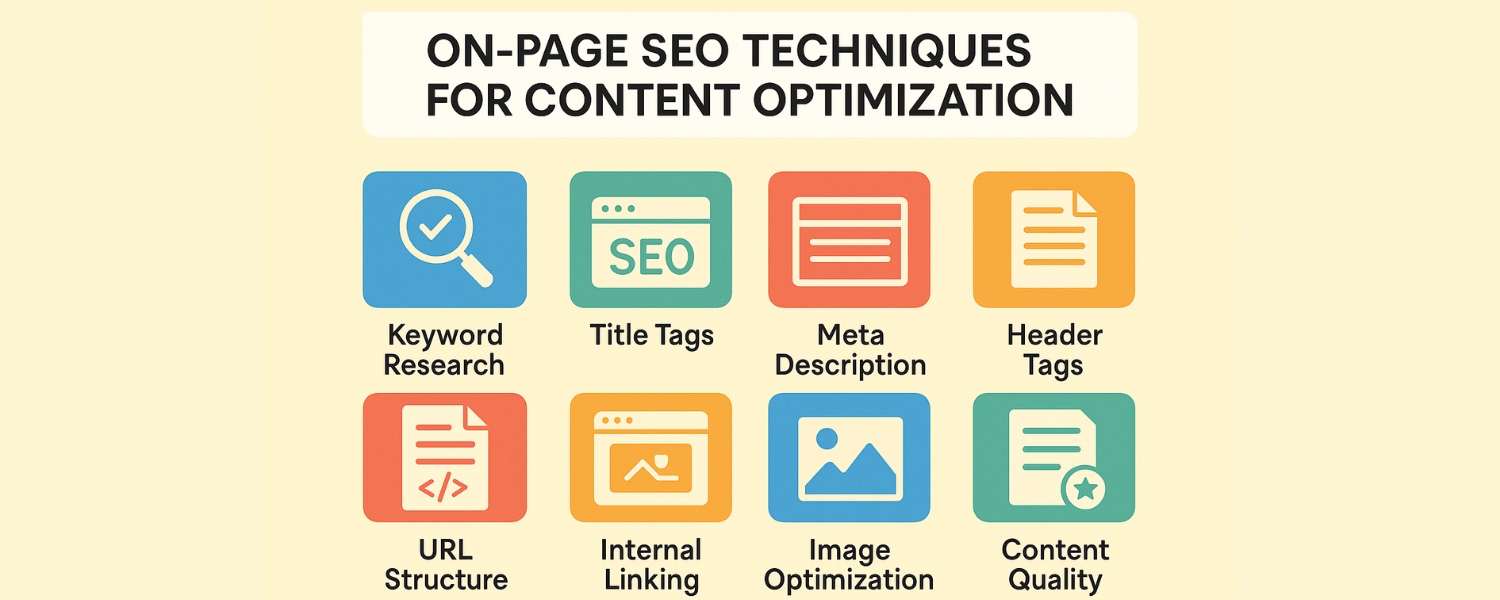
Once you start writing the content, you need to optimise it on-page so that search engines can effectively index and rank it. On-page SEO refers to all the measures you can take within your content and HTML source to help improve its search visibility.
Here are the key on-page elements and techniques to focus on for SEO content writing:
1. Compelling Title Tags (SEO Titles)
The title tag is the title of your page or post that appears as the clickable headline in Google search results. It’s also usually the main heading (H1) on your page. Crafting an effective title tag is crucial for both search engine optimisation (SEO) and click-through rate (CTR).
A few best practices for title tags include:
- Include the primary keyword: Try to use your main keyword in the title, preferably towards the beginning if it sounds natural. This signals relevance to search engines and also indicates to searchers that your content is directly related to their query.
- Keep it concise: Google typically displays the first ~50–60 characters of a title tag. If it’s too long, it will get truncated with an ellipsis. Aim for a title around 55-60 characters so it fully shows. For example, “SEO Content Writing: 10 Best Practices for Beginners” is short and to the point.
- Make it enticing: Remember, the title is often the first impression a potential reader has. Use words that drive interest – known as power words (e.g., “ultimate,” “essential,” “proven”) – or include numbers if appropriate (like “7 Tips” or “2025 Guide”).
- Avoid duplication: Every page on your site should have a unique title tag. Don’t reuse the same title keyword across many pages, or you could confuse search engines and cannibalise rankings.
For instance, a well-optimised title might be: “SEO Content Writing Guide: How to Create Content that Ranks in 2025.” It’s 60 characters, includes the keyword “SEO Content Writing,” and tells the reader exactly what to expect.
2. Meta Descriptions that Drive Clicks
The meta description is the snippet of text that appears below your title in the search results. While meta descriptions are not a direct ranking factor (adding keywords in them won’t boost your rank by itself), they greatly influence whether users click on your result.
Tips for meta descriptions:
- Summarise and sell: Think of the meta description as a mini advertisement for your content. In one or two sentences, summarise the content’s value and include a subtle call-to-action or hook to entice the searcher to click.
- Keep it around 1–2 sentences (under ~155 characters): There’s a limit to what Google will show. On mobile, descriptions get cut around 105 characters; on desktop, around 155-160 characters. Make those first 1-2 sentences count by delivering a clear message upfront.
- Include the primary keyword or a synonym: When the search query is present in your meta description, Google will often bold it in the results, drawing attention. It also reassures searchers that your page is relevant to their search. However, only include it where it reads naturally – no keyword stuffing here.
- Use active voice and action verbs: Engage the reader directly. For example, “Discover how to…” / “Learn the secrets of…” / “Get tips to…” are active and inviting. Phrases like “learn more,” “find out,” or “explore ways” can subtly encourage users to click.
- Avoid duplication (again): Each page needs its own unique meta description. If you don’t write one, Google might auto-generate it from your content, but that auto-snippet may not be as compelling or coherent. It’s better to craft one yourself.
For example, a strong meta description for this guide could be: “Wondering how to write content that ranks on Google? This complete beginner’s guide to SEO content writing shares step-by-step tips on keyword research, on-page optimisation, and creating content that readers and search engines love.”
3. Clean, SEO-Friendly URLs
The URL (or slug, the part of the URL specific to the page) is another on-page element to optimise. Short, descriptive URLs are not only easier for users to read and remember, but also for search engines to index. Best practices for URLs:
- Include the target keyword or topic: If your article is about SEO writing tips, a slug like /seo-writing-tips is clear and effective. Google uses the URL path as a clue to the content topic.
- Keep it short and simple: Avoid long strings of words or unnecessary numbers and parameters in URLs. For instance, yourdomain.com/blog/seo-content-writing-guide is preferable to yourdomain.com/blog/2025/08/15/authorname/seo-content-writing-guide-how-to-rank. Shorter URLs tend to perform better and are less likely to break if shared.
- Use hyphens to separate words: Hyphens are standard in URLs as word separators. Don’t use spaces (which get encoded as %20) or underscores (which are harder to see in underlined links).
- Avoid dates or overly specific information: As a content writer, you may need to update your posts over time. If your URL includes a year or date and you update the content later, the date in the URL may make it appear outdated (and changing URLs can be a hassle due to redirects). Stick to evergreen URLs when possible.
For example, if the page title is “12 Tips for Writing SEO-Optimised Content in 2025,” a nice URL would be something like: …/seo-content-writing-tips. We exclude the year so the URL remains valid beyond 2025, and it’s straightforward.
4. Header Tags and Content Structure
Using headings (H1, H2, H3, etc.) to structure your content is crucial for both readability and search engine optimisation (SEO). We touched on this during outlining – now it’s time to implement it in the content.
- Use one H1 for the title: Typically, your CMS (such as WordPress) will automatically assign the main title of the article as an H1. Ensure your primary keyword or its variant appears in this H1 title for relevance.
- Organise sections with H2 subheadings: Each major section of your article should start with an H2 that summarises the point of that section. For example: “Keyword Research Strategies” or “Common SEO Writing Mistakes.” Subheadings serve as signposts for readers and search engines, indicating the content’s subject matter.
- Use H3S (and H4S if needed) for subsections. If you have a list of subpoints or steps under an H2 section, use H3 for each subpoint. For example, under a section “On-Page SEO Techniques,” you might have H3S for “Title Tags,” “Meta Descriptions,” “URLs,” etc. This nested structure is both logical for readers and a clear signal of content structure to search engine crawlers.
- Incorporate keywords in headings naturally: Headings are prime real estate for keywords, because they carry more weight than regular paragraph text. If you can include your target keyword or related keywords in some of your headings in a way that makes sense, do it. For instance, instead of a bland H2 like “Introduction,” a keyword-rich yet reader-friendly H2 could be “What Is SEO Content Writing and Why It Matters.”
- Make headings descriptive: A visitor should be able to glance at your subheadings and know exactly what they can learn from each section. Phrases like “How to…”, “Top 5 …”, “Why … Matters”, etc., can set clear expectations. Descriptive headings also improve your chances of getting featured snippets – those highlighted answers on Google. For example, phrasing a subheading as a question (e.g., “How Do You Write an SEO-Friendly Article?”) and then answering it directly below can create a Q&A-style snippet.
Properly structured content not only enhances SEO but also improves user engagement. As one Reddit expert bluntly put it, “skimmable content tends to perform well”, because on-screen readers appreciate being able to jump to the part they care about. Make sure your page is not just a wall of text; break it up with headings and subheadings.
(Pro tip: consider adding a table of contents for very long articles. It can be a simple list of H2S (and possibly H3S) at the beginning, with anchor links. This improves navigation – users can click to jump to a section – and can even earn you jump links in Google’s search results.)
5. Write in Natural, Keyword-Rich Language
As you write the body text, aim for a balance between including keywords and maintaining natural flow. Gone are the days when SEO writing meant repeating a keyword verbatim 20 times on a page.
Keyword stuffing is a big no-no, and it will do more harm than good. Google’s crawlers are smart enough to understand variations of a phrase and the overall relevance of a topic.
Here’s how to handle keywords in the content:
- Use the primary keyword a few times in the text, especially in the opening paragraphs and closing if possible. It should feel organic, as if you’re genuinely discussing that topic (which you are). For example, in this article, you see “SEO content writing” mentioned naturally throughout, but it’s not in every sentence.
- Include secondary keywords and synonyms where they are relevant and make sense. If your primary keyword is “email marketing strategy,” you might naturally also discuss “email campaigns,” “newsletter strategy,” “email audience,” and so on. This reinforces context.
- Answer the questions and cover the topics from your research. By doing that, you will often incorporate the keywords without even trying too hard, because you’re writing about those very terms.
- Maintain readability: Always prioritise the reader’s experience. If you overuse a keyword to the point it sounds odd, you’ve gone too far. A good rule of thumb from an SEO perspective is that if a non-SEO-savvy reader can notice that a particular phrase is being overused, it’s likely hurting more than helping.
- Use variations. If a keyword phrase is hard to fit in a sentence due to grammar, you can rearrange or split it. For example, the phrase “best SEO content writing tips 2025” is awkward as is. You could write, “our best tips for SEO content writing in 2025”, – conveying the same idea but in a reader-friendly way.
Overall, aim for a tone and style that feels human. Google’s advice (and updates like the “helpful content” update) explicitly encourages content written for people, not search engines. If you stick to that principle while being mindful of keywords, you’ll likely hit the right balance.
6. Optimise Images and Media
Images, diagrams, infographics, and videos can greatly enhance your content. But they also need a bit of SEO love:
- Use descriptive file names: Instead of using image123.png, name your image file something like ‘on-page-seo-checklist.png’ before uploading. This gives a hint to search engines about the image content.
- Add alt text for images: The alt attribute is used in HTML to describe an image for accessibility (screen readers) and in cases where the image cannot be displayed. For SEO, alt text provides context to search engine crawlers about what the image is showing. Write a concise description that includes a keyword if relevant.
- Compress images for speed: Page speed is a key SEO factor, and large images can significantly slow down load times. Use compressed formats (JPEG for photos, PNG for graphics, or modern formats like WebP) and consider compressing images via tools or plugins without noticeable quality loss. Fast-loading pages keep users happy, which is good for rankings.
- Provide transcripts for videos or audio: If your content includes a video or audio clip, include a text transcript or at least a detailed summary below it. Not only does this help with SEO (search engines can’t watch a video, but they can read the accompanying text), it’s also great for accessibility.
- Use relevant captions (if appropriate): Captions under images (the little descriptive text) are optional, but if an image needs context, a caption can be useful for users. Search engines also read caption text, which can add to the thematic relevance of your page.
Additionally, don’t forget to use images and media when they add value! Content with visuals is more engaging and often more informative. Screenshots, charts, and examples can make complex information easier to digest.
7. Internal and External Linking
Linking is a crucial aspect of on-page SEO that content writers often overlook. There are two kinds to pay attention to:
- Internal Links: These are links within your content that direct users to other pages on your own website. Internal linking serves multiple purposes: it helps readers discover more of your content and stay on your site longer, and it helps search engine crawlers understand the structure of your site, spreading ranking power across pages. For example, within an article about SEO writing, you might internally link a mention of “on-page SEO” to a detailed post you have about on-page optimisation.
- External Links: These are links within your content that direct users to other websites. It might seem counterintuitive to send readers away, but linking to authoritative sources adds credibility to your content. If you cite a statistic or fact, linking to the source (such as an industry report or a reputable blog) is good practice. Google can view external links as signals that you are creating well-researched content and not just making things up. However, be discerning: only link to high-quality, trustworthy sites.
From a user experience perspective, internal links keep people engaged with your site, and external links show you’ve done your homework. A balance of both is healthy.
A quick example: in an article about “healthy smoothie recipes,” you might internally link to your “10 Healthy Ingredients” post, and externally link to a nutritional study backing up the health benefits of smoothies.
One more tip: consider using anchor links within the page for long content. These are basically internal links that jump to another part of the same page (like the table of contents links that jump to sections).
It’s not a direct SEO boost, but it can improve usability for lengthy guides, thereby indirectly helping users navigate quickly (they’ll be less likely to bounce out of frustration).
8. Readability and Formatting (SEO Writing is Human-Friendly)
While we have a whole section on readability next, it’s worth noting that formatting your content for readability is also an SEO technique, as mentioned under on-page SEO.
Why? Because content that’s easier to read and understand tends to perform better in search. Google’s algorithms take into account user engagement metrics.
So apply these formatting tips as you optimise on-page:
- Use short paragraphs and sentences. Large blocks of text are intimidating on screen. Paragraphs of 1-3 sentences are perfectly fine in web writing. Our friend on Reddit put it aptly: web readers prefer short paragraphs because they’re easier on the eyes and align with how we consume content online.
- Employ bullet points or numbered lists to break out lists of tips, steps, or examples. We’re doing it right now in this very section. Lists are inherently scannable and digestible.
- Emphasise key points with bold or italics if needed, but use sparingly for effect (like bolding a critical term on first mention).
- Ensure plenty of white space. Margins, line spacing, and not overstuffing content all contribute to a cleaner look.
- Use a conversational tone where appropriate. We’ll expand on tone later, but an easy-to-read, conversational style often means simpler sentences and a friendly voice, which naturally improves readability and user engagement.
By implementing these on-page optimisation techniques, you enhance the crawlability, relevance, and user appeal of your content.
Think of on-page SEO as tuning the engine of a car (your content) – it ensures that all parts work together smoothly, allowing the content to perform optimally in search rankings.
Writing for Readability and Engagement

So far, we’ve covered how to satisfy search engines; now let’s focus on satisfying your readers. Readability and engagement are crucial because even if your content ranks and gets clicks, it needs to hold the reader’s attention and deliver value.
Those positive user signals can also indirectly boost your SEO. Here’s how to make your writing clear, engaging, and tuned to human readers:
1. Craft a Strong Introduction
Your introduction sets the tone and determines whether someone will continue reading. A good intro should grab attention, identify the problem or question being addressed, and promise a benefit or solution.
For example, you might start with a compelling statistic or question (“Did you know 90% of content gets no traffic from Google?”), then acknowledge the reader’s challenge (“If you’re a new blogger, that stat might sound scary, but fear not.”), and finally preview how the article will help (“In this guide, we’ll show you how to write SEO content that stands out and ranks, even as a beginner.”).
2. Use a Conversational Tone
Most web content (unless very formal or academic) benefits from a conversational tone – writing that feels like one person talking to another.
This doesn’t mean you ignore grammar or professionalism; it means you write in a natural, relatable way. Some tips to achieve this:
- Use the second person (“you”) frequently. This speaks directly to the reader and makes your content feel like a dialogue. E.g., “When you start optimising your articles, you might wonder where to place keywords.”
- Use simple language. Don’t use a ten-dollar word when a ten-cent word will do. “Use” instead of “utilise,” “try” instead of “endeavour,” etc. Industry jargon should be used only if you’re sure your audience understands it; otherwise, provide a quick explanation or use a more common synonym.
- Use short sentences where possible. Mix long and short sentences for rhythm, but lean towards brevity. It’s perfectly fine to have a one-liner sentence if it emphasises a point or eases the flow.
- Ask rhetorical questions to engage the reader’s mind. For instance, “So, how do you find these golden keywords?” – questions like this can make the reader pause and think, and it mimics a conversation.
- Imagine you’re explaining something to a friend or a colleague. This can automatically make your writing more down-to-earth.
As one experienced content strategist mentioned, try not to be overly stiff or formal – “This isn’t an academic college paper. Write as if you’re having a conversation with the reader.”.
Of course, adapt to your audience; if you’re writing for C-suite executives on a B2B platform, your tone might be a bit more professional.
3. Format for Easy Skimming
We discussed headings and lists earlier, which are part of formatting, but let’s reiterate the philosophy: many readers skim. In fact, usability studies have found that on the web, people read at most about 20-28% of the words on a page during an average visit. Rather than fighting this behaviour, work with it.
Make your content skimmable by:
- Using plenty of subheadings (we’ve done that in this guide).
- Highlighting key terms or takeaways in bold.
- Using bullet points or numbered lists wherever it makes sense (for lists of tips, steps, features, benefits, etc.).
- Incorporating white space (don’t cram text; let paragraphs breathe).
- Breaking up long chunks of text with images or callout boxes (e.g., an indented quote or a summary).
Notice how, in this guide, no paragraph is too long; many are just a couple of sentences long. That’s intentional for readability.
Skimmable doesn’t mean shallow. It just means organised in a reader-friendly way. A skimmer should be able to get the gist of your article by reading the headings and perhaps the first line of each paragraph.
Try this as a test: take a glance through your finished draft reading only the headings and any highlighted text.
4. Keep Paragraphs and Sentences Short
We touched on this, but it’s worth isolating as a practice. Using short paragraphs (often 1-4 sentences) and short sentences, where possible, makes content much easier to read on screens.
Big blocks of text can overwhelm readers, especially on mobile devices, where a single paragraph can take up an entire screen if it’s lengthy.
One idea per paragraph is a good rule of thumb. If you find yourself writing a paragraph that’s, say, 8-10 sentences long, see if it can be split into two or more paragraphs.
Even if those new paragraphs are just one or two sentences each, that’s fine. It’s about rhythm and digestibility.
Similarly, for sentences, while it’s good to vary sentence length to avoid monotony, lean towards a concise structure.
If a sentence is running on and contains multiple ideas, consider breaking it into two. Reading your content aloud is a great way to catch unwieldy sentences.
5. Provide Examples and Stories
Examples are a secret weapon for engagement. Whenever you explain a concept, try to follow it with a concrete example or analogy. Abstract advice can be understood better when it’s illustrated.
For instance, earlier, when discussing search intent, we used the drone photography example from Expert Photography’s content, which makes a concept tangible and real. Examples also make your content unique; you’re adding something that isn’t just generic theory.
If appropriate, include short anecdotes or case studies. People love stories. Even a two-sentence story about how you applied a tip and saw success (or how someone failed by ignoring it) can resonate more than just the tip by itself.
For example: “I once ignored meta descriptions on a batch of articles, and I noticed their CTR was significantly lower compared to pages where I wrote custom descriptions. After I updated those descriptions with compelling text, I saw a bump in traffic as more people clicked through.”
6. Engage Readers with Direct Address and Questions
We mentioned writing in the second person (“you”) – continue doing that throughout to keep the reader mentally involved. Every so often, ask a direct question to the reader or a rhetorical question that you then answer.
For example: “You might be wondering, how many keywords should I use? The answer is, use as many as make sense, but not one more. In simplistic terms: a lot, but not too many!”
Using parenthetical asides or commentary can also create a conversational feel – just don’t overdo it to the point of being distracting. For instance, “(Yes, even SEO experts make this mistake sometimes!)” can add a human touch.
7. Edit for Clarity and Flow
Great writing is rewriting. After drafting your content, take the time to edit and proofread it. Given this is a guide on writing, it’s worth stating: proofreading is part of SEO content writing.
Why? Typos and grammatical errors can undermine your credibility and annoy readers. Additionally, a clean copy is easier for search engines to parse and won’t inadvertently change meaning due to mistakes.
While editing, look out for:
- Repetition: Are you repeating the same idea or phrase too many times? Cut or rephrase redundancies. (This also helps reduce any accidental keyword stuffing.)
- Jargon or complicated terms: If you find any, simplify or explain them.
- Passive voice overuse: Active voice tends to be clearer and more direct. “We analysed the data” is usually better than “The data was analysed.” Some passive is fine, but active voice often improves readability.
- Transitions: Ensure paragraphs and sections flow logically. Add transition words or sentences (e.g., “On the other hand,” “Next,” “However,” “For example,”) to guide the reader when shifting points.
- Length of content vs. value: Verify that every section genuinely adds value. If something feels like fluff, either enrich it with more substance or consider trimming it to improve its effectiveness. Remember, quality over quantity.
8. Invite Engagement
Finally, make your content a two-way street. At the end or even mid-way, you can encourage readers to engage – ask for their thoughts, invite comments, or pose a challenge.
For a blog post, ending with a question like “What SEO writing techniques have worked for you? Let us know in the comments!” can prompt interaction.
Additionally, if your content’s goal is to drive a specific action (such as signing up for a newsletter, downloading a resource, or contacting your services, i.e digital marketing services), include a Call to Action (CTA).
On commercial or business blogs, it’s standard to have a CTA at the end – e.g., “If you need help with your SEO content strategy, contact our team for a consultation.”
By focusing on readability and engagement, you ensure that once a visitor lands on your page (thanks to all your SEO efforts), they will have a positive experience.
Engaged readers are more likely to convert into fans, subscribers, or customers, which is the ultimate goal beyond simply generating page views. In summary, write for the user first and search engines second.
Essential Tools for SEO Content Writing
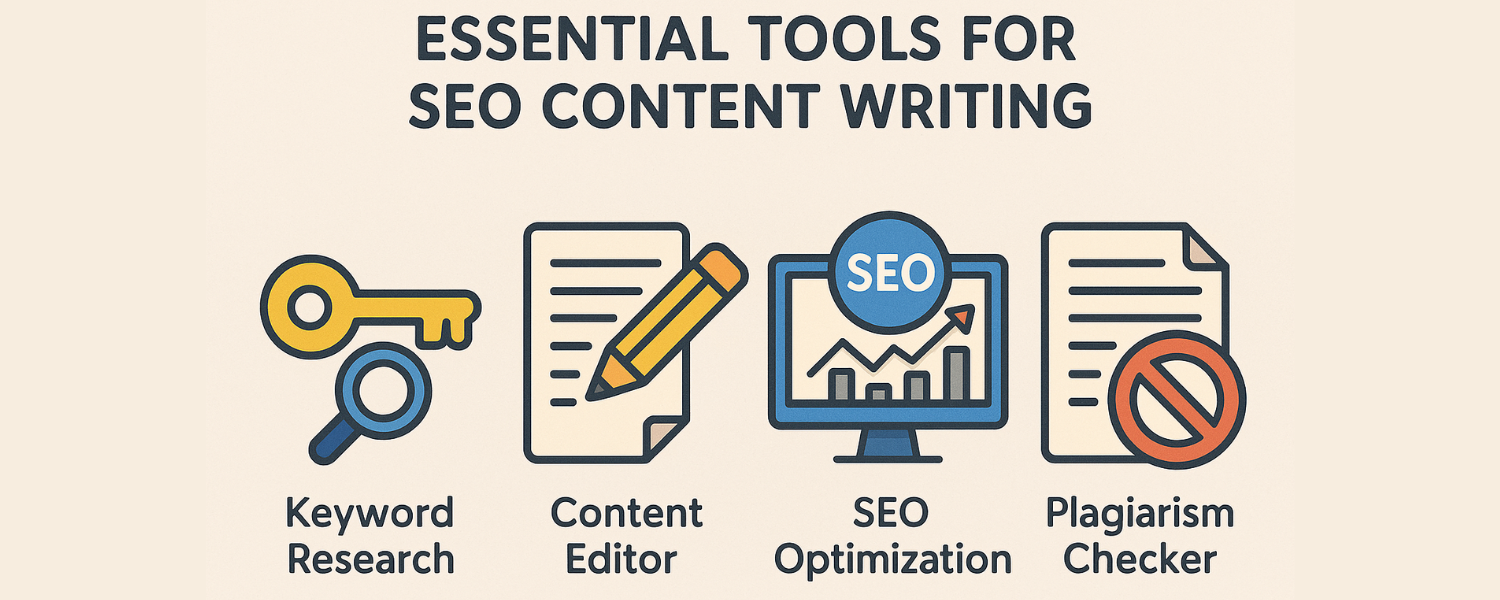
SEO content writing can be labour-intensive, but thankfully, there’s an array of tools to make your job easier and more effective.
These tools help with everything from keyword research to content optimisation and editing. Let’s break down some categories of tools and specific recommendations:
1. Keyword Research and SEO Analysis Tools
- Google Keyword Planner: A Free tool within Google Ads. Great for getting baseline keyword ideas and approximate search volumes straight from Google. Ideal for initial research if you’re on a budget.
- Semrush: A popular all-in-one SEO suite. Its Keyword Magic Tool is excellent for deep keyword research (as mentioned, you can input a seed keyword and get thousands of suggestions along with volume and difficulty).
- Ahrefs: Another top-tier SEO platform. Ahrefs Keywords Explorer provides rich keyword data, including clicks per search (so you know if a keyword results in clicks or just quick answers on Google).
- Moz: Moz’s Keyword Explorer is user-friendly and includes a “Priority” score combining volume, difficulty, and relevance. Moz also provides on-page grader tools and a Chrome extension (MozBar) for quick SEO insights on pages.
- Other keyword tools include Ubersuggest, KWFinder, Answer the Public, and Google Trends. These can complement your research by offering different perspectives. AnswerThePublic, for instance, is great for pulling out common questions (visualising queries in question form).
2. Content Optimisation and Writing Aids
- SEO Content Editors (SurferSEO, Frase, Clearscope): These have gained popularity for helping optimise content in the writing phase.Tools like SurferSEO analyse the top-ranking pages for your keyword and give guidelines on ideal content length, keywords/phrases to include, and headings to cover (essentially reverse-engineering what Google “wants” to see for that query). They often produce a content score.
- Yoast SEO (for WordPress): If your site runs on WordPress, the Yoast SEO plugin is almost a must-have. It allows you to set your focus keyword and then evaluates your post for keyword usage, title, meta description, alt text, links, etc.
- Grammarly and Hemingway Editor: Clarity and correctness are vital, and these tools help polish your writing. Grammarly is an AI-powered writing assistant that checks grammar, spelling, and also suggests style improvements.It can catch embarrassing typos or repeated words.Hemingway Editor focuses on readability – it highlights long or complex sentences, overuse of adverbs, and passive voice, among other issues.
- Copyscape or plagiarism checkers: Unique content is a cornerstone of SEO. You want to avoid any accidental duplication of existing content (even if unintentional).Copyscape is a popular tool that allows you to input your content or URL and scan the web for similar text. It’s used to ensure the content you produced is original.
- Readability analysers: Tools like Readable.com or the readability analysis feature within Yoast or Grammarly can provide a reading grade level for your content.Generally, aiming for a reading level of around 8th grade (or even slightly lower, depending on the audience) is recommended for broad web content. These tools can highlight sentences to simplify for improved comprehension.
3. Research and Idea Generation Tools
- AnswerThePublic: We mentioned it earlier – by entering a keyword, it shows a visualisation of questions (who, what, why, how, etc.) people ask about that topic, as well as comparisons and other phrases. It’s fantastic for getting into the heads of your audience and discovering angles to cover.
- Quora, Reddit: Searching these communities for your topic can reveal common pain points and discussions. They’re gold mines for content ideas and for understanding how real people talk about a subject (which can help you match tone and cover the right details).
- Google Search Console: If you already have content published, Google Search Console is a valuable free tool that allows you to see how your content is performing in search results.It shows which queries your pages are appearing for and their average rankings and click-through rates.
- Google Analytics: While more useful after publishing, GA can provide engagement metrics, such as time on page and bounce rate, for your content.If you notice users spending very little time on a particular article, that could indicate an issue with readability or content quality on that page, alerting you to improve it.
4. Productivity and Workflow
- Notion, Evernote or other note-taking apps: Useful for organising your keyword research, outline, and notes all in one place. Some writers draft directly in such apps for distraction-free writing before moving to a content management system (CMS).
- Project management tools (Trello, Asana): If you’re managing an editorial calendar or multiple pieces, these can help you track progress from research to draft to publishing.
- Time management (Pomodoro timers): Writing long content can be mentally taxing. Using a Pomodoro timer (25 minutes of focused writing, followed by a 5-minute break, and repeating) or any other time tracker can help keep you productive and avoid burnout. It’s not directly SEO-related, but anything that improves your writing workflow indirectly benefits your output.
Many of these tools offer free versions or trials, making them especially useful for beginners. You don’t need to use every tool under the sun – pick those that fill your particular gaps.
For example, maybe you struggle with grammar, so Grammarly is a godsend; or you find keyword research tedious, so Semrush or Ahrefs speeds it up immensely.
By leveraging tools appropriately, you can produce optimised content faster and with more confidence. They’ll help ensure you don’t miss technical details (like a forgotten alt tag or an unusual synonym for a keyword) and maintain high quality.
As the saying goes, “work smarter, not harder” – in SEO content writing, the tools are your power-ups to do just that.
Real-World Examples of Effective SEO Content Writing
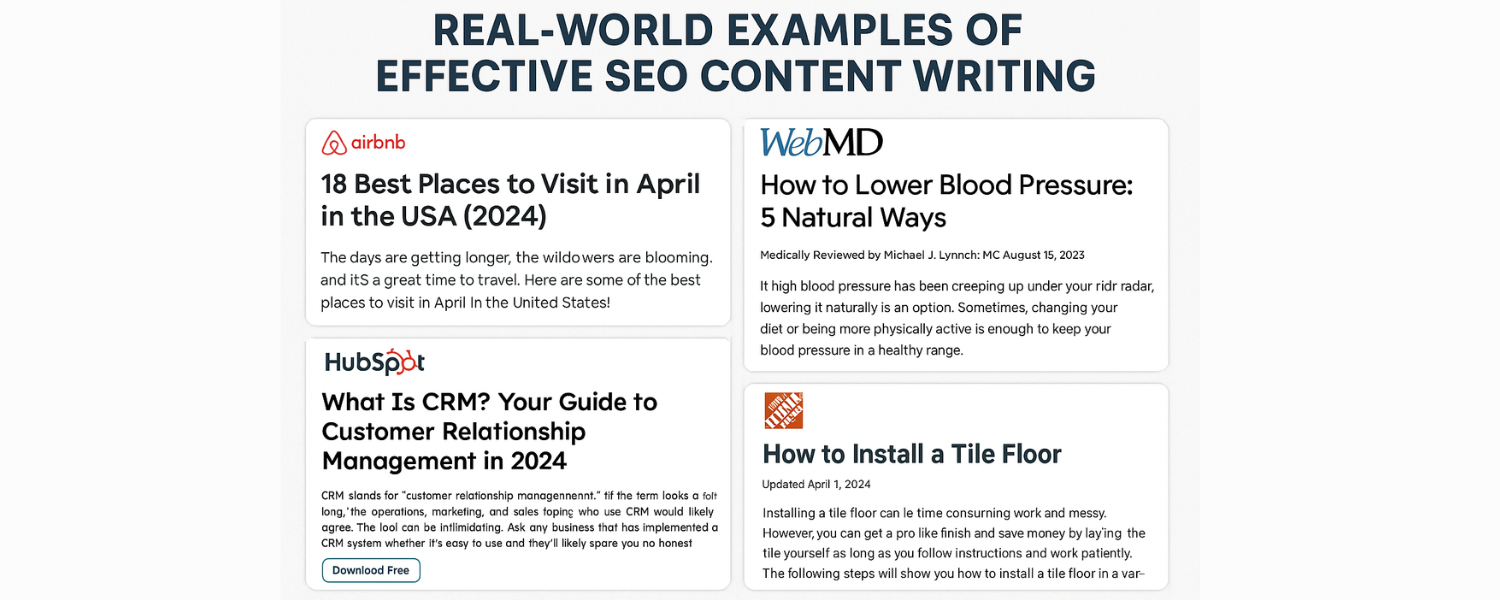
Sometimes the best way to understand what works is to see examples of SEO content done right. Let’s examine a few real-world examples from various websites, each showcasing a key aspect of successful SEO content writing.
These examples illustrate how the principles we’ve discussed come together in practice:
- Pick Up Limes – Writing for a Specific Audience: Pick Up Limes is a plant-based food and nutrition blog. Every article on the site is laser-focused on the interests of people eating a plant-based diet. For instance, a post about “kitchen essentials” on Pick Up Limes highlights the importance of sharp knives, particularly in the context of cutting vegetables, fruits, and nuts – staples of a vegan diet.
- Expert Photography – Satisfying Search Intent with the Right Format: ExpertPhotography.com garnered success with its drone photography guide. When people search for “drone photography,” they may be looking for tips and techniques on using a drone to take photos, rather than trying to buy a drone.
- Verywell Fit – Establishing E-E-A-T (Experience, Expertise, Authoritativeness, Trust): Verywell Fit, a health and fitness site, excels at demonstrating credibility in its content. Articles often include author bios that highlight credentials (e.g., dietitian, personal trainer) and mention that medical experts have reviewed the content.
- Wix (Blog) – Blending Content with Product Promotion Smartly: Wix, the website builder, operates a blog that frequently educates readers on web-related topics while naturally promoting its product. For example, in a post about “ecommerce security checklist,” Wix first provides tons of value: explaining why website security matters, listing threats, and giving general security tips.
- Backlinko – Using Original Research and Case Studies: Backlinko, founded by Brian Dean (now part of Semrush), gained fame for its in-depth case studies and original research content. For instance, Backlinko published a study analysing millions of Google search results to figure out ranking factors.
- Podia – Creating Content Hubs and Internal Links: Podia, a platform that provides tools for online course creators, has built a content hub centred on the topic of creating and selling online courses. They have a main pillar page, “how to create and sell an online course,” linking out to various in-depth subtopics (finding course ideas, outlining a course, marketing a course, etc.).
- ActiveCampaign – Managing Brand SERP and Comparisons: ActiveCampaign, an email marketing software, noticed that people often search “ActiveCampaign vs [Competitor]”. To own this narrative and protect their brand impression, they created a series of “versus” comparison pages (e.g., ActiveCampaign vs Mailchimp, vs Constant Contact, etc.).
- Mindbodygreen – Formatting for Skimmability and Engagement: As mentioned earlier, Mindbodygreen’s articles on wellness topics often employ reader-friendly formatting. They break up listicles with subheadings for each item, use short paragraphs, incorporate images and even bolded sentence summaries after major points.
Each of these examples highlights a different facet of SEO content excellence: understanding your audience, aligning with search intent, establishing credibility, integrating products naturally, offering unique value, structuring content effectively, and utilising reader-friendly formatting.
For instance, if you’re a small business blogger, consider focusing on audience targeting and formatting, as seen in examples like Pick Up Limes and Mindbodygreen.
If you’re in a YMYL niche (health, finance), take cues from Verywell on E-E-A-T. If you have the resources, create occasional standout pieces of original content, such as Backlinko.
Real-world success leaves clues. By analysing and learning from these examples, you can shortcut your learning curve and avoid reinventing the wheel. SEO is very much a game of standing on the shoulders of giants – observe what works for others, then do it even better in your own unique way.
Common SEO Content Writing Mistakes to Avoid
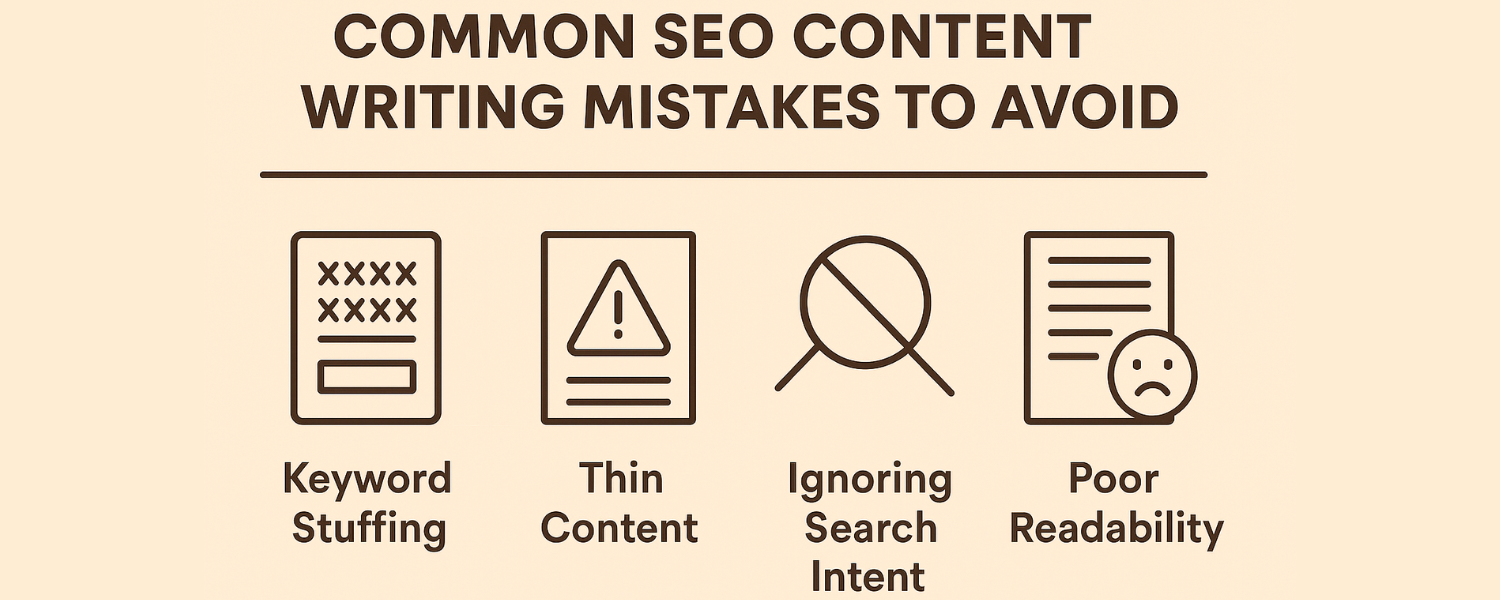
As you hone your SEO content writing skills, it’s equally important to know what not to do. Beginners (and even experienced folks) can fall into certain traps that undermine content performance.
Let’s go through some common pitfalls and how to avoid them:
- Keyword Stuffing: This is the cardinal sin of SEO writing. As we’ve reiterated, overloading your content with keywords (especially in an unnatural way) does more harm than good. Not only can it hurt readability and turn off readers, but search engines are sophisticated enough to detect keyword stuffing and may penalise it. If your keyword usage feels repetitive or forced, scale it back.
- Thin or Low-Value Content: Creating content that doesn’t say anything new or useful is a recipe for failure. This includes very short pages with little info, or longer pages that are mostly fluff. Remember Google’s Helpful Content guidelines – they want content that’s helpful and adds value beyond what’s already available.
- Ignoring Search Intent: Even a well-written article can flop if it doesn’t match what users need from that query. A common mistake is seeing a high-volume keyword and writing about it from the wrong angle.
- Poor Title and Meta Description (Low CTR): Even if you’ve written an excellent article, if the title tag and meta description are unappealing, people won’t click on it in the SERPs. A mistake is to use a dull title like “Update 5 – SEO Tips” (too vague and not user-friendly) or to neglect writing a meta description, leaving it to chance.
- Lack of Subheadings and Structure: Dumping a wall of text without proper headings is a blunder. Not only does it hurt readability, but it also misses out on SEO opportunities. Without subheadings, Google may struggle to understand content sections, and users are likely to become lost or overwhelmed.
- Neglecting Internal Linking: It’s easy to forget to add links to your own other articles or pages, especially if you write content in isolation. But not doing so is a missed opportunity. Internal links help distribute “link juice” and index your pages, while also keeping users engaged with more of your content.
- Using Low-Quality or Irrelevant External Links: While linking out is beneficial, referencing shady or low-authority sites (such as the first Google result you found, for example) can harm credibility. Another error is linking to sources that aren’t really relevant or necessary, which can confuse readers.
- Forgetting Mobile Users: This is more of a design or formatting issue, but as a writer, you should be mindful of it. The majority of searches and content consumption happen on mobile devices. If your content relies on big tables, wide images, or very long paragraphs that might be okay on a desktop but awful on a phone, that’s a problem.
- Not Updating Outdated Content: You wrote a great piece two years ago, and it ranked well; however, some of the information is now outdated, and you leave it that way. This is a mistake because stale content can drop in rankings as newer, fresher content comes along. We saw the stat from Surfer’s example that 73% of blog owners continually update their SEO content.
- No Call to Action or Next Step for the Reader: This is more about content effectiveness than pure SEO, but it’s worth noting. If you write a piece and the reader finishes it, then what? If you don’t guide them somewhere – whether it’s another piece of content, a sign-up, a product page, or a comment section – they might leave.
- Overlooking Technical SEO Basics: As a content writer, you may focus on the writing itself, forgetting that technical aspects can also be detrimental to your SEO efforts. This includes things like not using an H1 tag for the title (some themes might double H1S if not careful), not adding meta tags, forgetting to compress images (leading to slow load), or not using schema markup where it could help (like FAQ schema for Q&A content).
Avoiding these mistakes will save you from headaches and lost rankings down the road. Often, it’s about attention to detail and keeping the user experience and intent in focus at all times.
If you ever find yourself wondering, “Should I do X or is it okay to skip it?” think about it from both the user’s perspective and Google’s perspective.
One strategy is to create your own pre-publish checklist incorporating all these points (and the tips above). Before you hit publish or submit to a client, run through it: “Did I use keywords appropriately?
Does this meet intent? Are my title and meta strong? Are there any large blocks of text that could be broken up into smaller sections? Linked to relevant pages? Proofread? Mobile-friendly?” That final once-over can catch many issues.
Emerging Trends in SEO Content Writing
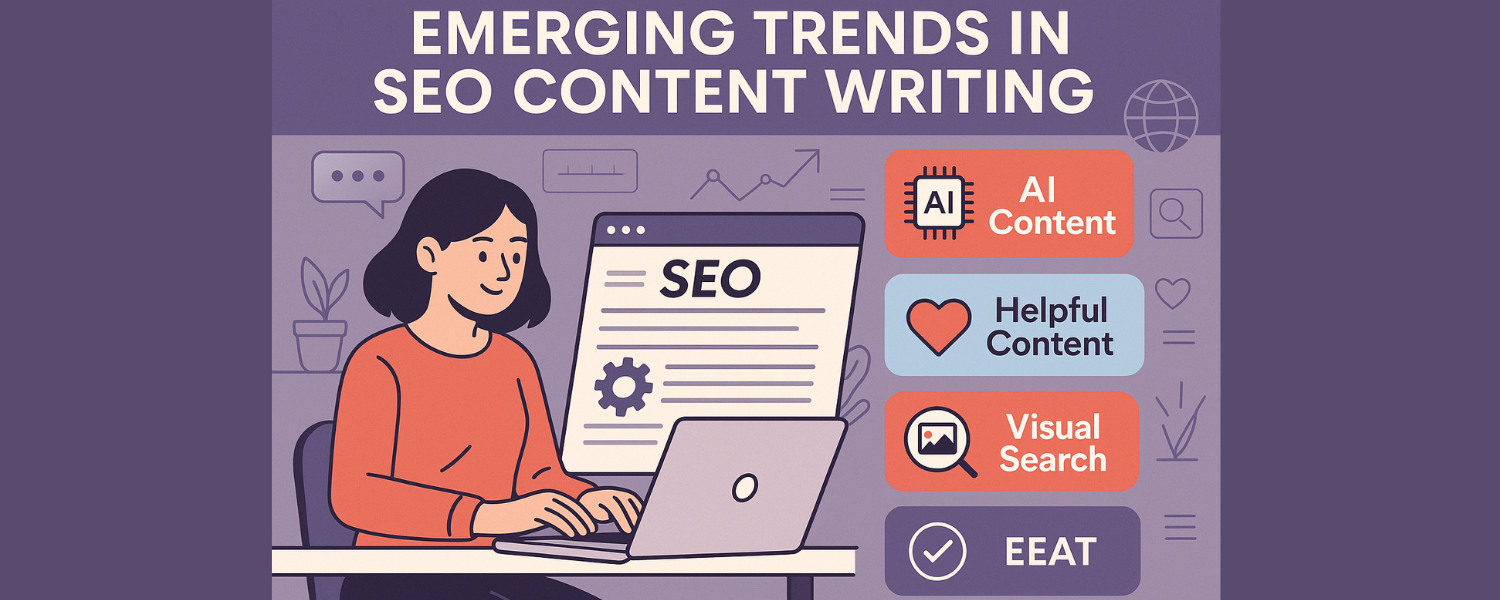
The world of SEO and content is always evolving. What worked a few years ago may no longer be sufficient today, and new developments continually shape how we approach SEO content writing.
As we look at 2025 and beyond, here are some emerging trends (and current realities) to keep in mind so you can stay ahead of the curve:
1. The Rise of AI in Content Creation (and How to Use It Wisely)
AI writing tools (like GPT-based models) have made huge strides. They can generate articles, brainstorm topics, or help with outlines in a matter of seconds.
Many content creators are utilising AI to aid with initial drafts or idea generation. However, relying solely on AI-generated content is risky.
Google has clarified that it’s not against AI content per se, but rather against low-quality content. A significant amount of unedited AI output can be generic or contain inaccuracies. Plus, AI lacks the true experience, expertise, and originality of a human writer.
In short, AI can save you time (e.g., helping with meta description suggestions or outlining), but treat it like a junior assistant.
You, the writer, are the editor-in-chief who must verify, personalise, and polish the content. This way, you harness AI’s efficiency without falling into the trap of mass-produced, soulless content.
2. Emphasis on E-E-A-T and Trust
We touched on E-E-A-T (Experience, Expertise, Authoritativeness, Trustworthiness) earlier with the Verywell example. Google’s algorithms, through updates like the Helpful Content Update and core updates, are increasingly calibrated to assess content quality in these terms. For content creators, this means:
- Show your relevant credentials and experience. If you have personal experience with the topic, mention it (e.g., “As a certified nutritionist, I’ve found…” or even, “In my 5 years of running a small business, …”).
- Get expert reviews or quotes. If you’re writing about a subject outside your own expertise, consider interviewing an expert or at least citing expert sources. This can lend credibility.
- Build a positive brand presence. Over time, a site that consistently publishes trustworthy content might earn a sort of “authority” halo in Google’s eyes.
- Handle YMYL topics with extra care. YMYL (Your Money or Your Life) refers to content that can impact someone’s health, finances, safety, or well-being. If you venture into those areas, the quality bar is extra high. Always double-check facts, use reputable sources, and possibly include expert review.
In essence, Google seeks content that users can trust, and it is continually improving its algorithm for evaluating that content (while also indirectly using human quality raters’ feedback to inform its algorithms).
Therefore, prioritise trustworthiness in your content. If something you write is speculative or an opinion, label it as such.
3. Optimising for Featured Snippets and ‘Position Zero’
We’ve already been in the featured snippet era for some time, but it continues to evolve. Featured snippets (the answer boxes at the top of search results) and other rich results (like People Also Ask boxes) are prime real estate.
Now, with the advent of AI-driven search results (such as Google’s AI snapshots and Bing’s AI chat), having content that directly answers questions is extremely important, as AI summaries often draw from top content.
To optimise for these:
- Use question-based headings. For example, an H2 that says “How do I train a puppy not to bite?” followed by a succinct answer (maybe a few sentences or a step list) can have a chance to be a featured snippet for that query.
- Provide concise, factual answers near the top of your content for definition-type queries. E.g., start an article with “What is X? – Definition: …”
- Include lists or tables if applicable. Google often features bullet-point lists or tables as snippets if the query suggests that format (e.g., “top 5 ways to…” might get a list snippet).
- Structured data: Implement FAQPage schema for Q&A content, HowTo schema for how-to guides, etc. This can make you eligible for rich results on the SERP. (Not exactly snippets, but other enhancements like dropdown FAQs.)
- Monitor snippet changes: Google occasionally updates what it displays. For instance, they recently reduced the frequency of snippets for certain YMYL queries (likely to avoid providing potentially harmful answers). Therefore, be aware that you might target a snippet, and it may disappear or change at some point. The key is to structure your content so that it’s snippet-friendly while ensuring it remains useful even if no snippet is shown.
Additionally, continuous scrolling on mobile (no longer indicated by a clear “page 2”) means that ranking even in positions 8 or 9 might not be as detrimental as before, as users scroll more. Still, top positions, especially position zero (snippet), receive outsized attention.
4. Voice Search and Conversational Queries
With the proliferation of voice assistants (such as Alexa, Google Assistant, and Siri) and voice search, people often use more natural language queries. Instead of typing “weather NYC” someone might ask “What’s the weather like in New York City today?” For content, this trend means:
- Target more long-tail, conversational keywords and questions. FAQ sections are a great way to naturally capture these. You might even write a Q&A-style article.
- Use natural language in your content (which we’ve stressed as good practice anyway). Writing in a Q&A format can inherently optimise for voice search, because voice results often come from FAQ-type content.
- Featured snippet importance for voice: Many voice assistant answers are directly read from featured snippets. So all the snippet optimisation tips above doubly apply if you want to capture voice search traffic.
While voice search hasn’t exactly killed the keyboard as some predicted, it has become a significant mode of search, especially on mobile devices. Ensuring your content answers common voice queries (who, what, when, where, why, how, “best X”, etc.) in a clear and succinct way can help you capture those users.
5. Visual Search and Image SEO
Platforms like Google Lens allow users to search using images or their camera. Image SEO may become increasingly important as people take pictures of products, plants, or landmarks to find information.
If you’re in ecommerce or any visual-heavy domain (food, fashion, travel), pay attention to:
- High-quality images and optimising their alt text as descriptions.
- Descriptive file names and surrounding text. Google analyses the context surrounding an image to determine its identity. If you have a picture of a product, mention the product name and details in the caption or nearby text.
- Possibly integrating image schema or metadata (like EXIF data for photos, though its SEO weight is debated).
- Using image sitemaps is especially beneficial if your site heavily relies on image content.
Additionally, consider creating content that can rank in Google’s image search results. Sometimes people search visually. For example, an infographic or chart from your post could appear in image search and attract users.
6. Content Experience and Core Web Vitals
Google’s Core Web Vitals (CWV) update emphasised the significance of site performance and user experience in determining rankings.
While CWV is more technical (loading speed, interactivity, and layout stability), as a writer or content strategist, you should collaborate with your web developers or choose platforms that ensure a slow site doesn’t bog down your content.
Trend-wise, this will only become more crucial. A fast and smooth content experience retains readers and likely gives a ranking edge over comparable content on a sluggish site.
7. Personalisation and Content Targeting
There’s a growing trend of search results personalisation and localisation. From an SEO content standpoint:
- Consider creating content targeted to local or specific audiences if relevant (e.g., “Mastering SEO Ranking for e-commerce vs. SEO Ranking for news sites” – niche down when appropriate).
- If your analytics reveal different user groups, you may tailor content or CTAs accordingly.
- Keep an eye on Google Discover as well, which can drive traffic based on personalised interests. Very engaging content (think catchy titles, relevant topics, and visually appealing feature images) can get picked up by Discover. While you can’t SEO for Discover in the traditional sense, writing on trending topics or evergreen topics that resonate, and having a compelling title/thumbnail, can earn you a spot.
8. Multimedia and Interactive Content
The future of content isn’t just text. Top content is increasingly supplemented with videos, interactive charts, quizzes, podcasts, etc. Google is indexing all sorts of media (even podcast audio for certain queries, or video segments via key moments). To stay ahead:
- Embed videos when useful (with transcripts). A how-to article with an embedded video tutorial can cater to both readers and watchers.
- Use interactive elements if possible. Even simple things like an interactive checklist, a poll in the article, or collapsible sections (for FAQs) can boost engagement.
- Google Web Stories (on mobile) and short-form videos are also worth watching, although not every site will utilise them; they can be a way to capture traffic in a more visual format.
9. Continuous Learning and Adaptation
Okay, this one is not a “trend” per se, but a necessity given trends: the SEO landscape can change with a single algorithm update. As a content writer specialising in SEO, staying informed is crucial.
Follow reputable SEO news sites (Moz blog, Search Engine Journal, Search Engine Land, Google’s own Search Central blog, etc.) to keep tabs on updates.
What’s emerging now is the idea of SEO content optimisation as an ongoing process, not a one-and-done approach. The algorithm is getting updates (core updates, etc.) multiple times a year.
For example, if Google decides that for a certain query, users prefer videos over articles, you might see your ranking slip. Recognising that trend could prompt you to add a video or adapt your content to fit what the SERP is rewarding.
10. User Engagement Metrics and “Human” Signals
While Google doesn’t openly confirm using metrics like bounce rate or time on page as direct ranking factors (they often say those can be correlated but not causative), it’s undeniable that content that pleases users tends to perform better.
With machine learning in algorithms, phenomena like pogo-sticking (where a user clicks a result and quickly returns to the search) can be interpreted as a sign that the result wasn’t satisfactory.
In sum, emerging trends call for SEO content writers to be more holistic: you’re not just a keyword stuffer or a blogger; you’re part researcher, part marketer, part UX optimiser, part editor.
It’s an exciting time because those who adapt and focus on quality will shine, whereas shortcut tactics (like spammy link-building or purely AI-written fluff) will diminish.
Keep an eye on how search evolves with AI and new interfaces (who knows, maybe AR searches in the future?). However, the constant guiding star should be to provide the best, most relevant content for users and ensure that search engines can find and understand it.
Conclusion: Mastering SEO Content Writing
SEO content writing is both an art and a science. It requires creativity to craft engaging, insightful content that resonates with readers and an analytical strategy to optimise that content for search engines.
By now, you’ve learned that success in this field comes from balancing these two sides – writing for humans while structuring and fine-tuning for algorithms.
Let’s quickly recap the key takeaways:
- Start with the user in mind: Always begin by understanding what your audience is searching for and why. When you meet their needs (by answering questions, solving problems, and providing value), you’re already halfway to achieving SEO success.
- Do thorough keyword research and planning: Use keywords as your compass, but not as shackles. They guide you to what topics and terms matter, but you weave them in naturally.
- Optimise on-page elements: Craft compelling titles and meta descriptions to earn the click. Use headings, clean URLs, and alt text to make your content easy to crawl and interpret. Link to other relevant pages – both to help readers and signal content relationships to Google.
- Make it readable and engaging: Format with the reader’s eyes in mind – short paragraphs, clear subheads, bullets, and visuals. Write in a friendly, clear tone. Provide examples, tell stories, and invite the reader to interact. Engaged readers spend more time on your page and trust your content, which indirectly benefits your SEO.
- Utilise tools and data: Take advantage of SEO and writing tools for efficiency and insight, from keyword finders to grammar checkers. However, remember that tools assist, not replace, your judgment and creativity.
- Learn from examples: Emulate strategies from sites that excel, whether it’s how they address user intent, establish authority, or organise content hubs. There’s a lot of wisdom in seeing what works in practice.
- Avoid common pitfalls: Steer clear of outdated tactics like keyword stuffing or cutting corners with low-quality content. Google’s getting smarter by the day; trying to “trick” it with thin content or spammy practices is a losing game. Instead, focus on sustainable, quality-driven techniques.
- Stay updated and adaptable: SEO isn’t a static field. Algorithm updates, new search features, and shifts in user behaviour mean you should keep learning. What’s a best practice today might evolve. By staying informed about emerging trends (such as AI, voice, and E-E-A-T), you ensure that your content strategy remains at the forefront.
As a beginner, this might feel like a lot to take in – and indeed, SEO content writing is a discipline you get better at with practice. The more you write and optimise, the more intuitive it becomes.
As you outline, you’ll start thinking about keywords, structure, and user intent. You’ll develop a sense for how to please both your readers and the Google gods.
Strategically placing keywords will become second nature, and you’ll have a toolkit of techniques to draw from (like “oh, I should add an FAQ section here for those extra questions” or “I recall a stat that would bolster this point, let me cite it”).
Over time, you build a kind of SEO instinct – but never lose sight of the fact that on the other end of the screen is a person seeking value.
Before we wrap up, here’s a little actionable roadmap moving forward:
- Apply what you’ve learned: Take an existing piece of content (or your next assignment) and go through it with this guide’s principles in mind. Identify areas to improve – maybe the title can be punchier, maybe there are opportunities to add internal links, or perhaps the text could use more subheadings and breakpoints. Implement those changes and monitor if it improves performance (rankings, time on page, etc.).
- Keyword research practice: If you haven’t already, choose a topic you want to write about. Do the keyword research steps outlined – find a primary keyword, a handful of secondary ones, and list the questions people ask. This practice will sharpen your research skills and provide a clear blueprint for writing.
- Build your own checklist: Create a condensed checklist based on this guide that you can refer to each time you write an SEO-focused piece. It could include: “Have I identified intent? Chosen primary/secondary keywords? Outline with H2/H3? Keyword in title? Compelling meta? At least one image with alt? 2-3 internal links? Etc.” Use it until these steps become habit.
- Keep learning: Follow a couple of SEO blogs or newsletters (like the ones from Backlinko/Semrush, Moz, Search Engine Journal). Even dedicating 15 minutes a week to reading about recent SEO news or case studies will keep you sharp and informed about new techniques and algorithm changes.
SEO content writing is a rewarding skill. Not only can it drive more traffic and customers to a business or blog, but it also forces you to become a better writer – one who can captivate an audience and deliver information clearly.
It’s about creating content that deserves to rank because it’s legitimately the best answer to the user’s query.
Now it’s time for you to put these insights into action. By combining the knowledge from this guide with your own creativity and effort, you’ll be well on your way to creating SEO-optimised content that climbs the search rankings and delights your readers.
Happy writing, and here’s to seeing your content shine on page one of Google!

.png)
Shopify SEO: Guide to Ranking Your Store and Driving Sales
Most Shopify store owners set up their store, list their...

Content Marketing : Definitive Guide to Strategy, Content Types, and Measurable ROI
Content marketing generates 3x more leads than outbound marketing at...

Above the Fold: Guide to Conversions, Rankings and Faster Pages
Above the Fold in 2026: The Complete Guide to Conversions,...

Off-Page SEO Checklist: Guide to Building Real Authority
Most websites spend months creating great content, only to wonder...

What Is Keyword Bidding? The Complete Strategy Guide for Smarter Ad Spend
Most advertisers believe the highest bid wins the auction. It...

What Is Google Trends? The 2026 Marketer’s Complete Guide
If you are not already pulling weekly insights from Google...
If you want a growth partner who will get to know every aspect of your business and treat your budget like their own — we are the right fit.
.png)


.png)
.png)
.png)
.png)
.png)
.png)
2026 ALL RIGHTS RESERVED MADE IN INDIA
