
Search Engines 101: The Ultimate Guide to How They Work, Types, and Top Alternatives
June 27, 2025
Search engines are the gateway to the Internet. Whether you’re an everyday user looking for answers or a business owner optimizing your website, understanding search engines is crucial.
Billions of searches happen each day on platforms like Google, Bing, and DuckDuckGo, connecting people with information, products, and services in seconds.
Google alone handles close to 90% of all web searches worldwide. This dominant role means that how search engines function and which search engine people use can have a huge impact on visibility in the digital world.
In this comprehensive guide, we’ll demystify search engines from the ground up. You’ll learn what search engines are and how they work behind the scenes (crawling, indexing, and ranking).
We’ll explore different types of search engines – from general-purpose giants like Google and Bing to metasearch engines that aggregate results, and vertical search engines specialized for images, videos, or specific industries. We’ll review the top search engines (Google, Bing, Yahoo, DuckDuckGo, Brave, etc.)
By the end, you’ll also discover the latest trends in search engine innovation – think artificial intelligence in search results, voice search, and beyond – and get practical tips and tools for leveraging search engines as an SEO beginner, marketer, or business owner.
Let’s dive in and unlock the secrets of search engines!
What Is a Search Engine?

A search engine is essentially a software system designed to help users find information on the internet. In more concrete terms, it’s like a digital librarian scanning an enormous index of the web to retrieve the most relevant results for your query.
When you type a question or keyword into a search engine, it scours its vast database of web pages (and other content). It returns a list of results, typically web page links accompanied by short descriptions or snippets.
In practice, using a search engine feels straightforward: you enter a query in your browser or search app, click “Search,” and receive an ordered list of results. However, behind that simplicity lies a complex search engine, a distributed computing system that often spans multiple data centers worldwide.
To paint a clearer picture, here’s a quick overview of what happens when you use a search engine:
- You enter a query: This could be a word, a question, or a phrase describing what you want to find. For example, “best Italian restaurant in New York” or just “weather tomorrow”.
- The search engine retrieves results by looking up your query in its index, essentially a massive database of web content, to find matching pages and information.
- Results are ranked and displayed: The engine doesn’t just throw all matches at you; it orders them by relevance and usefulness. You typically see a page of ten “blue link” results (in classic web search), often with additional features like images, answer boxes, or ads.
A key point in the definition is that search engines provide hyperlinks to web pages and other content in response to your query.
They act as a navigation tool for the web’s vast information. Without search engines, the sheer volume of content online would be impossible to sift through.
For example, Google’s index comprises hundreds of billions of pages, totaling millions of terabytes of data.
It’s also important to note that not everything on the internet is reachable via standard search engines. Some content is intentionally hidden from or inaccessible to search crawlers (more on crawlers in the next section), such as private databases or pages behind login forms – this is part of what is known as the “deep web.”
How Do Search Engines Work?

Searching the web might feel instantaneous, but a lot is happening under the hood. Search engines work through a three-step process often summarized as crawling, indexing, and ranking (or serving).
Let’s break down these steps in simple terms:
A. Crawling – Discovering Content: Search engines must first discover the pages that exist on the web. They do this with web crawlers (also called spiders or bots), which are automated programs that “browse” the internet continuously.
Crawlers follow links from one page to another, much like a person might navigate the web, but at a massive scale and speed. When a crawler visits a webpage, it scans the content and extracts any hyperlinks on that page, queuing those linked pages to see next.
B. Indexing – Organising Content: Once a crawler finds a page, the next step is indexing. This is similar to the search engine taking notes on the book it has just read and adding it to an enormous index, which is essentially a structured database of all discovered content.
The search engine analyzes the page’s text, images, and other media to understand its content. It examines the page title, headings, and keywords in the content, among other factors (often referred to as “signals”).
The index is the backbone of a search engine – it’s the comprehensive catalog that maps keywords and topics to specific pages.
C. Ranking & Serving Results – Answering the Query: Finally, when a user enters a search query, the search engine ranks the indexed pages to present the most relevant and useful results. This step is where a lot of the search engine’s secret sauce (algorithms) comes into play.
The engine takes your query and tries to understand what you mean and what you’re looking for. It then retrieves potentially relevant pages from its index and orders them by relevance and quality before showing them to you.
The ranking algorithms consider hundreds of factors. Some known factors include: how well the page’s content matches your keywords, the authority or credibility of the page (which can be gauged by things like how many other sites link to it), the freshness of the information, your geographic location (for example, searching “pizza delivery” will show local results), and even user behavior signals (did other users click this result and find it helpful?).
An example: If you search for “Silicon Valley cast”, the engine recognizes that Silicon Valley is likely the TV show and that you want the cast of that show, not information about the geographical region.
It will then display a result with the cast names, possibly accompanied by a special knowledge panel listing the actors. This involves understanding context (TV show vs. place) and delivering the specific info requested (cast list).
Speed is another remarkable aspect – search engines typically answer queries in well under a second, even though they may be searching through an index of billions of pages. This is made possible by the massive computing infrastructure and efficient algorithms in use.
D. Sidebar – The Role of SEO: Because search engines drive so much web traffic, the practice of Search Engine Optimization (SEO) emerged to help websites rank higher.
SEO is essentially about understanding how search engines crawl, index, and rank content, and then tailoring your website to perform well in those steps (through relevant content, keywords, fast loading, quality backlinks, etc.).
Now that we’ve covered the basics of search engine mechanics, let’s look at the different flavors of search engines out there. Not all search engines are the same – some have their indexes, others piggyback on the big ones, and some focus on specific types of content.
Types of Search Engines

Not all search engines operate in the same way or serve the same purpose. We can broadly categorize search engines into several types based on how they retrieve information and the type of content they focus on.
The main categories we’ll cover are general-purpose search engines, metasearch engines, and vertical (specialized) search engines. Additionally, we’ll touch on hybrid approaches and web portals. Here’s an overview:
1. General-Purpose Web Search Engines
These are the search engines most people think of first – they index and search the entire web (or as much of it as they can) and are not limited to any specific topic.
General search engines utilize their own crawling and indexing systems to create a comprehensive database of websites across various topics.
Examples include Google, Bing, Yahoo, Baidu, Yandex, and Brave Search, among others. Each of these maintains an extensive index of webpages. Google’s index is famously massive and updated continuously, which is one reason it’s considered highly comprehensive. Microsoft’s Bing similarly crawls the web and has its index (which also powers Yahoo Search and others).
One thing to note: many so-called different “search engines” are powered by the same backend. For instance, Yahoo Search is powered by Bing’s technology and index since the 2010 partnership, so searching on Yahoo gives you results very similar to Bing. Likewise, older names like AOL and Excite now also fetch results from Bing’s index.
A. Key characteristics of general search engines:
- Crawl their web index: They have their own “spiders” that scour the web. For example, Google has Googlebot, Bing has Bingbot.
- Wide coverage: They aim to cover all topics and kinds of queries (informational, transactional, navigational, etc.).
- Global (usually): Many operate in multiple languages and countries, often with localized versions (such as Google.fr for France or Bing’s different region settings).
- Monetization: They typically search ads alongside organic results (Google’s AdWords, Bing Ads), which is how they make revenue.
2. Metasearch Engines
A metasearch engine (or aggregator) is a bit different – it doesn’t have its exclusive index of the web. Instead, a metasearch engine queries multiple other search engines on your behalf and then aggregates or combines the results for you. In other words, it’s a “search engine of search engines.”
When you use a metasearch engine, your query may be sent to Multiple Search Engines, such as Google, Bing, and Yahoo, all at once. The metasearch engine then takes the top results it gets back from each source, merges and sometimes re-ranks them, and displays a consolidated results list.
Examples: DuckDuckGo (to an extent), Startpage, Dogpile, Searx/SearXNG (an open-source metasearch), and Brave Search (when using Google fallback).
DuckDuckGo is an interesting case – it’s often considered a general engine. Still, under the hood, it relies on other engines for many of its results (it gets data from Bing, Apple, Yandex, and others) rather than crawling the entire web itself.
A. Advantages of metasearch engines
- Privacy: Many metasearch engines (like DuckDuckGo or Startpage) emerged to offer a more private search experience.
- Comprehensive results: By merging multiple sources, metasearch engines can sometimes find what a single engine might miss. If one engine has a gap, another might cover it.
- Unified interface: You get one familiar interface, but benefit from many engines behind the scenes.
B. Drawbacks of metasearch engines
- No unique content of their own: They’re limited by what the source engines provide. If all sources miss something, the metasearch will too.
- Potentially less relevant ranking: Combining results from different engines is tricky.
- Dependence: If a major engine changes its access policy or blocks the metasearch, it can impact the service.
Despite these, metasearch engines are popular, especially among privacy-conscious users.
DuckDuckGo is a prime example – it has grown significantly, performing around 3 billion searches per month as of recent years, by offering a “no-tracking” promise while still delivering quality results (largely thanks to Bing’s index and other sources under the hood).
To define it succinctly: A metasearch engine is a search engine that searches multiple search engines at once and aggregates the findings into one set of results. It’s like asking several experts a question and then compiling their answers for the best overview.
3. Vertical and Specialized Search Engines
A vertical search engine focuses on a specific vertical (industry or content type) rather than the entire web. These are sometimes referred to as specialized search engines. Instead of being a jack-of-all-trades, a vertical search engine aims to be a master of one domain.
Think of it this way: if the general search engines are like a huge department store with every product, a vertical search engine is a boutique that only sells shoes, or only books, or only whatever its niche is – but it might have more variety or expertise in that niche.
A. Common categories and examples of vertical search engines
- Images and Media: Search engines dedicated to images, videos, or music. Example: YouTube is effectively the world’s second-largest search engine if you count query volume, and it’s purely for video content.
- Shopping/Product Search: Example: Amazon is essentially a search engine for products. When users want to make a purchase, many go directly to Amazon’s search bar. Similarly, eBay has a search engine for auctions and products.
- Local & Maps: Search engines for local businesses or places. Google Maps is effectively a search engine for locations and local services (restaurants, stores, etc.), combining mapping data with search.
- Jobs and Careers: There are search engines specifically for job listings (e.g., Indeed, LinkedIn Jobs, Monster). LinkedIn itself is an interesting vertical: it’s a professional networking platform, but its search function is used to find people, jobs, or companies in a business context.
- Academic and Research: Example: Google Scholar (for scholarly articles, research papers), Microsoft Academic (now deprecated, but existed), Semantic Scholar, PubMed (for biomedical literature). These let you search academic databases, which you wouldn’t easily find via general Google, because they focus on scholarly content.
- Web Archives: Example: The Internet Archive’s Wayback Machine – it’s a search engine for archived web pages and historical snapshots of websites. If you want to find how a website looked in 1999, you “search” the Archive’s database by URL or keyword.
- Social Search: Searching within social networks can also be considered a form of vertical search. Twitter (now X) has a powerful search for tweets and real-time updates, so much so that people use Twitter as a real-time news search engine (“What’s happening right now?”).
- Industry-specific: There are search engines dedicated to specific industries, such as medical search engines like WebMD’s search or PubMed for healthcare information, Legal search (e.g., finding law cases or patents on engines like Google Patents), and Financial search (such as searching SEC filings on Edgar).
The definition of a vertical search engine in simple terms: “A vertical search engine focuses on a specific domain or type of content, providing more contextually relevant results for that subject.” For example, LinkedIn is a vertical search engine for finding people or companies (professional context), Zillow for housing, and Kayak for travel.
Why use a vertical search engine?
Because they often understand context better. They can apply filters and criteria specific to that domain, such as a job search engine that lets you filter by salary or location, a travel search engine that enables you to set dates and the number of travelers, and an academic search engine that knows you might want to filter by publication date or subject area.
Note: Some vertical search engines are integrated into general engines as special sections. Google is a “horizontal + vertical” hybrid because, within Google, you can conduct a vertical search by clicking on “Images,” “News,” or “Shopping,” etc. However, you can also visit dedicated sites (Google Scholar is separate from Google web search, for instance).
4. Other Categories – Hybrid and Specialised Platforms
While the above three are the main categories, a few other noteworthy mentions:
- Hybrid Search Engines: Some newer search engines try to combine approaches. For example, Brave Search initially used a combination of its own index and third-party results as it expanded. It has now achieved “full independence” with its index, but allows an optional Google fallback for more complex queries.
- Web Portals with Search: In the early days, sites like Yahoo were “portals” that included a search engine alongside news, email, and other services. Yahoo started as a human-curated directory before it had a search engine. Today, Yahoo’s search engine is powered by Bing, but Yahoo, as a portal, demonstrates how search can be one feature of a broader service.
- Enterprise Search Engines: These are search engines used within companies or on specific websites (intranets, document repositories). For instance, the search function on a corporate website or a knowledge base is powered by a specialized engine (like Google’s Programmable Search Engine, which allows you to create a custom search for your site).
- Desktop Search Tools: Searching your own computer’s files is done by desktop search engines (like Windows Search, macOS Spotlight, etc.). They index your local files, allowing you to find that PDF or photo on your hard drive quickly. Again, these are specialized in scope (your device) and are a form of search engine, too, albeit not for the web.
Now that we have a taxonomy of search engine types, we can proceed to examine the top search engines in use today, mainly in the general-purpose category. We’ll see how they stack up and what features or philosophies distinguish them. After that, we will also revisit some niche and privacy-focused engines, and later on, dive into trends shaping the future of search.
A Brief History of Search Engines (From Archie to Google and Beyond)
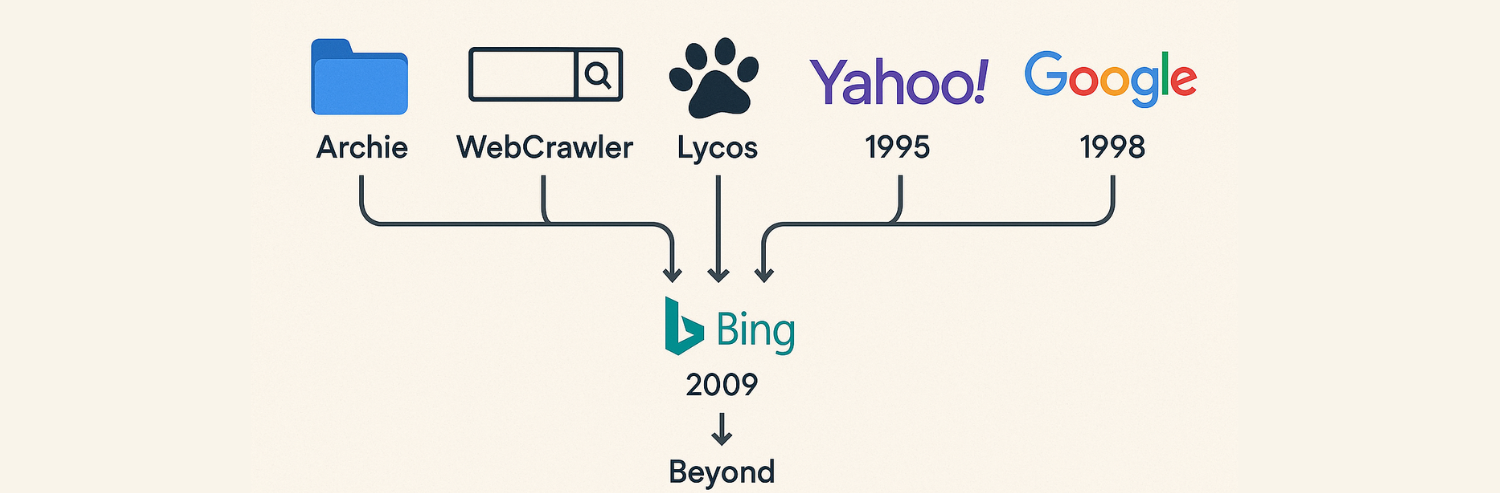
Before we compare today’s search engines, it’s worth looking back at how search engines evolved. This historical context will give you an appreciation for the technology’s rapid advancement and why Google became so dominant.
The concept of searching digital information predates the web itself. In the late 1980s, as the Internet was growing, simple search tools emerged:
- 1989-1990 – Early Days: The first well-documented search engine was Archie, created in 1990 to search FTP files (a way of storing files online). Its name, “Archie,” is actually “archive” without the “v”. It would download directory listings of files on FTP servers and let users search for file names.
- 1993 – The Web’s First Search Engines: The World Wide Web as we know it was born in the early 90s. Initially, lists of websites were maintained manually (Tim Berners-Lee himself kept a list of websites at CERN). But as the web grew, that wasn’t feasible. In 1993, several landmark search projects came about.
- Mid-1990s – Explosion of Search Engines: By 1994-1995, as more people got online, numerous new search engines emerged. WebCrawler, Lycos, Infoseek, Excite, AltaVista, Yahoo! (though Yahoo began as a human-curated directory, it added search later in 1995), Ask Jeeves (Ask.com) in 1996 – these were some big names.
- 1998 – Google’s Rise: Google was founded in 1998 by Larry Page and Sergey Brin, introducing a game-changing ranking approach called PageRank, which ranked pages based on the quality and number of other pages linking to them, among many different factors. This often produced more relevant results than the keyword-based methods of the time.
- 2000s – Consolidation and Competition: During the 2000s, some early engines faded or were acquired. Yahoo shifted from using Google’s results in 2000-2004 to using its own tech (after acquiring Inktomi and Overture) around 2004, and later to Bing’s tech in 2010. Microsoft entered the market with MSN Search (later rebranded as Live Search, then as Bing in 2009).
- 2010s – Era of Mobile and Features: With the rise of smartphones, searches shifted increasingly to mobile devices. Search engines have adapted by improving local search (since mobile users often search for local information), voice search (with virtual assistants like Siri, Google Assistant, and Cortana allowing spoken queries), and quick answers (Google introduced the Knowledge Graph in 2012 to provide instant information on people, places, and more).
- 2020s – Search Meets AI and New Alternatives: Very recent years have been particularly exciting (and tumultuous) for search. Two big trends: AI-powered search and new players. In 2023, Microsoft made headlines by integrating an AI chatbot (powered by OpenAI’s GPT models) into Bing, called the new Bing with “Copilot” or chat mode.
Today, Google remains the dominant search engine by far, with a market share of around 90% and over 1 trillion searches per year (some estimates put Google’s search count at over 8.5 billion searches per day, combining all its properties).
As of late 2024, Google’s share was ~89-91%, while Bing’s share was around 3-4%, Yahoo’s share was 1-2%, and the share of other engines was each under 1% globally. In certain countries, local players lead (Baidu in China, Yandex in Russia, Naver in South Korea – we’ll mention those soon).
The history of search engines, spanning over 30 years, has evolved from a handful of simple tools to a wild west of numerous competitors, and now possibly into a new era where AI and privacy concerns are reshaping the landscape.
With this background in mind, let’s jump into profiling the top search engines you should know about today, how they compare, and what makes each one unique.
Top Search Engines and Their Features (Google vs. Bing vs. the World)
In this section, we’ll look at the major search engines in use, particularly general-purpose web search engines, since these drive the majority of search traffic. We’ll cover each of the big names – Google, Bing, Yahoo, DuckDuckGo, Brave, Baidu, Yandex, and more – highlighting their strengths, weaknesses, and any special features or focus.
1. Google Search
It’s almost impossible to talk about search engines without starting with Google. Launched in 1998, Google quickly became synonymous with “search” due to its highly relevant results and clean interface. Today, Google is the undisputed market leader in search engines, handling nearly 90-92% of all search queries worldwide. It’s also the world’s most visited website overall.
A. Key Features and Strengths
- Unrivaled Index Size & Speed: Google has an enormous index of web content – billions upon billions of pages. It invests heavily in crawling (Googlebot) and can index new pages very quickly. This means Google often has the most up-to-date and comprehensive coverage of the web (including obscure pages). The search is generally very fast and reliable.
- Advanced Ranking Algorithms: Google’s ranking system (comprising hundreds of algorithms and signals) is extremely sophisticated. It examines everything from the content on a page to the authority of that page or site (as indicated by backlinks and PageRank), to user behavior, and your context (including location and device). Google’s aim is to understand intent – what you really want.
- Rich Results and SERP Features: Google’s results pages are very feature-rich. You don’t just get links – you often see things like:
- Featured Snippets: An answer box at the top for certain questions (e.g., a definition or a quick how-to) extracted from a relevant webpage.
- Knowledge Panels: Information boxes on the right side (on desktop) for popular entities (e.g., a panel with a celebrity’s bio or a company’s info).
- People Also Ask: Expandable questions related to your query.
- Image packs, video carousels, news boxes, local map packs, shopping results, etc., depending on query type.
- Essentially, Google aims to fulfill multiple needs directly on the search page.
- Featured Snippets: An answer box at the top for certain questions (e.g., a definition or a quick how-to) extracted from a relevant webpage.
- Vertical Search Integration: Google has dedicated search verticals, including Google Images, Google News, Google Videos (which also surfaces YouTube results), Google Maps (for local search), Google Scholar, and Google Books, among others.
- Continuous Innovation: Google continually updates its search engine. For instance, it introduced voice search and conversational search capabilities (you can literally ask Google Assistant a question by voice). In 2023-2024, it rolled out AI “Search Generative Experience” (SGE) to provide AI-generated summaries for queries, illustrating how search is evolving.
- Additional Services: Google’s ecosystem (Gmail, Android, Chrome, YouTube, etc.) all feed into making Google Search a central hub. For example, your search history can personalize results (unless you turn that off), and Google’s data on trending searches or user behavior can refine its algorithm.
- Market Share: As noted, Google has about 91% market share as of mid-2024. On mobile devices, its share is often even higher (95%+ in many regions), partly because of Android’s dominance. In some countries, Google is slightly less dominant (e.g., Russia, China, where local players lead), but in most of the world, it remains the top choice.
B. Pros (Why Google is loved)
- Best-in-class relevancy: Most users find that Google consistently provides them with what they’re looking for more often than others. It’s very good with complex queries and natural language.
- Comprehensive results with useful extras: You not only get the link but also quick info (for example, Google will directly show the weather, sports scores, unit conversions, etc. as answers).
- Huge ecosystem: If you use other Google services, search integrates with them (for instance, searching “my flights” on Google will show your upcoming flight info from Gmail). For businesses, Google Search Console and Analytics provide a wealth of data about how your site appears in Google search results.
- Speed and ease of use: The interface is simple (just a search bar on Google’s homepage) and queries return very fast. Google’s autocomplete suggestions and related searches can also help refine queries.
C. Cons (and criticisms of Google)
- Privacy and Data Collection: Google tracks a lot of data about searches (to personalize ads and results). Every search, click, and location – whether you’re signed in or not-is potentially logged. Some users are uncomfortable with the extent of profiling. DuckDuckGo’s popularity, for example, stems from its rejection of this tracking.
- Ads and Commercial Bias: Google’s search results, especially for commercial queries, often show many ads at the top. Sometimes, the first screen on mobile devices might be almost entirely comprised of sponsored results. Businesses usually need to purchase ads to achieve top visibility for lucrative keywords.
- Filter Bubble: Because Google personalizes results to some extent (based on your location, search history, etc.), some argue it can create a “filter bubble” where you mostly see content that aligns with what the algorithm thinks you want, potentially narrowing your exposure. Google has downplayed this impact, but it’s a point of debate.
- Algorithm Opacity: SEO professionals sometimes feel at the mercy of Google’s algorithm updates. Google doesn’t disclose exactly how ranking works (to prevent gaming the system), so when changes happen (like a core update that can shuffle rankings), it can be challenging for site owners who lost visibility.
- Monopoly concerns: With Google so dominant, there’s less competition driving innovation in traditional search. There are ongoing antitrust cases (e.g., the U.S. DOJ case in 2023 accusing Google of monopolistic practices in search). If Google is the default everywhere (Android phones, Apple pays to make Google the default on iPhones, etc.), some worry it stifles competitors.
Still, for most practical purposes, Google is the gold standard. As a business owner or marketer, you must ensure that your site is indexed on Google and ideally optimized for it.
This involves utilizing tools like Google Search Console to monitor your online presence, adhering to Google’s SEO guidelines, and potentially running Google Ads to achieve immediate visibility.
2. Microsoft Bing
Bing is Microsoft’s search engine, launched in 2009 (rebranding and upgrading their previous Live Search/MSN Search).
While Bing’s global market share is small compared to Google (around 3–4% globally in 2024), it is the second most-used search engine worldwide and has a significant presence on desktop searches, especially in North America.
Bing also powers other search engines: notably Yahoo Search (since a deal in 2010) and the search functions of AOL and some smaller players, meaning Bing’s index actually underlies a larger portion of searches than it appears at first glance.
A. Key Features and Strengths
- Visual Search and Rich Media: Bing has long touted its strength in image and video search. Its image search is very user-friendly, featuring advanced filters (such as layout and color) and a visually appealing interface. Bing also pioneered features such as endless scroll in image search and image recognition, allowing users to search by image (similar to Google Lens functionality).
- Integration with Windows and Office: Bing is deeply integrated into Windows PCs (the search bar in Windows 10/11 uses Bing for web results, and Cortana voice assistant uses Bing). It’s also the default engine in Microsoft’s Edge browser. This ecosystem integration means many users end up using Bing by default, especially on desktop.
- Microsoft Bing “Copilot” (AI integration): In early 2023, Bing made a splash by integrating a GPT-4-powered chat mode. Accessible via the Edge browser or the Bing site, Bing AI Chat (sometimes referred to as Bing Copilot) can conversationally answer complex questions, complete with citations to sources.
- Rewards Program: Bing Rewards (now called Microsoft Rewards) is a unique perk – users earn points for searches, which can be redeemed for gift cards, donations, etc.. This incentive, while not huge, has drawn some users to use Bing more regularly (“Why not get points for searching?”).
- Different Search Results: Bing’s search algorithm often yields slightly different results than Google for the same query. Sometimes Bing surfaces content that Google doesn’t, and vice versa. For instance, Bing has been observed to be a bit more lenient with showing unofficial content (like some piracy or torrent links, which Google tends to suppress aggressively).
- Layout and Features: Bing’s homepage is famous for its daily changing background image (often beautiful photography). On the results page, Bing also has its own version of instant answers and knowledge graphs (called Knowledge Panels or Snapshots).
- Privacy controls: While Bing is not a “private search engine” (Microsoft does collect search data, especially if tied to your Microsoft account), it must comply with GDPR and other relevant regulations. Microsoft states that it doesn’t use any personal data from corporate customers for advertising purposes, and it allows users to opt out of personalized ads.
Market Niche and Performance: As of 2024, Bing’s global share is around 3.5% on desktop and a bit less on mobile (since most mobile devices default to Google, except some Windows phones, which are rare now).
However, in the United States, Bing (including Yahoo searches it powers) can account for more like 6–7% of search engine market share, and on desktop specifically, it can be 10–15% in some reports.
B. Pros of Bing
- Diversified results and algorithm: As mentioned, Bing may display different or reordered results. For a user, Bing occasionally finds something that Google missed (especially if Google heavily demotes a site for spam reasons and the user wanted that site).
- Better for certain media queries: Some users find Bing’s image search superior in UX. Bing also offers specialty searches, such as Bing Maps and Bing Travel, each with its unique features.
- The AI edge: Currently, Bing’s integration of OpenAI technology means it offers something Google’s leading search engine doesn’t (yet): an integrated chat mode that can synthesize information with references.
- Rewards and Microsoft integration: If you’re heavily invested in the Microsoft ecosystem (Xbox, Windows, Office 365), using Bing and Edge can feel cohesive. Rewards for giving points back are a nice perk.
- Ad network reach: From an advertiser’s perspective, advertising on Bing (via Microsoft Advertising) not only reaches Bing but also Yahoo and other partners. While smaller than Google Ads, competition on some keywords is less fierce, which can result in better ROI in some instances.
C. Cons of Bing
- Lower index size: Bing’s index, while huge, is not as extensive as Google’s. There are niche or less popular websites that Google might index, but Bing might not. Webmasters sometimes notice that Bing doesn’t crawl their site as deeply unless it’s a popular one.
- Relevancy gap (perception): Many users historically felt Bing’s results were “not as good” as Google’s for their queries. This gap has narrowed significantly in the last decade – blind tests have shown that Bing can match Google on many queries – but the perception persists.
- Less innovation until recently: Before AI integration, Bing was often perceived as a follower rather than an innovator in search. It introduced some features, but many were catching up to Google. That changed with the introduction of AI chat – now Bing is leading in this area.
- Global presence: Outside Western countries, Bing is not widely used. If your target audience is, say, in Europe or India, Google is still the primary choice. In China, Bing has a small presence (and some censorship to comply with regulations).
For SEO beginners and business owners, the advice is usually: focus on Google (because that’s where most of your traffic will come from), but don’t ignore Bing. The good news is, basic best practices (quality content, technical soundness) often help both.
However, a smart move is to also use Bing Webmaster Tools (just like Google Search Console). By verifying your site there, you can see how your site performs on Bing, submit sitemaps, and gain valuable insights. Bing Webmaster Tools even offers SEO analysis and keyword reports.
3. Yahoo! Search

Yahoo was one of the early pioneers in the web directory and search space – founded in 1994, it was the portal and search engine many used in the late 1990s and early 2000s.
While Yahoo’s independent search technology took a backseat, the brand remains a search destination for some users. As of the mid-2020s, Yahoo Search is essentially powered by Bing’s search index and algorithm.
So, one might ask, why mention Yahoo separately? The reason is that Yahoo is still the 3rd largest search engine globally in terms of user preference (at around ~1-2% market share), and some people continue to use Yahoo.com for searching out of habit or because it’s the default in specific setups.
A. Key points about Yahoo Search
- Powered by Bing: Since 2010, Yahoo and Microsoft have had agreements that made Bing the underlying engine for Yahoo Search. There was a period where Yahoo experimented with using Google for some searches (around 2015 under a Yahoo-Google deal), but that didn’t last.
- Yahoo-specific enhancements: Yahoo used to have its search features like Yahoo Answers (community Q&A) and Yahoo’s directory, but most of those have been shut down (Yahoo Answers shut down in 2021).
- Popularity: Yahoo remains popular in Japan – interestingly, Yahoo Japan is a separate company and licensed entity, and until recently, it used Google’s search engine. So Yahoo is a bit fragmented. In the U.S., Yahoo’s share is small but not negligible (especially when combined with Bing’s figures).
- Portal aspect: Many users coming to Yahoo Search are engaging with Yahoo’s homepage or other services (mail, news). So, Yahoo captures users within its ecosystem and keeps them engaged with relevant content. From an advertiser’s perspective, if you run a Microsoft Ads campaign, your ads might show on Yahoo Search as part of the Bing Network.
B. Pros of Yahoo (as a search option for users)
- Familiar brand & interface: Some people trust Yahoo because they’ve used it for decades. The results from Bing are behind the scenes; on the front end, they see Yahoo’s layout, which they might prefer.
- Integrated content: If you’re already on Yahoo reading news or checking your Yahoo Mail, using the same site’s search is convenient. Yahoo’s front page often has trending topics that can prompt searches.
- Additional Yahoo services: Searching for specific topics on Yahoo may yield Yahoo-specific content (for example, a finance query might display a small chart or link to Yahoo Finance, a leading financial information site).
- Privacy is similar to Bing’s: Yahoo will track your searches and serve ads, similar to Bing. There’s no special privacy advantage here, except that Yahoo did offer a “Yahoo Search Premium” in Japan, which provided an ad-free search experience for a subscription fee, but that’s a niche offering.
C. Cons of Yahoo
- Not truly independent: Yahoo’s results are only as good as Bing’s results. If Bing has a weakness in some area, Yahoo does too. In a sense, Yahoo lost its identity in search – it’s a re-skin of Bing in many ways.
- Fewer unique features now: Yahoo used to have cool, unique search features (in the early 2000s, it had a really advanced news search and Yahoo Answers, which sometimes would appear for queries).
- Ads and busy portal: The Yahoo search results pages can be a bit busier (including potentially more ads or graphics from the portal content). Some users might find it a cluttered experience compared to Google’s simplicity.
For business owners/marketers: Ensure you’re accounting for Yahoo by default when you do Bing optimization. If you’re running ads on Bing, you’re covering Yahoo.
There’s no separate submission needed for Yahoo anymore – just get indexed on Bing, and you’ll appear on Yahoo Search too. One thing to consider: specific demographics (like an older audience) might still have Yahoo as their homepage.
4. DuckDuckGo

DuckDuckGo (DDG) is a search engine that has gained a loyal following by championing privacy. Founded in 2008, DuckDuckGo’s hallmark is that it does not track users – no storing of personal information, no search history profile, and minimal cookies, among other measures.
Their motto is “Privacy, simplified.” This resonates with users who are uncomfortable with the amount of data Google and others collect.
DuckDuckGo’s approach to search is interesting: it’s built on multiple sources. It doesn’t primarily crawl the web itself (on a large scale) but rather aggregates results from Bing (which is a major provider), Apple (for maps), Yandex (for some international results), its own crawler (the DuckDuckBot, which is limited) and other partners like Wikipedia for instant answers.
A. Key Features of DuckDuckGo
- Privacy Focus: DuckDuckGo does not save your searches or link them to a personal profile. It serves the same results to everyone for a given query (no personalization). It also forces an encrypted connection and doesn’t use tracking cookies.
- “No Filter Bubble”: Since DDG doesn’t personalize, some users prefer it to escape the “filter bubble” they fear on Google. You get a more unbiased view of results.
- Simple Interface & Instant Answers: DuckDuckGo’s interface is clean and minimal, similar to Google’s but without the extra frills. It has its own version of Instant Answers (they call them *!bangs and Instant Answers).
- Bangs (!bang syntax): One of DuckDuckGo’s most beloved features is the bangs. By typing an exclamation mark followed by a shortcut, you can search directly on other sites. For instance, !w Python searches Wikipedia for “Python”, !a laptops takes you to Amazon search for “laptops”. There are thousands of these bangs (for YouTube, Reddit, almost any major site).
- Growing Market Share (especially in mobile browsers): As of 2025, DuckDuckGo’s overall search market share remains under 1-2%, but it has been steadily growing. In the US, it accounted for approximately 2.07% of the search market in early 2025. That may sound small, but consider it was near zero a decade ago. DuckDuckGo serves over 100 million searches per day on average as of late 2023/2024, which shows real usage.
- Monetization without tracking: DuckDuckGo generates revenue through advertising, but it’s done in a contextually relevant manner. They show ads based on your current search term (like a search for “car insurance” might show an ad for insurance, just like Google would) – but they don’t store who you are or what else you searched.
B. Pros of DuckDuckGo
- Privacy and Anonymity: The biggest selling point – you can search with peace of mind that you’re not being profiled. There are no creepy ads following you around based on something you searched.
- Clean, uncluttered results: DuckDuckGo’s results pages are relatively clean, with fewer aggressive ads than Google (usually just a couple at the top and bottom). Many users find the experience calmer.
- Consistent results: Since results aren’t personalized, if two people search the same thing, they get the same results, which can be useful for collaboration or just knowing you’re not missing something due to personalization.
- Bangs and goodies: The bang shortcuts are genuinely useful for power users. Additionally, DuckDuckGo offers helpful instant answers, such as generating strong passwords (e.g., “password 12” will generate a 12-character password). Go directly to a site’s search.
- Community trust: DuckDuckGo has built a brand around being the “ethical” search engine. This goodwill means its user base often evangelizes it.
C. Cons of DuckDuckGo
- Reliance on Bing (and others): Because DuckDuckGo pulls a lot from Bing’s index, sometimes if Bing’s results are weaker for a query, so are DuckDuckGo’s. Also, if Bing doesn’t have a page indexed, neither will DuckDuckGo. However, DuckDuckGo does have its own crawler to supplement and claims to use “over 400” sources, including Bing, Yandex, Yahoo, Wikipedia, etc.
- Less Personalised or Smart: Some users miss Google’s personalisation – for instance, Google might know you often click on StackOverflow for coding answers and rank those higher for you. DuckDuckGo will show a more general order.
- Fewer advanced capabilities: Google has tons of specialised features and integrations (like searching by voice, AR search in some cases, Google Lens for images, etc.). DuckDuckGo’s feature set is more limited.
- Smaller ecosystem: DuckDuckGo is mainly just a search (and a simple browser). They don’t have the expansive ecosystem of maps, email, etc. (They do partner with Apple for maps and have directions, but it’s not as seamless as Google’s map integration).
- Perception of result quality: For many queries, DuckDuckGo works well (especially for common, straightforward ones). But for some very niche or technical searches, some users feel they eventually need to “!g” (bang Google) to get the best result.
Overall, DuckDuckGo is an excellent alternative search engine for those who value privacy and want to avoid Google and Bing’s tracking apparatus. It’s easy to try out – no need to install anything; go to duckduckgo.com (or set it as your default search engine in your browser). For SEO and marketing purposes, note that if your site is indexed on Bing, it will also appear on DuckDuckGo.
One tip: If you have a privacy-oriented product or content, consider advertising on DuckDuckGo via Microsoft Ads, targeting the DuckDuckGo placement specifically. You might find an appreciative audience there, since DuckDuckGo users may respond well to ads that align with their values (DuckDuckGo only shows a few ads, so a good ad can stand out).
5. Brave Search

Brave Search is a relatively new player, launched by Brave (the company known for its privacy-focused Brave Browser) in 2021. Despite being new, Brave Search is noteworthy because it set out to create an independent search index from scratch, aiming for both privacy and independence from Major Tech Companies.
By 2023, Brave Search announced it had achieved 100% independence, meaning it is no longer relying on third-party indexes like Google or Bing for its results.
A. Key Features of Brave Search
- Independence: Unlike DuckDuckGo, which relies on Bing, Brave Search crawls the web itself to build its own index. It emphasizes that it’s not using Google or Bing behind the scenes, which is a significant advantage for diversification.
- Privacy: Brave Search, like their browser, is privacy-first. They don’t track your searches or create a profile. It’s an anonymous search like DuckDuckGo. They also don’t have ads (for now), or they have an ad-free experience by default during the beta period.
- Transparency and Community Ranking: Brave has introduced something called Goggles – an experimental feature that allows the community to create custom ranking criteria. For example, you could apply a “Tech Blogs Only” goggles that will alter search results to prioritise a set of tech sites, or an “open source forums” goggles, etc.
- Integrated in Brave Browser: If you use Brave Browser, Brave Search is the default engine there. This has helped it gain users (Brave Browser has millions of users, and many have stuck with the default Brave Search).
- Growth: Brave Search surpassed 1 billion queries by 2022 and has continued to grow steadily since then. It reportedly served 1.19 billion queries in December 2024 alone, indicating a significant increase. It’s still small in market share globally (<1%), but it’s one of the fastest-growing alternatives.
- Unique Features: Brave Search currently has a fairly straightforward interface (inspired by Google’s simplicity). It provides instant answers for some things using its own or third-party APIs (such as summaries and calculators), but these features are still in development.
- No censorship or neutrality: Brave claims to be more neutral and resistant to censorship. They aren’t subject to the same pressures as, say, Google, which in some countries is required to censor its results. Brave can run from outside such jurisdictions. However, Brave does have to handle spam and ranking quality, so neutrality doesn’t mean showing everything.
B. Pros of Brave Search
- Independent index (Diversification): Using Brave contributes to breaking the Google/Bing duopoly on indexes. If you want an internet with more than two core search indexes, supporting Brave Search helps.
- Strong privacy: Like DuckDuckGo, Brave doesn’t track you. And Brave, being the browser maker, ensures that if you use their browser, the entire pipeline (browser + search) is privacy-by-default.
- Innovation in ranking: The Goggles feature, and potentially other community integrations, could enable specialized search experiences.
- Integrated tools: Brave is building an ecosystem (browser, search, even a news reader). Using Brave Search in Brave Browser feels seamless and fast. They also have a discussion feature that automatically shows relevant user discussions from sites like Reddit in your results, which is neat if you want to see what people are saying about a topic.
- Ad-free (as of now): Currently, Brave Search is mostly ad-free, providing a refreshing experience. It’s likely to introduce ads later, but possibly in a privacy-preserving manner (Brave is known for experimenting with private ad models in its browser).
- Transparency: Brave has been relatively transparent about the percentage of results coming from their index vs others (which started high but is now at 100%). They also have a public community forum where users can give feedback on search quality.
C. Cons of Brave Search
- New, so still improving index: Brave’s index is young, so there may be gaps. Especially for obscure queries or very recent content, it might not have it or rank it well yet. Google and Bing have a decades-long head start in crawling and ranking signals (backlinks, etc.)
- Features not fully mature: It may lack some of the convenience features users expect. For instance, Google has one-boxes for flights, unit conversions, song lyrics, etc. Brave might not have all those answer boxes or as much local business info yet. It did partner to have some local results and maps (via OpenStreetMap and others), but it’s not as fleshed out as Google/Bing maps integration.
- Minimal personalisation: Currently, Brave Search, like other privacy engines, doesn’t personalise (although the Brave browser itself can learn your interests locally for particular features). So again, no personalisation might be a con for some who like tailored results.
- Small market share: If you’re thinking as a business, Brave Search traffic is minimal compared to Google. It may not yet be reflected significantly in your analytics. But it could grow, so early adopters keep an eye on it.
- Lack of verticals: If you want image search, Brave Search does offer it, but it may still rely partly on Bing for that (the independence of their image index is unclear). They do have an “Images” tab and a “Video” tab. However, specialised things like news search and shopping search are not yet separate products.
- Brand unknown to mainstream: Outside tech circles, Brave is not a household name like Google or even DuckDuckGo. So, converting average users will be a challenge (Brave Browser’s users are a funnel, but beyond that, people have to trust a newer engine).
Brave Search’s arrival is exciting for the search industry because it signals potentially renewed competition and innovation. For SEO and marketers, there is currently no dedicated Brave Search console or equivalent.
The best you can do is ensure your site is accessible to Brave’s crawler (BraveBot). BraveBot respects robots.txt and crawls in a manner similar to other bots. If you’re visible on the web and have some links, Brave will likely pick you up promptly.
6. Other Notable Search Engines (e.g., Baidu, Yandex)
So far, we’ve covered search engines primarily in the English-speaking or global context. However, it’s worth noting a few international search engines that dominate specific regions, as well as some niche engines:
- Baidu: Often called “China’s Google,” Baidu is the largest search engine in China (where Google is blocked). Baidu has about 57-72% of the Chinese search market, depending on the source, and globally it accounts for around 0.5-1% of searches (because China’s huge population, but much of that isn’t counted in global stats due to the firewall). Baidu’s services include maps, music, and even an encyclopedia (Baidu Baike).
- Yandex: Known as “Russia’s Google,” Yandex is the leading search engine in Russia (though Google also has a presence there). Yandex had a share of approximately 68-74% in Russia as of mid-2024. Globally, it’s small (~<1%). Yandex is more than just a search engine; it’s a major tech company offering services such as email, maps, and a taxi service (similar to Uber), among others. For Russian-language content or in Russia, Belarus, or Kazakhstan, Yandex is a key player.
- Naver: In South Korea, Naver is a dominant search engine and portal, often outpacing Google in local usage. Naver is like a portal with curated sections, Q&A (Knowledge iN), etc. It had a roughly 42-58% share of the Korean search market (statistics vary, with one source citing 47% in 2025). Naver’s search results page is very different: it’s split into sections (like ads, then Naver’s own curated content, then web results way down).
- Ecosia: A special mention – Ecosia is a search engine that uses Bing’s results but promises to use its ad revenue to plant trees. It’s basically a Bing-powered engine with a green mission. It has gained some popularity among environmentally conscious users. It’s smaller, but notable as a cause-driven engine.
- MetaGer, Qwant, and others: In Europe, several privacy-focused search engines are available, including Qwant (a France-based engine that utilises Bing and its indexing for French sites) and MetaGer (a German metasearch engine). Swisscows (based in Switzerland) focuses on family-friendly results and privacy, using Bing plus its own index for German content. Startpage (Netherlands-based)- as we mentioned – delivers Google results privately.
- Ask.com: Once a big name (Ask Jeeves), it pivoted to Q&A and then basically faded. Now, Ask.com results are also syndicated from another engine (I believe from Google or another). It’s no longer a major player, but the brand still exists as a website.
- Internet Archive’s search: We discussed the Wayback Machine, which isn’t a general search, but is used for historical content.
Specialty engines for specific content: Some examples:- WolframAlpha: Not a web search, but a “computational knowledge engine” – it directly computes answers (good for math, science, facts). Often, even Google will show Wolfram Alpha results for specific queries. It’s vertical in a sense (for factual calculations).
- LinkedIn search: As described, it’s vertical for jobs and people. Mentioned in SEJ that LinkedIn is being used as a search engine for business networking. For businesses, that means optimising your LinkedIn Page so you appear in LinkedIn’s search results (different from web SEO).
- Reddit search / Social searches: People often use site-specific searches for forums or social media. For instance, many tech-savvy users will go to Reddit and use its search function (or Google with the site:reddit.com query) to find authentic user discussions. Recognising this, Google even surfaces Reddit posts high for many queries. However, within Reddit, their search engine (once underdeveloped, but now improved) is how you find threads.
- Travel & e-commerce: As touched on, Amazon’s search algorithm (A9) is crucial for product sellers, and travel sites (like Booking.com or TripAdvisor’s search within the site) are essential if in that industry.
- WolframAlpha: Not a web search, but a “computational knowledge engine” – it directly computes answers (good for math, science, facts). Often, even Google will show Wolfram Alpha results for specific queries. It’s vertical in a sense (for factual calculations).
In summary, the “top search engines” globally in usage are: Google (by a considerable margin), followed by Bing (including Yahoo and others it powers), then perhaps Baidu (due to China), then Yahoo (if counted separate but effectively Bing), Yandex (in Russia), DuckDuckGo, and Naver. Each has its domain of strength.
For a marketer or SEO beginner, the key takeaway is: know your audience and region. If you’re primarily targeting the U.S. or global markets, focus on Google (and some Bing).
If targeting Russia, Yandex SEO is a whole discipline (with Yandex webmaster and their rules). China – you’d focus on Baidu SEO (and possibly Shenma, a mobile search engine by Alibaba, which has some market share).
Also, keep an eye on upstart engines like Brave and the enduring interest in private search (e.g., DDG), as they represent both potential traffic sources and shifting user sentiment regarding search.
To wrap up this section, let’s do a quick comparison table summarising some key points about the major search engines we’ve discussed:
Table: Overview of Notable Search Engines and Their Characteristics
| Search Engine | Type / Index | Key Features | Primary Audience / Region |
| Own index (Googlebot) | Most comprehensive index; advanced AI ranking; extensive SERP features (snippets, knowledge panels); dominates global market (≈90%). | Global (the world’s most widely used); all audiences. | |
| Bing | Own index (Bingbot) | Strong multimedia search; powers Yahoo, AOL, DuckDuckGo (partial); integrating GPT-4 AI chat (Copilot); rewards program. | Primarily US & Western markets; Windows/Edge users. |
| Yahoo! | Powered by Bing | Portal experience (news, etc.) with Bing search results; familiar brand. | US & Japan: users of Yahoo portal services. |
| DuckDuckGo | Metasearch (Bing + others) | Privacy, no-tracking search; same results for everyone; “bang” shortcuts for site-specific searches. | Privacy-conscious users globally (notably the US, Europe). |
| Brave Search | Own index (since 2023) | Independent index with focus on privacy; community ranking (Goggles); integrated with Brave browser. | Tech-savvy and privacy-focused users (growing globally). |
| Baidu | Own index (Chinese web) | Dominant in China (Chinese language); local laws censor services like maps and Baike. | China (not much outside use). |
| Yandex | Own index (Russian & multi-lang) | Dominant in Russia, offering a wide range of services (mail, taxi, etc.); handles Cyrillic and Russian contexts effectively. | Russia, CIS countries (also Turkey to some extent). |
| Naver | Own ecosystem (Korean web) | Portal with curated content; Naver-owned pages are often prioritised; unique SERP layout. | South Korea. |
| Startpage | Metasearch (Google results) | Google results delivered with complete privacy, no tracking; the user can customise the theme. | Privacy-focused users who prefer Google-quality results (mainly Europe/US). |
| Ecosia | Metasearch (Bing results) | Eco-friendly – uses ad revenue to plant trees; transparent financial reports of tree planting. | Environmentally conscious users (Europe, etc.). |
| Ask.com | Own content + Google/Bing | Originally Q&A focused (“Ask Jeeves”); now mostly syndicated results plus some news. | Diminished usage among some US and UK users. |
| WolframAlpha | Computational engine (own DB) | Directly computes answers (math, science, facts) rather than indexing web pages; used by Siri and others for factual queries. | Students and professionals need calculations or data. |
| Wayback Machine (Archive) | Archival search (own DB) | Searches historical web pages and archived content; not a current web search but a time-capsule search. | Researchers, historians, and curious users are checking old sites. |
(This table provides a simplified snapshot; many engines also offer additional features and have nuanced differences in their algorithms.)
Now that we have covered the major players and types of search engines, let’s shift perspective a bit and discuss how all this knowledge applies to you, whether you’re a beginner in SEO, a marketing professional, or a business owner looking to leverage search engines to reach your audience.
Why Search Engines Matter for Your Business and SEO Strategy

By now, it’s clear that search engines are a primary means by which people find information and make decisions online. For business owners and marketers, mastering search engines – both how they work and how to optimise for them – is crucial for online success.
Here’s why and how you can apply the insights from this guide:
- The primary source of web traffic is often organic search (people finding your site via a search engine result), which is the largest source of traffic for websites, outpacing direct visits and social media referrals for many.
- SEO (Search Engine Optimisation) is Key Marketing: SEO is the practice of improving your site’s visibility in search results. Since Google dominates, SEO has traditionally meant aligning with Google’s guidelines – including mobile-friendly design, relevant keywords in content, fast site speed, and quality backlinks, among others.
- Paid Search (SEM): Apart from organic results, search engines offer advertising platforms (Google Ads, Microsoft Ads for Bing/Yahoo). Many businesses invest in pay-per-click ads to appear at the top of search engine results pages for specific keywords. This is search engine marketing (SEM). It can be costly but effective for immediate visibility while you grow your organic ranking.
- Local Search & Maps: If you have a regional or brick-and-mortar business, search engines are critical for local discovery. Google’s local pack (the map and 3 results that show when someone searches “near me” or a service in their area) is prime real estate. Ensure you have a Google Business Profile listing so that you appear on Google Maps and in local search results.
- Vertical Search Optimization: Depending on your niche, you may need to optimize beyond just web results. For example, if you do video marketing, you must consider YouTube SEO (since YouTube is effectively a search engine for videos and is owned by Google, so its results often appear in Google searches too). If you’re in e-commerce, Amazon SEO is a thing (making your product rank higher on Amazon’s search).
- Content Strategy & SERP Features: Knowing how search engines present information helps tailor your content. For instance, Google often shows a snippet from a page as an answer (featured snippet). Suppose you structure your content well (with clear definitions, a Q&A format, and the use of schema markup). In that case, you increase your chances of being featured as the answer, which can significantly boost clicks and brand visibility.
- User Trust and Preference: Many users implicitly trust search engines to provide them with credible results. Ranking on the first page can lend your business credibility in users’ eyes (“if Google puts it top, it must be good”). There’s also a lot of user preference around search engines; some tech-savvy users might only use DuckDuckGo or Brave – if that aligns with your brand (e.g., you run a privacy-focused product), make sure you’re visible on those engines and perhaps even advertise there.
- Staying Updated with Trends: The search landscape isn’t static. It’s vital to keep up with changes, like Google’s algorithm updates (which can dramatically affect your rankings) and new features (e.g., Google’s AI snapshots might mean fewer clicks to your site, so you adapt by providing content that still draws users in). Also, monitor the growth of alternatives: if Bing’s AI helps it gain market share, or if Apple ever launches its search engine (rumours exist), you’ll want to diversify your optimization.
- Webmaster Tools: Utilise the free tools that search engines provide. Google Search Console gives insight into how Google sees your site (indexing issues, what queries you show up for, etc.). Bing Webmaster Tools does the same for Bing/Yahoo (and indirectly DuckDuckGo, as it uses Bing’s data). Yandex and Baidu have their webmaster portals for those markets.
- User Experience & Technical Health: Search engines increasingly emphasise good user experience – that means fast-loading sites, mobile-friendly design, secure (HTTPS) connections, and content that satisfies the user’s query (as evidenced by them not bouncing back to search results). Google’s algorithms (through Core Web Vitals, etc.)
- Multi-Platform Strategy: Beyond just web search, consider search on social media. For instance, hashtags or keywords on Instagram or TikTok (they have search functionality, and many young users use TikTok like a search engine for trends or how-to content). Ensure your brand content is discoverable there too.
In essence, search engines connect you with your potential audience at the exact moment they express a need or question. By understanding how they work and the landscape of options, you can tailor your online presence to be there as an answer.
Next, we will look ahead at where search engines are going – the emerging trends and innovations that could further change how people search and how businesses optimise.
This is important because the strategies that worked five years ago might not suffice five years from now (consider the rise of voice assistants or AI-powered answers).
Trends and Innovations Shaping the Future of Search Engines

Search engines have evolved significantly from simple keyword matchers to AI-powered answer engines. The evolution isn’t stopping, it’s accelerating.
Here are some significant trends and emerging innovations in the search engine world, and what they mean for users and content creators:
1. AI-Powered Search & Chatbots
Perhaps the most significant wave right now is the incorporation of artificial intelligence (huge language models, LLMs) into search:
- Generative AI Answers: Google and Bing have both introduced features that allow AI to summarize information for you at the top of search results. For example, Google’s Search Generative Experience (SGE) can generate an AI-driven overview of a topic or answer, drawing from multiple sources. Bing’s AI chat will directly answer your question in detail, citing sources.
- Chatbot Search Companions: The integration of chatbots (like OpenAI’s ChatGPT technology) allows users to have a conversation with search. Instead of typing separate queries and scanning results, you can ask follow-ups in natural language. Bing’s ChatGPT-powered mode allows for multi-turn conversations. Google’s Bard and future Gemini AI aim to achieve similar goals. This is transformative – it provides an interactive experience.
- Implications: If AI is answering questions, users may click fewer traditional links because they can find what they need directly on the SERP itself. This trend of “zero-click searches” (which was already an issue with featured snippets and knowledge panels) may intensify. For content creators, it means optimising to be the source the AI cites (ensuring your content is high-authority and easy for AI to parse).
- Personal AI Assistants: Beyond web search, personal assistants (Siri, Google Assistant, Alexa) use search under the hood. As these AIs become more sophisticated, an increasing number of users may rely on voice or chat interactions. Already, about 20-30% of the population uses voice search regularly. Questions like “Hey Alexa, who offers the best car insurance near me?” blend local search with AI. Ensuring your business information is structured (schema, up-to-date listings) helps you get picked by these assistants.
2. Voice and Conversational Search
Voice search deserves separate emphasis. With the proliferation of smart speakers and voice assistants on phones and cars:
- Growth of Voice Queries: A significant number of queries are spoken. These queries are often longer and in natural language (e.g., “what’s the weather tomorrow in Chicago?” vs. a typed “weather Chicago tomorrow”). Search engines have adapted by improving natural language understanding. Google’s Hummingbird and BERT updates were about grasping context, which helps both text and voice
- Local and Instant Needs: Many voice searches are local (“Find a coffee shop near me”) or simple Questions and Answers (“How tall is the Eiffel Tower?”). For businesses, this means optimising for local voice search (ensuring your Google Business listing has common voice query keywords like “open now, offers takeout”, etc.).
- Screenless Challenges: On a smart speaker, there’s no screen to display ten options; the assistant provides one result or perhaps reads a snippet. This means if you’re not that #1 result (or a preferred data source), you get zero visibility. Search engines often draw answers from sources such as Wikipedia, official websites, or top-ranking pages.
- Conversational Continues: Voice and AI overlap: e.g., you ask one question, then a follow-up (“Alexa, how about tomorrow?” referring to weather). The system has context now. Search is becoming more conversational even outside explicit chat modes. Google’s algorithms try to carry context from previous queries in a session to serve you better.
3. Visual Search and Multimodal Search
We’re seeing search go beyond text:
- Image Search & Recognition: Google Lens, introduced a few years back, allows you to search using your phone’s camera or an image – for example, take a picture of a plant to identify it, or of a product to find where to buy it. Bing also has visual search (and even a new image creator AI as part of Bing). This is visual search. For e-commerce, this is big – users might snap a photo of a cool chair, and search engines show similar chairs for sale
- Multimodal Search: Google is working on “Multisearch,” which allows you to combine text and images. E.g., take a photo of a dress and type “in red colour”, and it finds similar dresses in red. This type of search means that content should be machine-readable in multiple ways (both visual content and descriptive text are essential). AI can now “see” images (via computer vision) and read text, then combine understanding.
- AR Search: Augmented reality might play a role, such as searching in AR for information about what you’re looking at (Google Lens already does translation by overlaying text on the real world through your camera). Imagine walking down a street, pointing your phone camera at a restaurant, and getting search results (reviews, etc.) on
4. Continued Emphasis on User Experience & Core Web Vitals
Search engines are increasingly ranking sites based not only on relevance, but also on user experience metrics. Google introduced Core Web Vitals (including loading speed, interactivity, and visual stability metrics) as ranking factors in 2021. If your site is sluggish or has annoying pop-ups, it can negatively impact your rankings.
- Mobile-First & Page Experience: Google employs a mobile-first indexing approach, utilizing your site’s mobile version for indexing and ranking. Ensure your mobile site is fully functional and not pared down in content. Additionally, page experience (including HTTPS, no intrusive interstitials, etc.) is also essential.
- Zero Results for Simple Queries: For very straightforward queries (such as “100 USD in EUR” or “time in Tokyo”), Google sometimes displays the answer without showing any other results. They experimented with this for a bit. While they rolled it back for most cases (because sometimes people did want to see sources), it demonstrates an intent to provide answers faster to users for simple needs.
- No-Click SERPs: Already more than half of searches on Google end without a click to any external site (because the user got the info on Google’s page, via answers, maps, etc.). That trend could rise with AI answers. To cope, sites might need to focus on queries where people want more detail than a snippet can provide, or offer tools and interactive content that search engines can’t directly answer (such as calculators and quizzes that prompt a click).
- First-Party Content & Walled Gardens: Google and Bing are increasingly trying to keep users within their ecosystems (e.g., Google’s own travel booking modules or job listings that keep users on Google). For a business, this means that sometimes you should participate in these initiatives if they are beneficial (such as using Google’s Local Service Ads, which show up as vetted providers, or ensuring your job postings are properly marked up so they appear in Google for Jobs).
5. Personalisation vs. Privacy
There’s a dual trend: search engines want to personalise more (to improve relevance), but users and regulators push for privacy.
- Personalisation and Context: Google uses your location, search history, and click data, among other factors, to subtly reorder results it thinks you’ll prefer (though it claims this is mainly for purposes such as local results or disambiguation). Bing does the same thing if you’re logged in with a Microsoft account.
- Privacy Tools and Legislation: On the other hand, laws like the GDPR and movements such as the ban on tracking cookies are also affecting search. Google is phasing out third-party cookies (not directly a search issue, more ads, but still). Engines like DuckDuckGo thrive on the backlash to data harvesting.
- Transparency: Expect search engines to provide users with more transparency and control, such as Google’s “Why this result?” feature, which reveals factors contributing to a page’s ranking (e.g., matching keywords). They might expand that to reassure users about the unbiased nature of their algorithms. Additionally, there is discussion about watermarking AI-generated content, which could be relevant if search engines begin to distinguish between them.
6. Vertical Integration and Specialised Search Growth
While Google and Bing try to be everything, user behaviour sometimes shifts to verticals:
- Amazon as Search: Already, more product searches start on Amazon than on Google for some categories. This trend of going straight to specialised platforms can continue (e.g., searching for jobs on LinkedIn or Indeed instead of Google). Search engines might respond by better indexing those verticals or partnering.
- Social Search: With TikTok’s rise, interestingly, Gen Z sometimes uses TikTok or Instagram to search for things (like fashion ideas, restaurant reviews). Google acknowledged this trend and is trying to incorporate more social media content (they sometimes show TikTok or Instagram videos for some searches, or forum discussions via the “Discussions” feature in Google, similar to Brave’s concept).
- Question-Answer Platforms: Google has its ‘People Also Ask,’ but there are also Quora, Stack Exchange, Reddit, etc. People often search for answers to questions and end up on these platforms. Google recognises that – usually prioritising Stack Overflow for a programming query or a Quora thread for a subjective question.
7. Search Engine Alternatives and Decentralisation
- Decentralised Search: There are small movements, such as YaCy (a peer-to-peer search index shared by users) or Presearch (a blockchain-based search that rewards users with cryptocurrency for searching). These are not mainstream yet, but they indicate experiments in making search less corporate-controlled. If decentralisation gains traction (similar to how people are exploring decentralised social media), search might feature niche communities using these.
- Subscription Search Engines: Neeva tried a paid, ad-free search model (it didn’t last, but maybe others will try). Kagi (by former StackOverflow folks) is another paid search engine for power users that claims better results and no ads. It’s small-scale but has some devoted users. If such models gain traction, we could see a segment of users opting out of ad-supported search entirely.
- Regulatory Impacts: Antitrust cases, such as those in the US, could lead to changes (e.g., Google may not be able to pay Apple to be the default option, which could open up opportunities for others). The outcome of these cases in the next year or two might shake the defaults that keep Google so entrenched.
In summary, the future of search appears to be heading towards more integrated AI, enhanced conversational and visual capabilities, and a constant balancing act between convenience and personalisation on one hand, and privacy and fairness on the other.
For users, it likely means faster, more direct answers and new ways to search (such as talking, snapping a photo, etc.). For businesses and SEO, it means continually adapting: focusing even more on providing high-quality, authoritative answers (since AI might bypass trivial content), optimising technical aspects for new search modes, and embracing multiple platforms (one can’t rely solely on classic Google SERPs).
Conclusion
Search engines have become an indispensable part of modern life – the silent navigators that instantly connect our questions with answers.
In this guide, we journeyed through the expansive world of search engines, from their basic definition and inner workings to the diverse types and the major players dominating the scene.
Let’s recap the key takeaways:
- Definition & Importance: A search engine is essentially a digital librarian for the web, indexing and retrieving information in response to user queries. They have transformed how we access knowledge, making the vast internet navigable. For businesses and content creators, search engines are the primary means by which audiences discover them, underscoring the importance of understanding search engine optimization (SEO), including on-page SEO and off-page SEO.
- How They Work: We broke down the process into crawling (discovery), indexing (organisation), and ranking/serving (retrieval). Search engines use web crawlers to constantly scour the web, build enormous indexes that map keywords to content, and then employ complex algorithms to rank results by relevance and quality. Knowing this helps us appreciate SEO tactics, such as the importance of having a crawlable site and incorporating relevant keywords into content.
- Types of Search Engines: We explored general-purpose engines (Google, Bing, etc.), which aim to index the whole web; metasearch engines like DuckDuckGo that aggregate results from others (offering privacy and variety); and vertical search engines that specialize in a particular domain (from image search to academic papers to local business search). Understanding the type ensures we use the right tool for the right job – for instance, going to YouTube for video how-tos, or to a travel search engine for flights.
- Top Search Engines: Google remains the titan, with a roughly 90% global market share, prized for its powerful algorithms and rich features, although it raises privacy concerns with its data collection practices. Bing stands as the second player, integrating AI and leveraging its Microsoft ecosystem to slowly grow. Yahoo survives as a Bing-powered portal. DuckDuckGo has carved out a niche by not tracking users and delivering a clean, anonymity-focused experience.
- Historical Insights: We traced the evolution of search from the early 1990s (Archie, AltaVista, Yahoo’s directory) to Google’s revolution in 1998, through the growth of mobile and voice search, up to the current infusion of AI. This history reveals a trajectory toward faster, smarter, and more integrated search experiences – and reminds us that dominance can shift with technological leaps (just as Google leapfrogged past older engines, new paradigms like AI could upend the status quo again).
- User Preferences & Real Examples: By examining user discussions (such as the Reddit thread), we observed that preferences vary – some users stick with Google for its accuracy, while others prefer alternatives for reasons like privacy or novelty (e.g., trying Bing’s AI or using multiple engines for different tasks). This validates that offering a variety of search options (and being present on multiple platforms) is wise.
- Marketing & SEO Perspective: For those in SEO or running a business, we emphasised the importance of search engines in driving traffic and visibility. We discussed practical steps, such as using webmaster tools, focusing on content quality, and optimizing for local search. We also highlighted that while Google commands the most attention, optimising for Bing can pay off (and that typically helps with Yahoo and DuckDuckGo by extension, since they share Bing’s index).
- Emerging Trends: The world of search is dynamic. AI and machine learning are arguably the biggest game changers now, enabling features such as conversational search and rich, direct answers. Voice search is making search more hands-free and integrated into daily routines. Visual search is turning cameras into search bars. These trends indicate a future where search is more ubiquitous (occurring in the background with assistants) and intuitive (you won’t always have to type keywords – you might speak or show what you want).
In conclusion, search engines remain a cornerstone of the internet experience, continually innovating to better serve users.
For SEO beginners, marketing professionals, and business owners, staying informed about search engine behaviour and trends isn’t just academic – it directly informs how you should build and refine your online presence.
By understanding how search engines crawl and rank, you can ensure your site is accessible and compelling. By understanding the features of each platform, you can tailor your optimization (e.g., include Bing-friendly elements or cater to the Q&A style that voice assistants prefer).
By watching the horizon for new developments (such as AI and voice), you can future-proof your strategy and potentially gain an early-mover advantage.
At the end of the day, the goal of all search engines aligns with the goal of most content creators and businesses: to connect the right information (or product or service) with the people who are looking for it.
If you focus on providing genuine value, answering questions clearly, and following best practices, you’ll position yourself to ride the waves of algorithm changes and new trends.
The specifics of SEO tactics might evolve, but the core principle remains: help the search engines help the users, and you’ll benefit too.
Here’s to your success in navigating the world of search engines – may your content always be discoverable, and may you always find what you’re searching for!

Mastering Content Monitoring Tools and Strategies for Success
Content monitoring tools are the backbone of any serious digital...
How to Win in Hickory’s Data Center Corridor: 6 B2B Digital Marketing Strategies
If your business operates in Hickory's data center corridor, you're...

Referring Domains: Guide to Measuring, Analyzing High Quality Domains
Referring domains are unique websites that link to your site (often via...

SEO for Healthcare Clinics in Bradford: 4 Proven Pillars to Attract More Patients
SEO for healthcare clinics in Bradford is the single most...

Content Monitoring: What It Is, Why It Matters, and the Best Tools to Track Content Changes
Content monitoring is the ongoing practice of tracking, analyzing, and...



.png)
.png)
.png)
.png)
.png)

2024 ALL RIGHTS RESERVED MADE IN INDIA
.png)