
What Is Keyword Intent? An Overview & How to Identify It?
July 31, 2025
Have you ever wondered why a page ranking #1 on Google for a popular keyword still doesn’t bring valuable traffic or leads? The answer often lies in keyword intent.
Keyword intent, also known as search intent or user intent, is the purpose behind a user’s search query.
In simple terms, it’s the reason why someone enters a specific term into a search engine. Understanding this intent is one of the most important aspects of successful SEO and digital marketing.
In fact, without a strong grasp of searcher intent, even a well-funded marketing campaign can flop, attracting visitors who don’t convert.
Conversely, by aligning your content with keyword intent, you can not only increase your traffic but also attract more qualified prospects who are ready to engage with your business.
Illustration: Analyzing search queries to unlock user intent. Understanding the “why” behind a keyword helps connect users’ searches with the content that best answers their needs.
What Is Keyword Intent (Search Intent)?
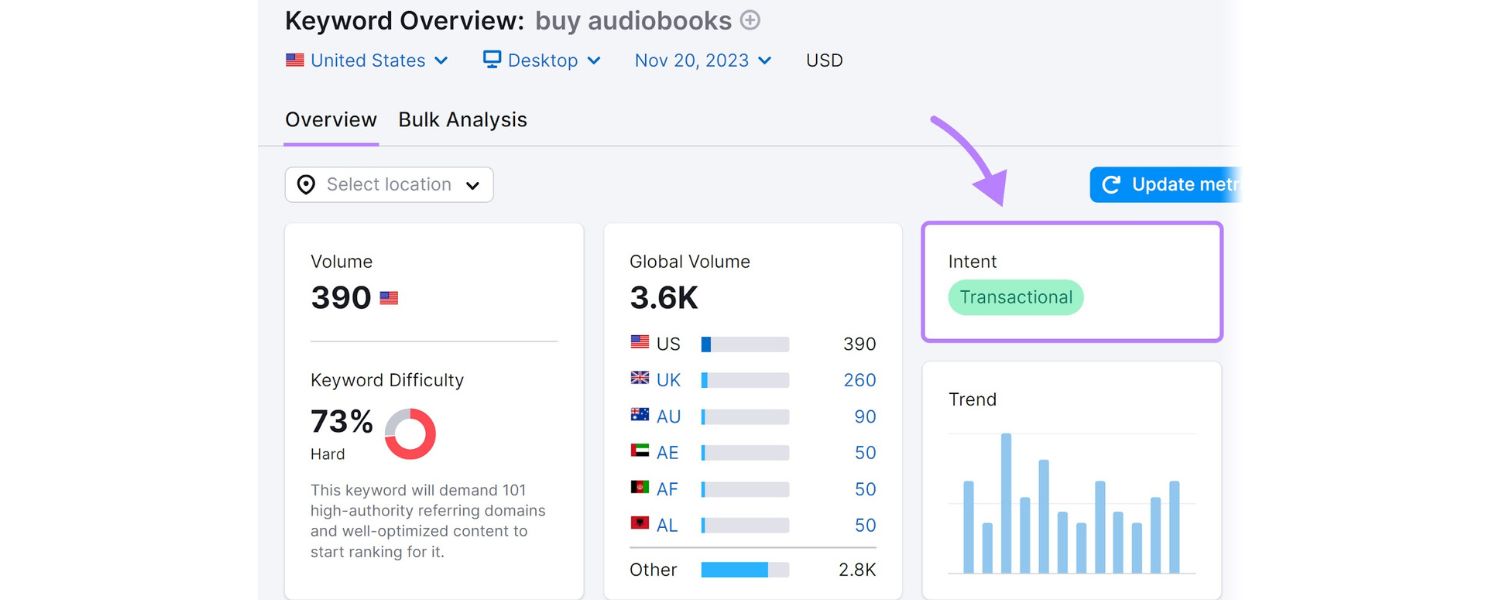
Keyword intent refers to the underlying goal or motivation a searcher has when they type a query into Google or another search engine.
Every keyword or phrase people search falls into some category of intent, they might be looking to learn something, go somewhere, buy something, or compare options.
For example, a person searching “buy running shoes online” clearly wants to make a purchase (transactional intent), whereas someone searching “best running shoes for flat feet” is likely comparing products or seeking reviews (commercial intent).
On the other hand, a query like “running shoes size chart” suggests the user just wants information (informational intent), and a search for “Nike official store” has the intent of finding a specific website (navigational intent).
In essence, keyword intent tells us what the search engine user really wants to accomplish with their query.
SEO experts often summarize it as the searcher’s why: Why did they use those particular words? Are they trying to answer a question, learn a definition, find a specific site, or make a purchase?
Understanding this “why” is crucial because it should shape how you approach that keyword in your content.
If your page doesn’t match the user’s intent, Google is unlikely to rank it highly, and even if it does rank, visitors may leave immediately because the content doesn’t satisfy their needs.
It’s important to note that keyword intent = search intent = user intent, these terms are used interchangeably in the SEO world to mean the same thing.
Throughout this guide, we’ll use “keyword intent” and “search intent” synonymously. Now, let’s explore why optimizing for keyword intent is so critical for SEO success.
Why Keyword Intent Matters for SEO and Conversions
Matching your content to keyword intent is a game-changer for SEO, user experience, and conversion rates.
Here are some of the biggest benefits of aligning with search intent:
1. Better Google Rankings
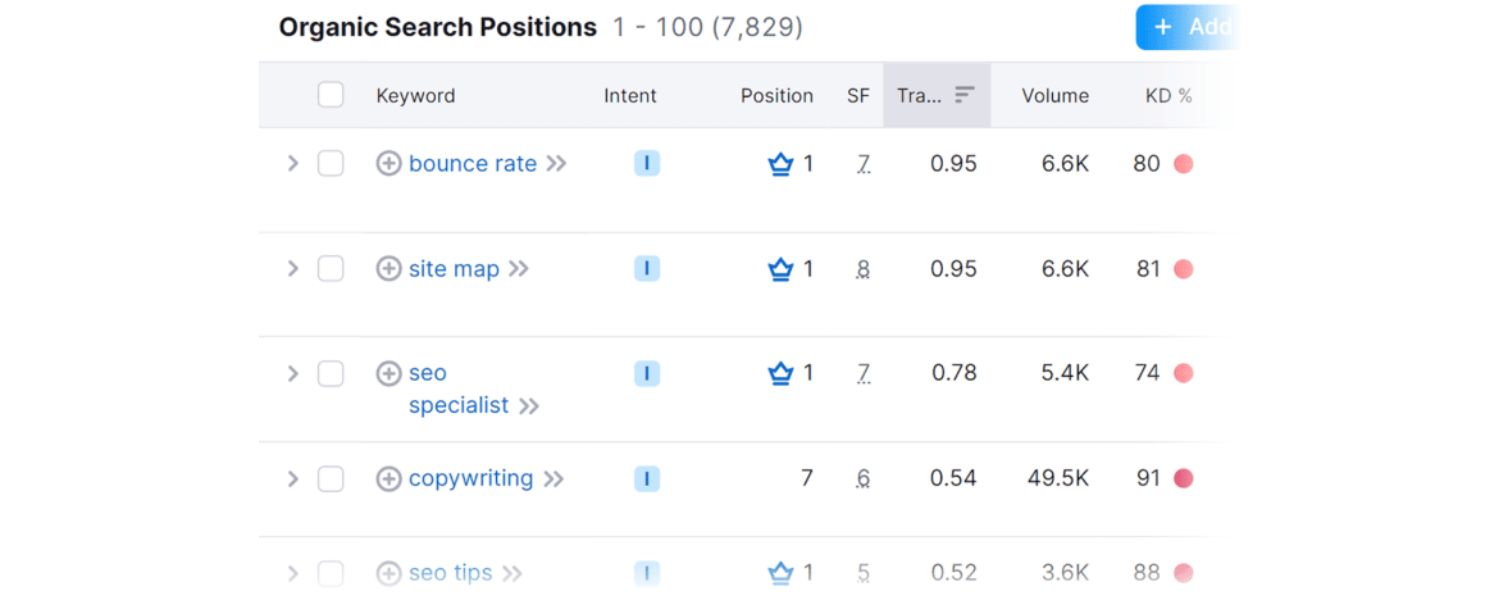
Google’s algorithm prioritizes content that best answers the searcher’s query. Its core goal is to deliver the most relevant results for what the user is looking for.
If your page perfectly satisfies the search intent (for example, providing a thorough how-to guide for a “how to…” query or a product page for a “buy…” query), you stand a much higher chance of ranking on the first page.
On the flip side, if your content is misaligned – say, a product page targeting an informational query – Google will demote it in favor of pages that match the intent.
In Google’s eyes, relevance = intent match, so understanding intent helps you give Google exactly what it wants to show users.
2. Higher-Quality Traffic
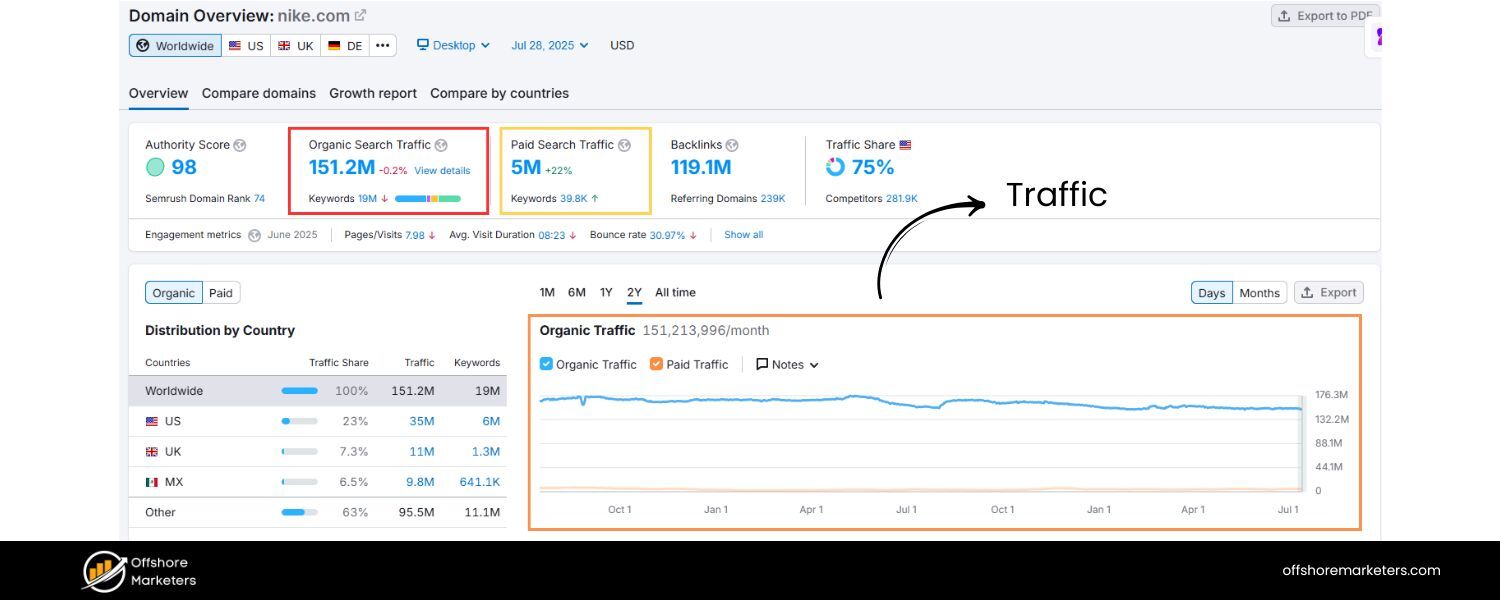

When you align content with intent, you attract visitors who actually want what you’re offering. This means more qualified, high-quality traffic.
For instance, an e-commerce page optimized for “buy [product]” keywords will draw in visitors ready to purchase, whereas a generic blog post on that keyword might bring in people just browsing.
Being mindful of a keyword’s search intent helps you create content that attracts the right kind of organic traffic – users eager to take action.
In short, you’ll get fewer random visitors and more prospects who are likely to convert.
3. Improved Conversions & Sales
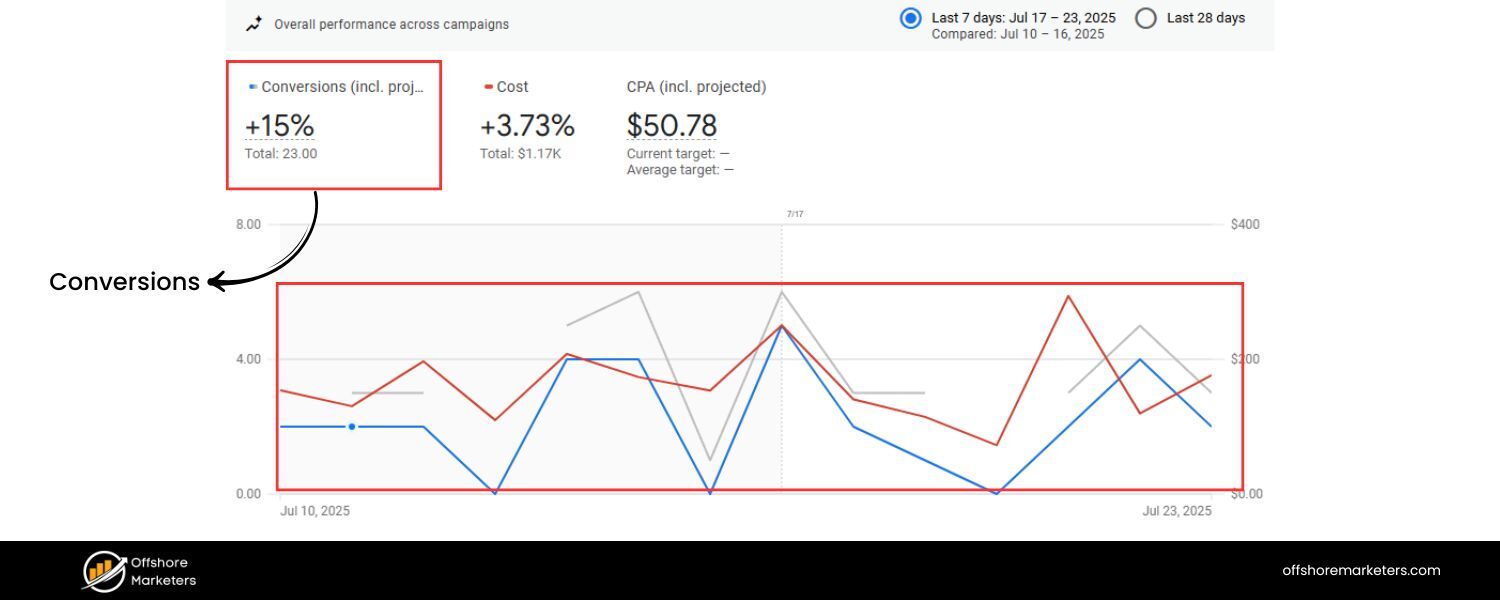
Targeting high-intent keywords (especially commercial and transactional queries) can dramatically boost conversion rates.
These visitors are further along in the buying cycle and more likely to convert compared to those searching purely for information.
By focusing on keywords with strong purchase intent, businesses have seen conversion rates significantly higher than average.
For example, one analysis found that comparison keywords (like “X vs Y”, which indicate commercial intent) averaged an 8.4% conversion rate, outperforming more general informational content.
The takeaway: When your content matches the visitor’s intent, you’re not just getting traffic – you’re getting the right traffic that is primed to convert.
4. Lower Bounce Rates & Higher Engagement
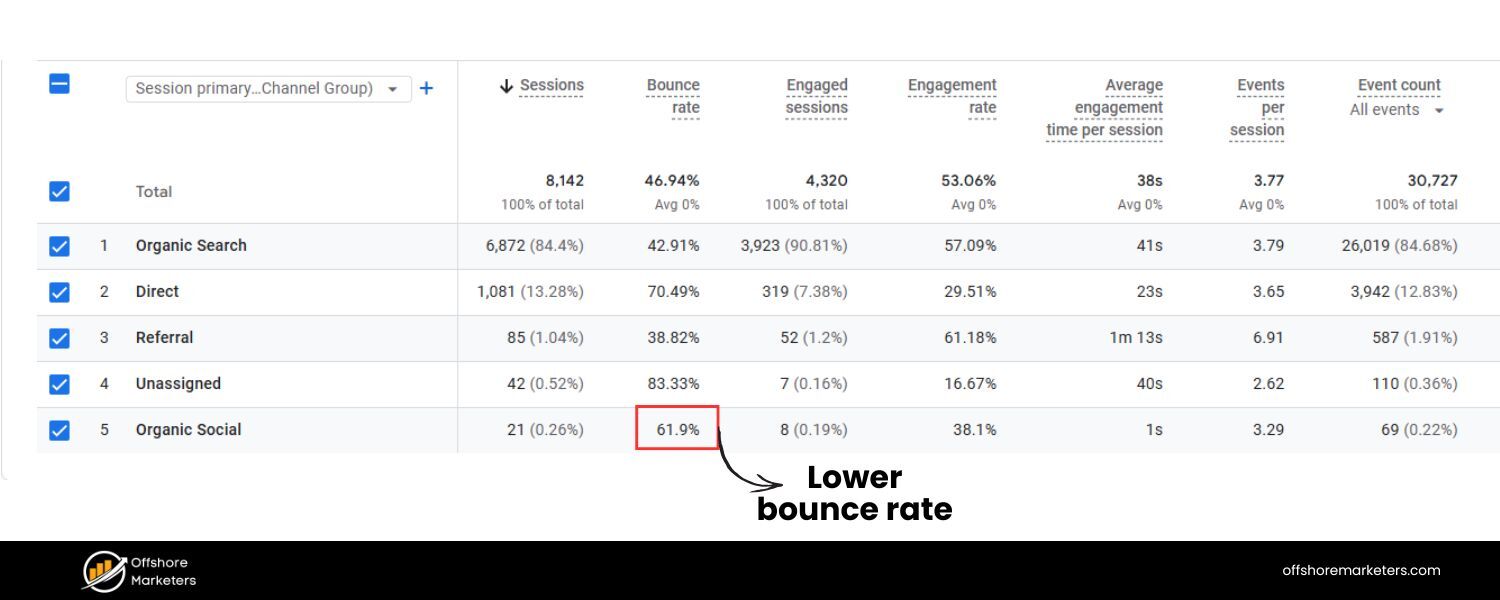
If a user finds exactly what they were searching for on your page, they’re more likely to stick around, read, and interact with your site.
Aligning content to intent therefore helps reduce bounce rate – visitors don’t hit the back button because their needs are met. Instead, they may read further, click other internal links, or engage with your calls-to-action.
Meeting search intent gives users a reason to stay on your site, which in turn boosts user engagement metrics and sends positive signals to search engines about your content quality.
5. Building Trust and Brand Loyalty
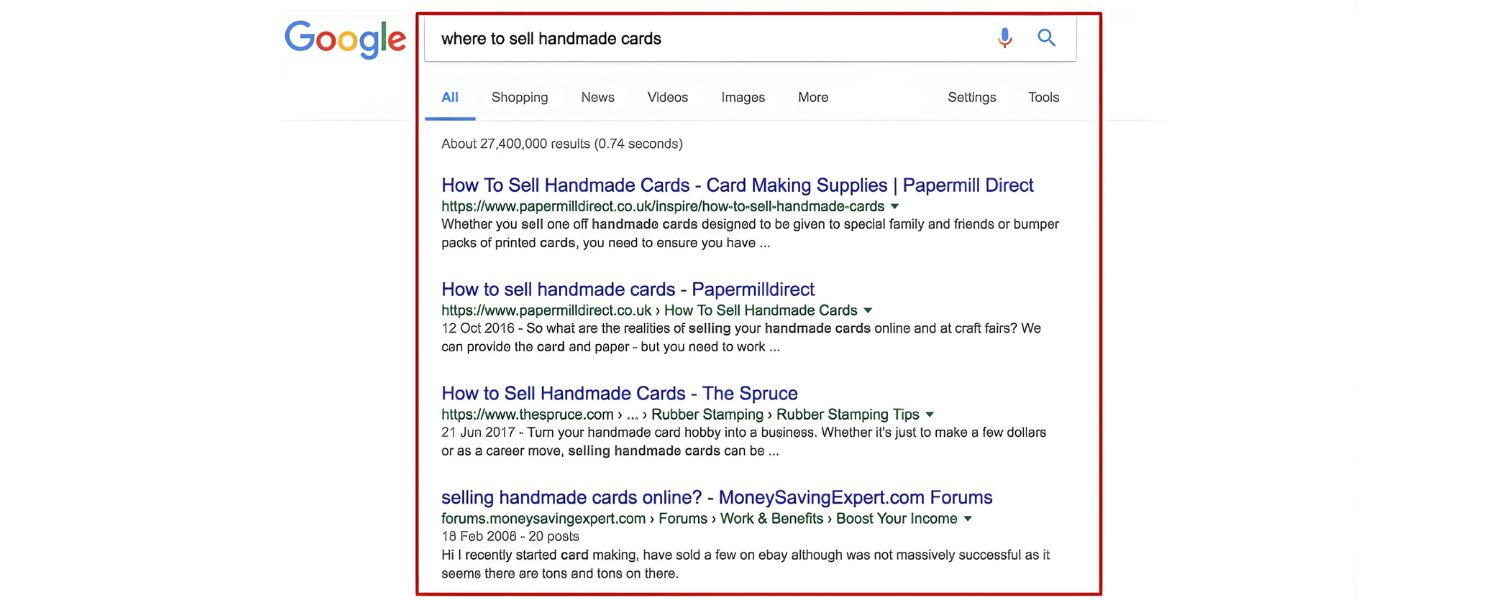
When your content consistently delivers what users are looking for, you become a trusted source in your niche.
For informational intents, providing comprehensive, useful answers can position your brand as an authority (so when that user eventually is ready to buy, your brand is top-of-mind).
For transactional intents, making the purchase process easy and satisfying builds customer confidence.
Overall, satisfying search intent enhances user satisfaction, which can lead to repeat visits, bookmarks, shares, and a stronger brand reputation.
In summary, optimizing for keyword intent creates a win-win: searchers get exactly what they need, and you get better SEO performance and business outcomes.
“Understanding search intent delivers a better customer experience and enables you to target ideal customers more effectively,” as one industry expert puts it.
Now that we know why it matters, let’s dig into the different categories of keyword intent.
The 4 Types of Keyword Intent (With Examples)
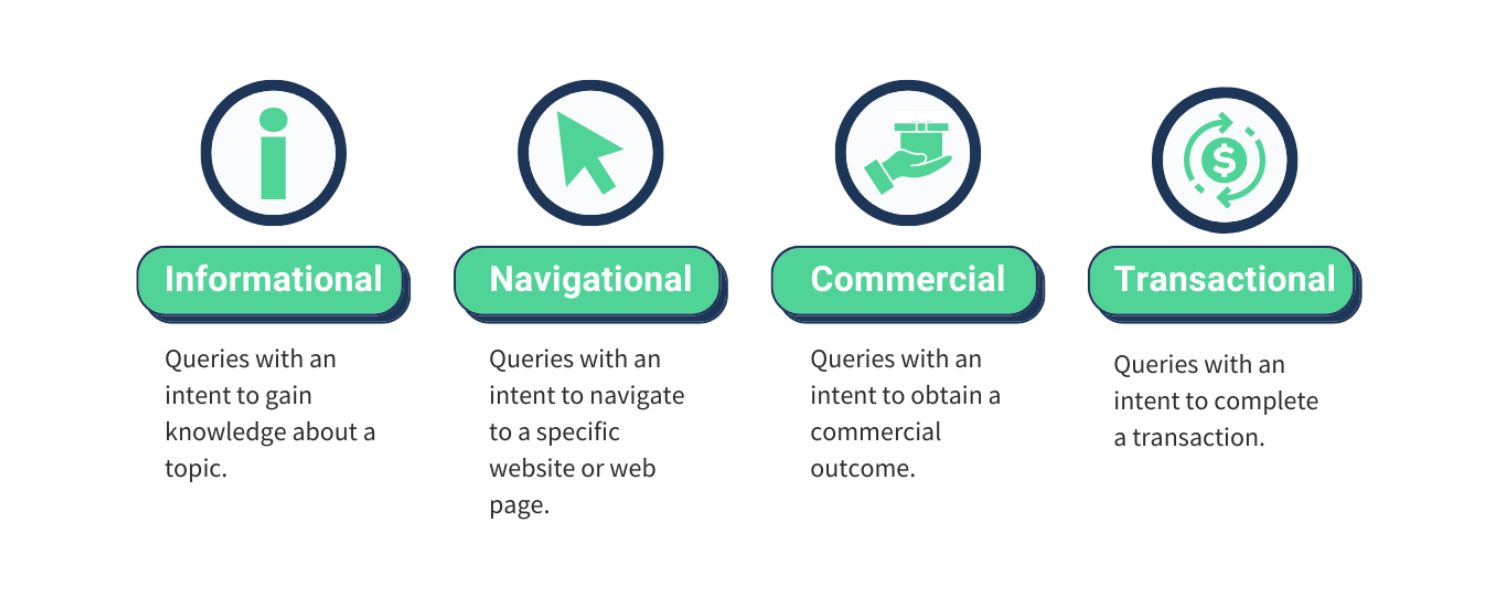
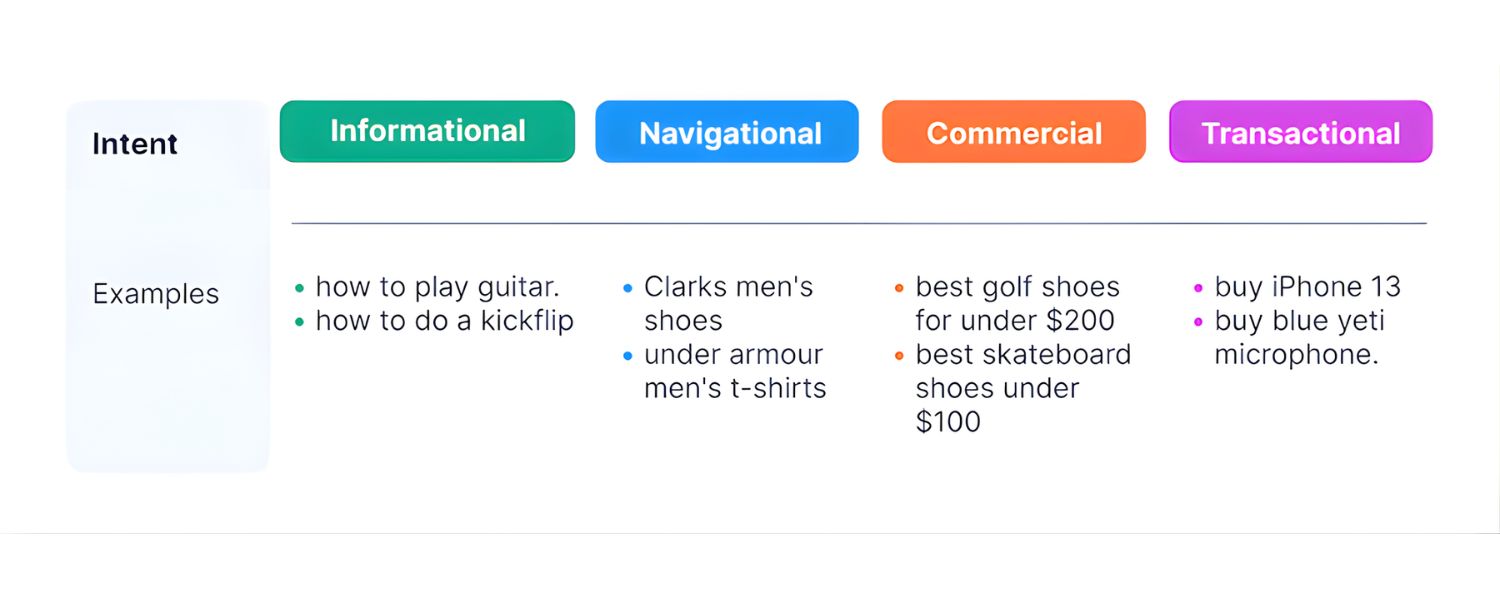
Not all searches are created equal. SEO professionals generally classify search intent into four main types:
1. Informational Intent
The searcher is looking for information or answers. (They want to learn something.)
2. Navigational Intent
The searcher is trying to get to a specific website or page. (They want to go somewhere.)
3. Commercial Intent (Investigational)
The searcher is researching products or services, often with the intent to buy soon but needs to compare or learn more. (They want to compare/evaluate options.)
4. Transactional Intent
The searcher is ready to perform a transaction or take an action, such as making a purchase or signing up. (They want to do something – typically buy.)
Let’s explore each of these in detail, with examples and tips on how to recognize and target them.
1. Informational Intent
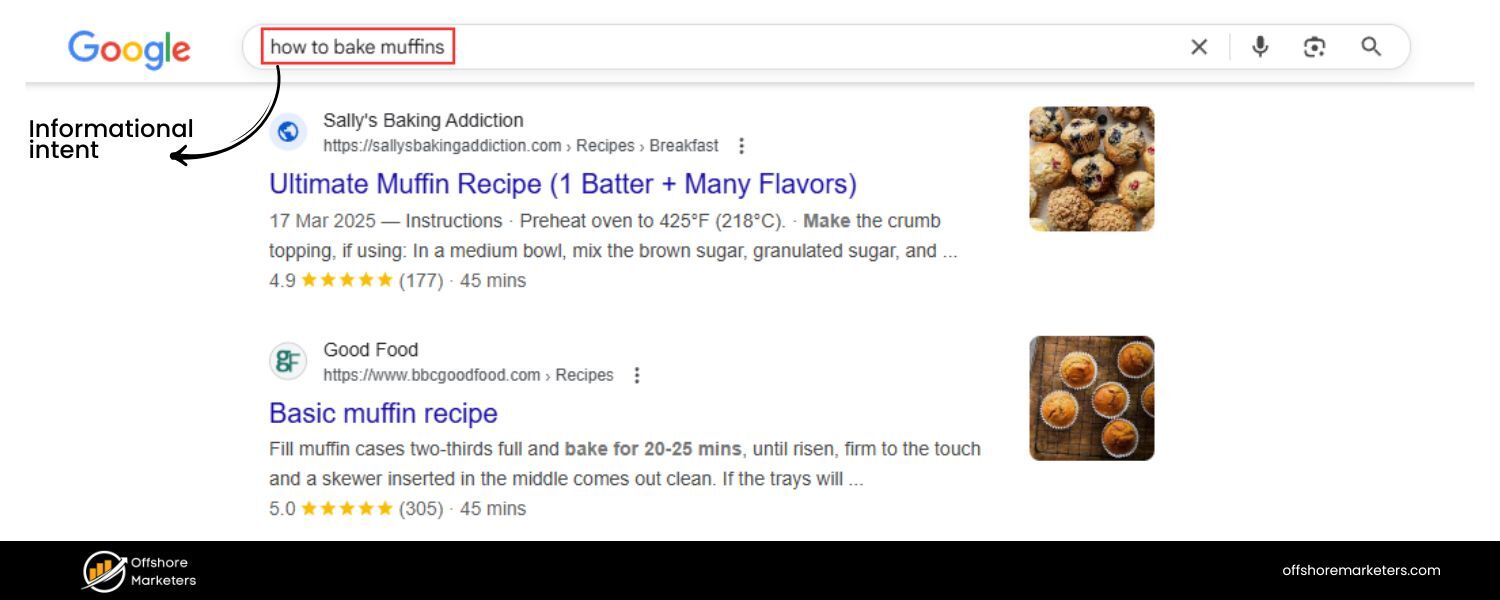
Informational keywords indicate that the user is seeking knowledge, answers, or how-to guidance.
These searches are typically questions or topic-based queries where the person wants to learn about a subject – often the who, what, how, why, or when of something. In fact, most broad queries on search engines are informational in nature.
Examples of informational searches:
A. “How to start a blog”
B. “What is keyword intent in SEO”
C. “Benefits of vitamin D”
D. “Python vs Java differences” (could also be commercial if comparison for purchase, but often general info)
E. “SEO trends 2025”
These queries might be phrased as direct questions (“how to do X?”, “what is Y?”, etc.) or as general keywords (e.g. just “vitamin D benefits”).
Often, searches starting with question words like “what is…”, “how to…”, “why does…”, “best way to…”, etc., signal informational intent.
However, not every informational query is a question – a single-word search like “photosynthesis” or a phrase like “pasta bolognese recipe” is also informational; the user simply didn’t phrase it as a question.
From an intent perspective, informational searches are usually top-of-funnel. The user is learning, not looking to buy something immediately.
Therefore, these keywords typically have low commercial intent (the searcher isn’t ready to purchase at this stage).
But they are high value in terms of content marketing: if you provide the information the user needs, you can establish authority and potentially guide them closer to your product or service over time.
How to target informational intent
Create thorough, valuable content that answers questions and educates the reader.
Great formats for informational queries include: blog posts, how-to guides, tutorials, explainer articles, FAQs, infographics, and videos.
Focus on providing comprehensive answers and actionable insights. For example, a user searching “how to optimise images for SEO” would be best served by a step-by-step guide or checklist on that topic.
By delivering high-quality informational content, you build trust with your audience – and when those readers eventually move into buying mode, they’ll remember your site.
(Plus, engaging informational content can earn backlinks, social shares, and long-term organic traffic.)
It’s also smart to incorporate related questions in your content (perhaps as subheadings or an FAQ section), since Google often features Q&A results (People Also Ask boxes) for informational intents. This can improve your visibility.
For instance, if you’re covering “benefits of remote work,” you might include Q&A like “What are the advantages of remote work for employers?” which matches common user questions.
2. Navigational Intent
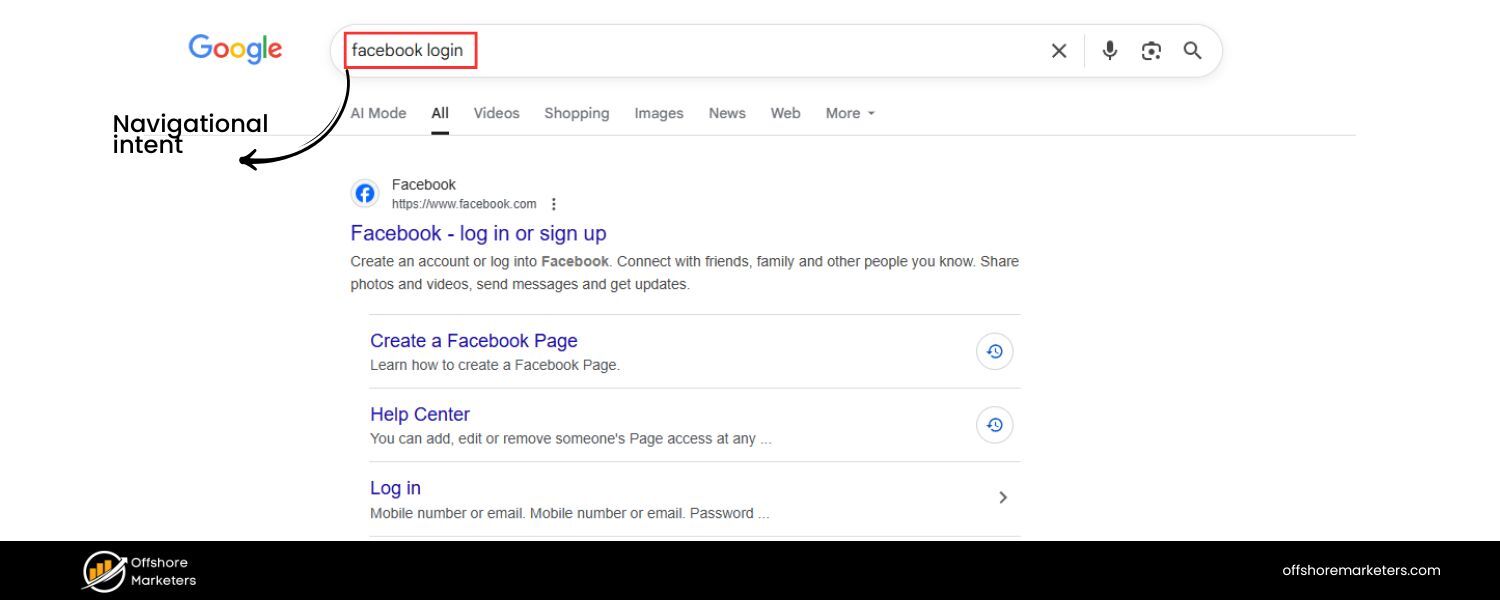
Navigational keywords are used when the searcher already knows exactly where they want to go – they’re essentially using Google (or another engine) as a navigation tool to reach a specific website or page.
In these cases, the user has a particular brand, site, or location in mind and types that into the search bar rather than using a bookmark or typing the URL.
A. “Facebook login” – (looking for Facebook’s login page)
B. “Gmail” – (likely wants to go to Gmail’s site)
C. “Chase online banking” – (user intends to navigate to Chase bank’s login page)
D. “Neil Patel blog” – (user wants the blog section of Neil Patel’s site)
E. “Wikipedia Python” – (user wants the Python page on Wikipedia)
Usually, navigational queries include a brand name, product name, or website name.
Often they are one- or two-word searches (just the brand or a short phrase like “YouTube”) because the user assumes the search engine will fetch the official site.
In some cases, a navigational intent query might be a bit longer if the user is zeroing in on a specific section (e.g. “Amazon return policy page”).
Characteristics and intent
Navigational searches typically have low direct purchase intent (the user isn’t looking to buy at that moment; they just want to get to a destination).
However, that doesn’t mean they have no commercial value – the user could very well convert after reaching the site (e.g., searching “Amazon Prime Video” to log in and then making a purchase).
But from the search perspective, they’re not looking for new options; they have one in mind. Navigational intent is often aligned with existing brand affinity or awareness.
How to target navigational intent: If the navigational query is your brand or website, you want to ensure your pages rank at the top.
This involves basic brand SEO: make sure your homepage and important pages are properly optimized with your brand name, and consider SEO for common things people search with your brand (like “[YourBrand] + login”, “[YourBrand] + support”, etc.).
It’s also crucial to have clear site structure so that sitelinks (subpages) appear for branded searches.
If people search your brand’s product names or features, have dedicated pages for those. Essentially, own your brand’s navigational landscape on search results.
If the navigational query is for another brand (i.e., not yours), there’s generally no benefit in trying to rank for it – and you probably won’t, because Google will almost always show the official site.
For example, if someone searches “Facebook,” Facebook.com will be the top result.
Competing for another brand’s navigational query is usually a losing battle and could be a poor user experience (searchers will skip over unrelated sites anyway).
The exception might be if you have a comparison or review that exactly matches someone seeking info on that brand (but then, the intent might be partly informational or commercial, not purely navigational).
As a rule of thumb: focus your SEO efforts on navigational queries related to your own brand and properties.
One more scenario
If your brand name is similar to another term or shared by something else, you might need to optimize to distinguish yourself.
For instance, a company named “Apollo” might compete with queries about Apollo (the NASA program, etc.).
In such cases, optimizing for “[Apollo] + [your industry]” or running a Wikipedia page can help ensure users with navigational intent for your brand find you and not something else.
In sum, navigational intent SEO is about being easily found for your own brand terms.
Make sure your site’s important pages (homepage, login, contact, etc.) are indexed and using obvious titles (e.g., “YourBrand – Official Site”), and consider buying ads on your brand name if competitors are trying to siphon those searches.
3. Commercial Intent (Investigational)
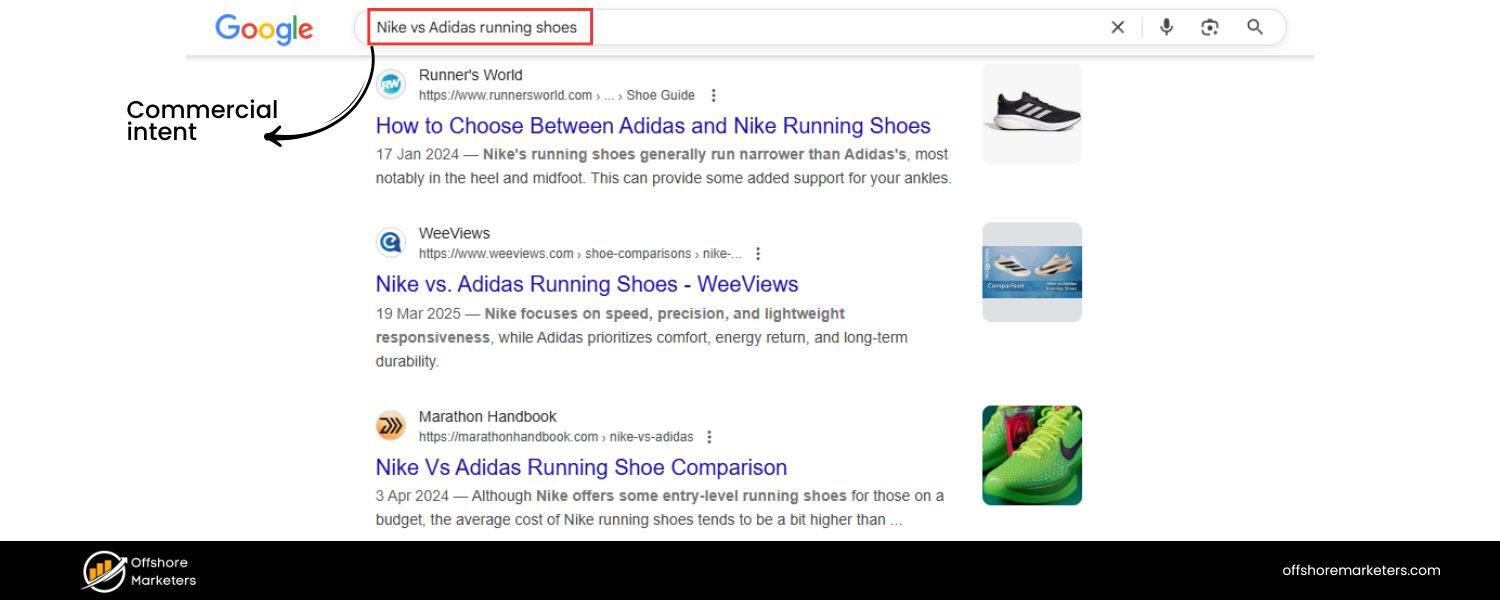
Commercial intent (often called “commercial investigation”) lies in-between informational and transactional intent.
Here, the user is researching products or services and considering a purchase, but hasn’t decided on a specific one yet.
They might be looking for reviews, comparisons, or best-of lists to evaluate their options.
In other words, they’re in the consideration stage of the buyer’s journey – past pure information-gathering, but not yet ready to pull out the credit card without further reassurance.
Examples of commercial intent searches:
A. “best mirrorless cameras 2025” – (looking to compare options before buying)
B. “Shopify vs WooCommerce” – (comparing two products/services)
C. “Top 10 project management tools” – (seeking a list to evaluate)
D. “Product XYZ review” – (wanting to read reviews of a specific product)
E. “Nike Air Zoom Pegasus vs Adidas Ultraboost” – (comparing two shoe models, likely before choosing one)
These queries often contain words like “best”, “top”, “reviews”, “vs”, “alternatives”, “pros and cons”, or phrases like “is XYZ worth it?”.
They may also include brand names or product names (especially in comparisons or reviews).
For instance, “XYZ vs ABC” or “ABC alternative” suggests someone is exploring options within a category, implying they are familiar with the brand offerings but seeking to determine which is superior.
Characteristics of commercial intent
Users with commercial intent have medium to high buyer intent, just shy of transactional.
They are typically planning to buy, but need a little more information or convincing before making the final decision. This could mean comparing features, prices, quality, or reading about other customers’ experiences.
Because these searches indicate an upcoming purchase, they are very valuable in SEO – often more valuable than generic informational queries – since capturing a user at this stage can directly lead to a conversion (once you satisfy their investigative needs and perhaps subtly promote your solution).
It’s worth noting that commercial intent queries can overlap with informational.
The line can blur; for example, “Canon 5D Mark IV vs Nikon D850” is informational (seeking info on differences) and commercial (intending to choose one to buy).
Google’s results for such queries usually feature content like detailed comparison articles, video reviews, etc., rather than straight product pages – because the intent is to research, not buy immediately.
In fact, Google often recognizes these as “commercial investigation” and will show a mix of results (blogs, reviews, maybe shopping results too).
Some SEO tools label these as “commercial” intent distinctly from transactional and informational.
How to target commercial intent: This is where content marketing and SEO really intersect with sales.
To capture these searchers, create content that helps them make a decision while gently steering them toward your product or service as the solution.
Effective content types include
A. Product comparison guides:E.g., “XYZ vs ABC – Which Is Better for [Use Case]?” If you offer one of the products (or have an affiliate site), you can compare features, highlight advantages, and be fair but persuasive.
B. “Best of” list posts (Listicles):E.g., “10 Best Project Management Tools in 2025 (With Pros & Cons)”. If your offering is in the list, you can showcase it alongside others.
Such posts attract those looking to survey the top options.
C. In-depth Reviews and Case Studies:E.g., “[Product] Review 2025” or “How [Product] Solved [Problem] for Me”. Honest, detailed reviews (with ratings, pros/cons) help users decide.
If you’re reviewing your own product, include customer testimonials or data.
D. Comparison tables, Infographics, Videos:Visuals can help distill differences between options.
A comparison chart of features or pricing, or a video “shootout” review, can engage users and communicate a lot quickly.
In your content, address the factors these searchers care about – common points of comparison like price, features, quality, support, etc.
For example, someone searching “XYZ vs ABC” likely wants to know the key differences, strengths/weaknesses of each, and which is ideal for certain scenarios.
If you can provide that and subtly emphasize where one excels (especially if that one is your solution), you’re more likely to earn the user’s trust and their business.
Also, don’t shy away from user-generated content like ratings or comments if applicable – many searchers seek social proof (e.g., star ratings, user reviews).
Google often shows rich snippets for “best” or “review” queries (like star ratings), so integrating structured data for reviews on your page can be beneficial.
Pro tip
Many commercial intent queries include specific brand names or terms like “alternatives” and “vs”.
These often have lower search volume than broad terms but extremely high conversion potential (since the user is deep in consideration).
Targeting these “comparison keywords” can be SEO gold. As one marketing study noted, “alternative and versus keywords convert at a higher rate than any other keyword type,” because searchers at this stage are highly qualified.
So, incorporate those terms in your keyword research and content strategy.
4. Transactional Intent
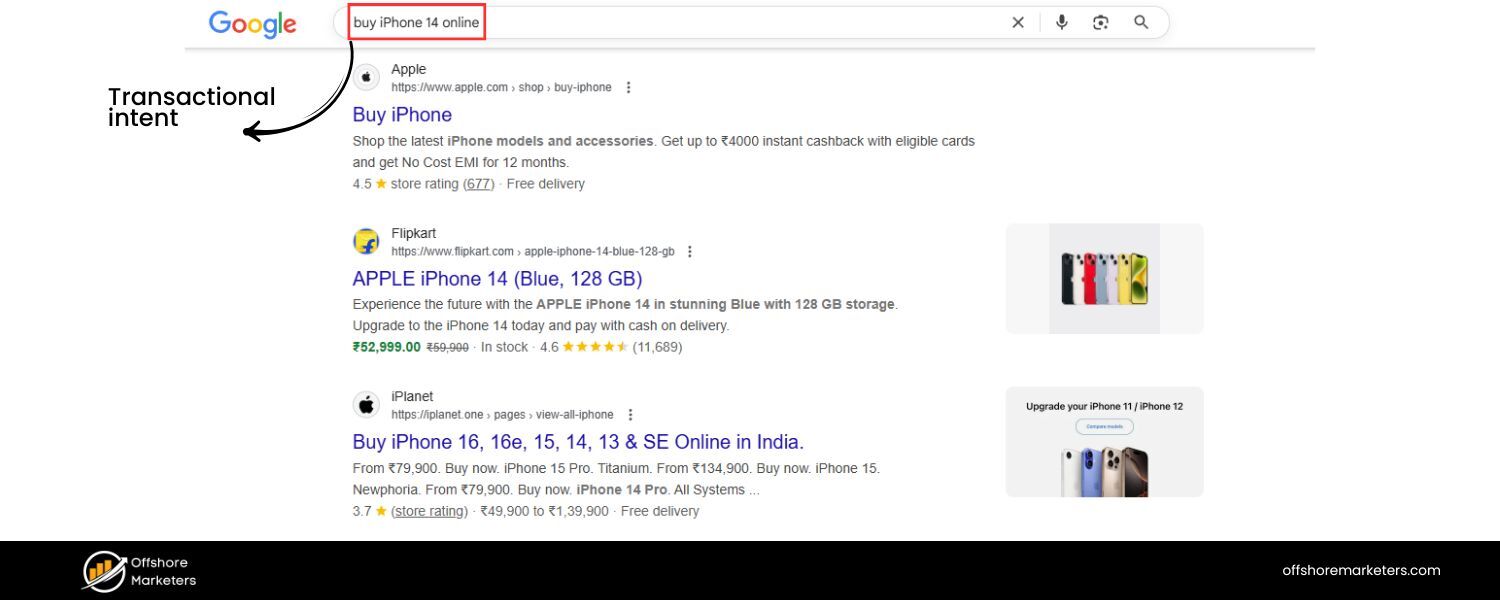
Transactional keywords are the money keywords – they indicate the user is ready to take an action that is often directly monetary (or a step close to it).
The classic example is a user who is prepared to buy something right now. These queries often include commercial terms and are specific about what the user wants to do.
Examples of transactional searches:
A. “buy iPhone 14 online” – (clear intent to purchase a specific product)
B. “Nike Air Max size 11 price” – (looking to buy a specific shoe, likely will click a shopping result or store)
C. “Cheap flight tickets to NYC” – (user intends to purchase tickets)
D. “Domain name registration” – (user wants to sign up for a service now)
E. “[Software] free trial” – (intent to start a trial, which is a conversion)
F. “Order pizza near me” – (ready to place an order, especially with “near me” which might trigger local transactional results)
Notice that many transactional queries contain verbs like “buy”, “order”, “purchase”, “book”, “apply”, “signup” or other action words.
They might include transactional terms such as “price”, “discount”, “coupon”, “deal”, “free shipping” etc…
Also, including “near me” or location names often indicates an intent to find something locally to buy (or visit).
Essentially, these users have their wallets out (or are at least in a very action-oriented mindset).
Characteristics of transactional intent:
These keywords have high buyer intent – the highest of all categories. The user is at the bottom of the funnel, often one step away from conversion.
If informational is “know,” navigational is “go,” commercial is “compare,” then transactional is “do” (specifically do the transaction).
From an SEO perspective, transactional keywords are extremely valuable but also often very competitive (since everyone wants the buyers).
They tend to be specific (longer-tail, including product names, model numbers, or exact services) – which is good for targeting, but you have to be sure you can provide what the user wants immediately.
Google’s SERP for transactional queries usually reflects the intent clearly.
For instance, a query like “buy Samsung Galaxy S21” will trigger shopping ads, product carousels, or local store results at the top, because Google knows the user likely wants to purchase.
An informational article would not rank here (and if it did, it wouldn’t get the click) because it’s not what the searcher wants at that moment.
How to target transactional intent:
For these queries, landing pages are key. You should serve the user a page that allows them to complete the desired action with minimal friction.Depending on your business, this could be:
A. Product pages or E-commerce pages
If you sell products, each product’s dedicated page (with “Buy Now” or “Add to Cart” options) should target the product-name keywords and purchase-oriented terms.
Ensure these pages have clear calls-to-action, pricing, and perhaps trust signals (reviews, secure checkout badges, etc.).
For example, someone searching “buy Nike Air Max 90” should land on a page where they can immediately see the shoe, price, and an “Add to Cart” button.
B. Service signup or contact pages
If the transaction is signing up for a service or contacting sales (for B2B), the page should facilitate that – e.g., a free trial sign-up page, a demo request form, or a quote request page.
A query like “project management software free trial” should take the user straight to a free trial registration page for that software.
C. Coupon and deal pages
Many users search for “[Brand] + coupon” or “discount [Product]”. If applicable, having a page that either lists current deals or acknowledges “There are no active coupons but here’s an ongoing sale” can capture those searches.
Alternatively, ensure your product page content (or meta tags) mention discounts if they exist (so Google might surface it).
D. Local business pages or listings
For “near me” queries or anything implying local intent (which is often transactional – e.g., “order pizza near me”).
Make sure you have Google My Business/Google Maps listings and well-optimized location pages. Being present in local pack results is crucial for those.
When optimizing for transactional intent, keep it focused
The user wants to accomplish something, so your page should be straightforward and conversion-oriented.
Use clear headlines that match the query (for instance, the title tag could be “Buy Nike Air Max 90 Online – Free Shipping” to immediately signal they can purchase here).
Ensure your page loads fast and is mobile-friendly (many “urgent” purchases are made on mobile). And incorporate any information the buyer might need at the final step (pricing, availability, shipping info, return policy, etc.)
So they don’t have to hunt around, otherwise they might bounce to a competitor.
One more tip
Transactional keywords are great targets for PPC (pay-per-click) campaigns as well.
In fact, transactional keywords are often important for PPC, since the high intent can justify the ad cost.
While this guide is about SEO, consider running ads on your top transactional terms to ensure you’re visible both in organic results and paid results – dominating the real estate for those high-intent searches.
Quick Recap of Intent Types
To summarize the four intent types and how you might satisfy them:
1. Informational:User wants to learn. Content to provide: Informative blog posts, guides, tutorials, videos, infographics.
Example: “how to improve website speed”
→ Provide a step-by-step optimization guide.
2. Navigational:User wants a specific site/page. Content to provide: The exact page or an easy path to it – optimize your homepage or relevant page.
Example: “Twitter login” → Your site (if you’re Twitter) should be the top result with a login page link.
If it’s your brand query, have that page; if it’s not your brand, you usually don’t target it.
3. Commercial:User is comparing/options research. Content to provide: Comparison articles, “best of” lists, reviews, detailed product information.
Example: “best email marketing software” → Create a comparison list of top email marketing tools (with yours included, if applicable) or a guide to choosing the right software.
4. Transactional:User is ready to act/buy. Content to provide: Direct landing page to complete the action – product page, sign-up form, checkout page.
Example: “buy Nike Air Max size 11” → Product page for Nike Air Max with size selection and “add to cart” button; or a category page filtered to that size.
Understanding these categories is fundamental, but real search behavior can sometimes mix intents.
Now, let’s look at how you can determine the intent behind keywords when doing research.
How to Identify a Keyword’s Intent
Before you optimize for intent, you need to figure out what intent a given keyword has.
Sometimes it’s obvious from the phrase itself (e.g. “buy X” is clearly transactional). Other times it’s subtler.
Here are effective ways to determine keyword intent:
1. Analyze the Google SERP (Search Results)
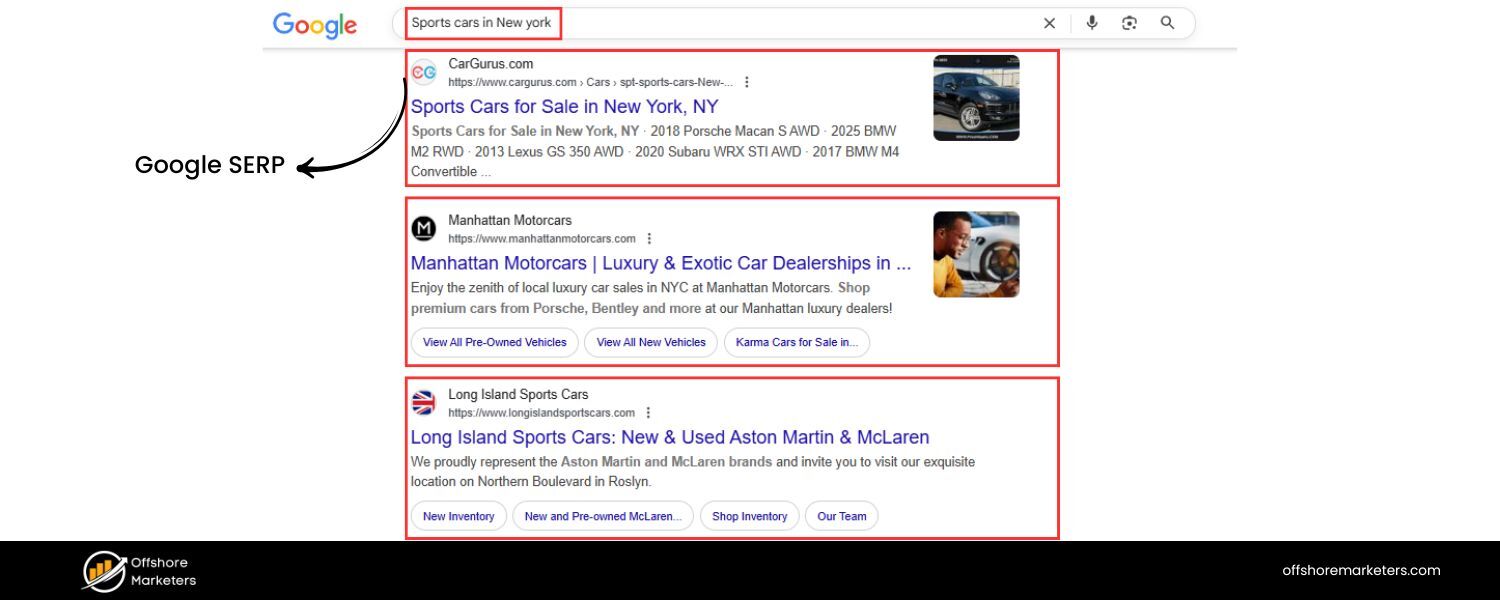
One of the simplest and most reliable methods is to search the keyword yourself (in an incognito/private window to avoid personalized results) and see what types of results Google displays.
Google’s algorithms implicitly interpret user intent, so the composition of the SERP is a strong clue to intent.
When you search your target keyword, observe the following:
Types of pages ranking
Are the top results blog articles, how-to guides, videos, product pages, category pages, or something else?
A dominance of how-to articles and informational blogs suggests informational intent. If you see mostly product pages, ecommerce listings, or shopping ads, it’s likely transactional.
Lots of review sites or “Top 10” lists indicate commercial investigational intent. And if the results are primarily a specific website or login pages, it’s navigational (often the query itself is branded in that case).
SERP Features:
Google often adds special features based on intent. For example:
1. Featured Snippets or “People Also Ask” boxes usually appear for informational queries (answering common questions).
2. Image packs or video carousels might appear if the query implies visual content (informational or commercial where visuals help, like “how to tie a tie” might get a video).
3. Shopping ads, product carousels, prices in results are a sure sign of transactional intent – Google is effectively saying “we think you want to buy, here are products”.
4. Local pack (map with 3 listings) indicates local intent, often transactional (e.g. “pizza near me”).
5. Knowledge panels (side boxes with facts) appear for certain informational queries (like famous people, places – informational) or brand queries (navigational/informational).
6. For instance, if you search “buy chia seeds” vs “what are chia seeds,” you’ll notice stark differences: the first yields shopping results and product pages because Google knows the intent is to purchase, while the second query shows an informational panel, articles, and “People also ask” questions. These SERP differences are a big hint to intent.
7. Wording and clues in titles/descriptions: The titles of the ranking pages often contain terms like “how to” or “what is” (informational), “review”, “vs”, “best” (commercial), or “buy”, “price”, “official site” (transactional/navigational).
8. If the top titles say “Top 5 tips for X”, that’s targeting an info seeker. If they say “Buy X – Official Store”, that’s targeting a buyer.
By reviewing a keyword’s search results, you can reverse-engineer intent. If your intended content type doesn’t align with what’s currently ranking, that’s a red flag you need to adjust.
Google is essentially telling you, “This is what users want for this query.” Your job is to deliver content in that vein, only better.
Pro tip: Click on a few of the top-ranking pages to see what they cover and how they are structured. Are they long-form articles or short pages?
Do they include comparison tables, images, or just text? This can inspire how to make your content both intent-satisfying and competitive.
Also, look for gaps: is there something users might want that those pages didn’t cover? Including that in your content can give you an edge (both in user satisfaction and possibly SEO).
2. Use Keyword Intent Labels in SEO Tools
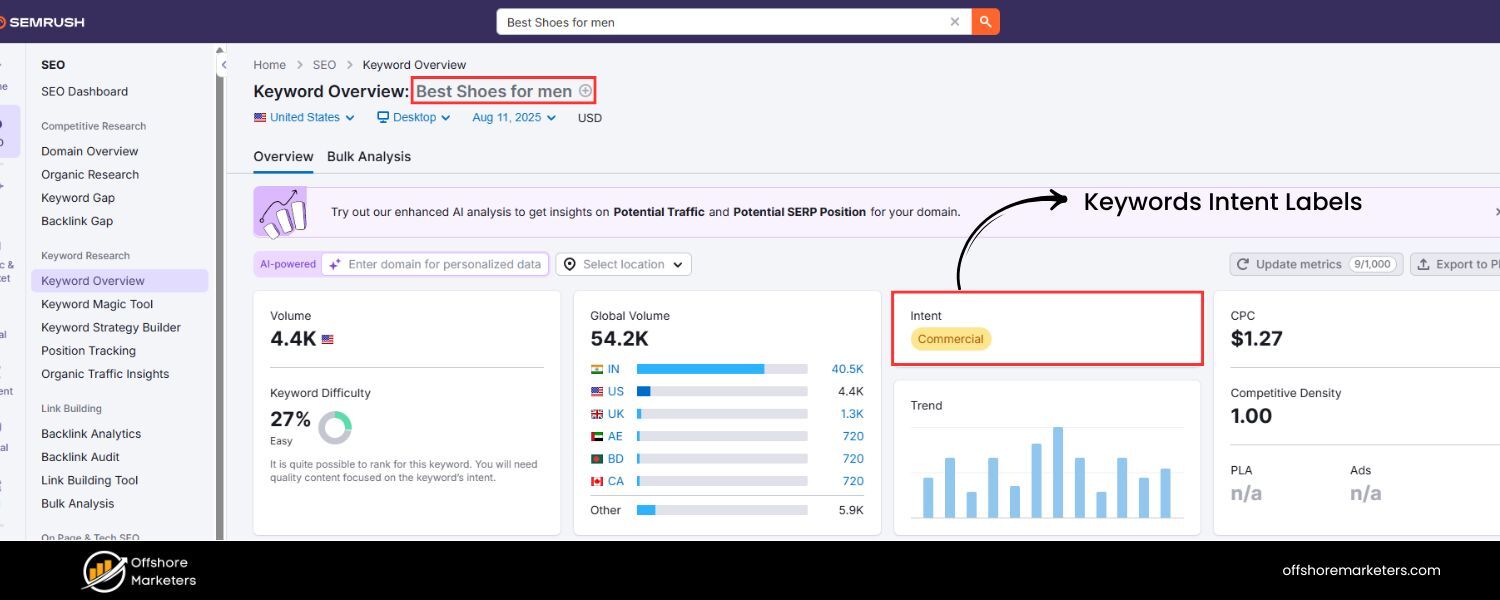
SEO tools have gotten smarter in recent years about intent. Many keyword research tools now automatically label keywords with an intent category (informational, navigational, commercial, or transactional).
For example, Semrush’s Keyword Overview and Keyword Magic Tool provide an “Intent” tag for each keyword. They might use abbreviations like I (Informational), N (Navigational), C (Commercial), T (Transactional).
Using these tools can save time. You can input a list of keywords and quickly filter by intent.
For instance, you could filter for only transactional keywords if you want to find high-intent terms to target. Or filter for informational to plan your blog content strategy.
Some tools even allow filtering by mixed intents (since a keyword can have dual intent).
How do these tools determine intent? Often it’s through machine learning that looks at SERP features and keyword modifiers.
For example, the presence of words like “buy” or “price” in a query strongly signals transactional, whereas words like “how” or “learn” signal informational.
If a keyword is a known brand or URL, that signals navigational. SEO tools combine these clues with SERP analysis to assign intent labels.
Tip:
If you have access to such a tool, take advantage of it in your keyword research phase. Suppose you enter a broad topic like “coffee makers” in a keyword tool – you’ll get hundreds of suggestions.
You can then filter by intent: informational (e.g. “how to clean a coffee maker”), commercial (e.g. “best coffee makers 2025”), transactional (e.g. “buy coffee maker online”).
This helps you map keywords to content types right away. Some tools even let you enter your domain and see which intents you’re already capturing versus missing, so you can find gaps.
Keep in mind the tools’ intent labeling is pretty good, but not perfect. Always sanity-check against the actual SERP as described in the previous step, especially for high-value keywords.
3. Look at Keyword Modifiers and Phrases
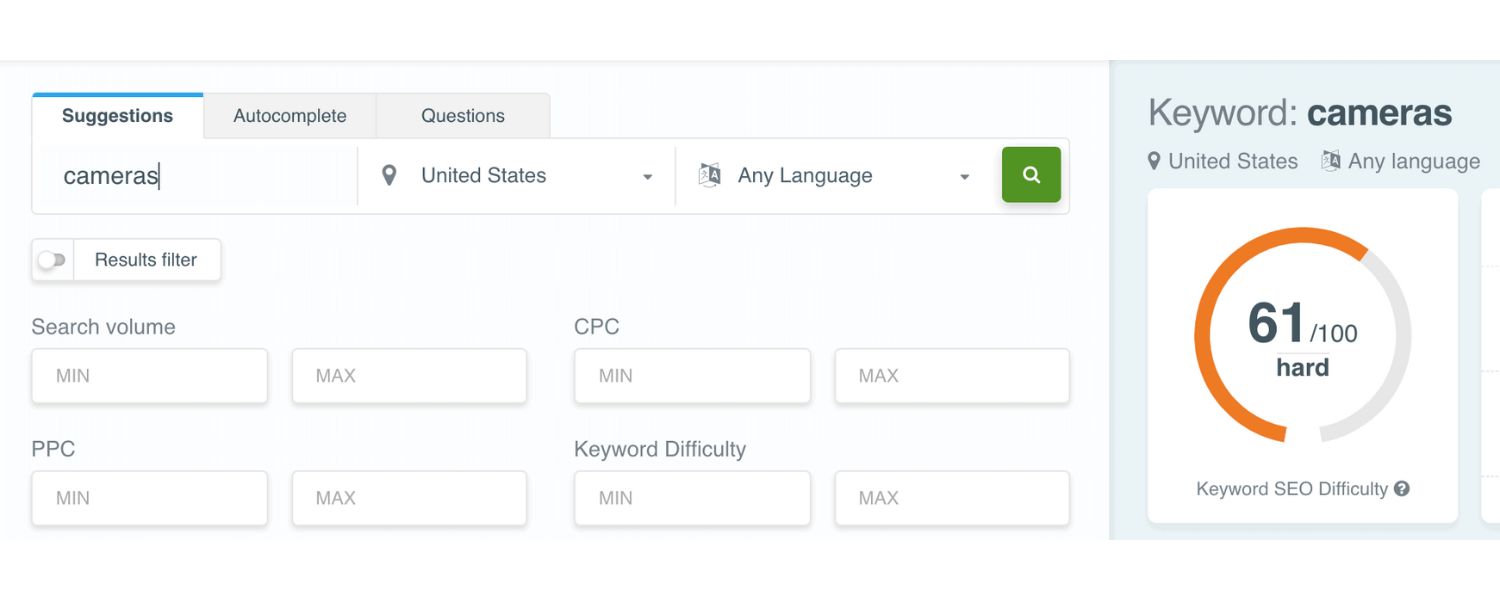
If you don’t have fancy tools, a bit of old-fashioned analysis works too. Many keywords telegraph their intent through specific modifiers, words commonly associated with certain intents.
Here’s a quick cheat-sheet of modifiers:
1. Informational modifiers:“how to…”, “what is…”, “guide”, “tutorial”, “why does…”, “tips”, “ways to…”, “learn”, “the history of…”, etc.
2. Navigational modifiers:Often just a brand or product name by itself, or with words like “login”, “homepage”, “official site”, “Facebook {something}”, etc.
3. Commercial (investigational) modifiers:“best”, “top”, “reviews”, “compare”, “vs”, “[product] vs [product]”, “alternatives to…”, “pros and cons”, “brand A review”, “brand A pricing” (pricing could also be transactional if they’re ready to buy, but often it’s part of research).
4. Transactional modifiers:“buy”, “order”, “purchase”, “for sale”, “coupon”, “discount”, “deal”, “free shipping”, “book [service]”, “apply now”, “sign up”, “nearest”, “cheap/affordable” (when directly relating to buying), “online” (as in “buy X online”), etc…
Scanning a keyword list for these words can give a quick sense of intent categories.
For example, if you have 50 keywords and you spot words like “best” or “vs” in 10 of them, you know those 10 are commercial investigation type. If “buy” or “price” is in some, mark those as transactional.
Also pay attention to word order and context. A keyword like “chocolate cake recipe” is informational (looking for a recipe). “Order chocolate cake online” is transactional (trying to buy a cake).
Sometimes one word makes all the difference.
4. Use Google’s Autocomplete and “People Also Ask”
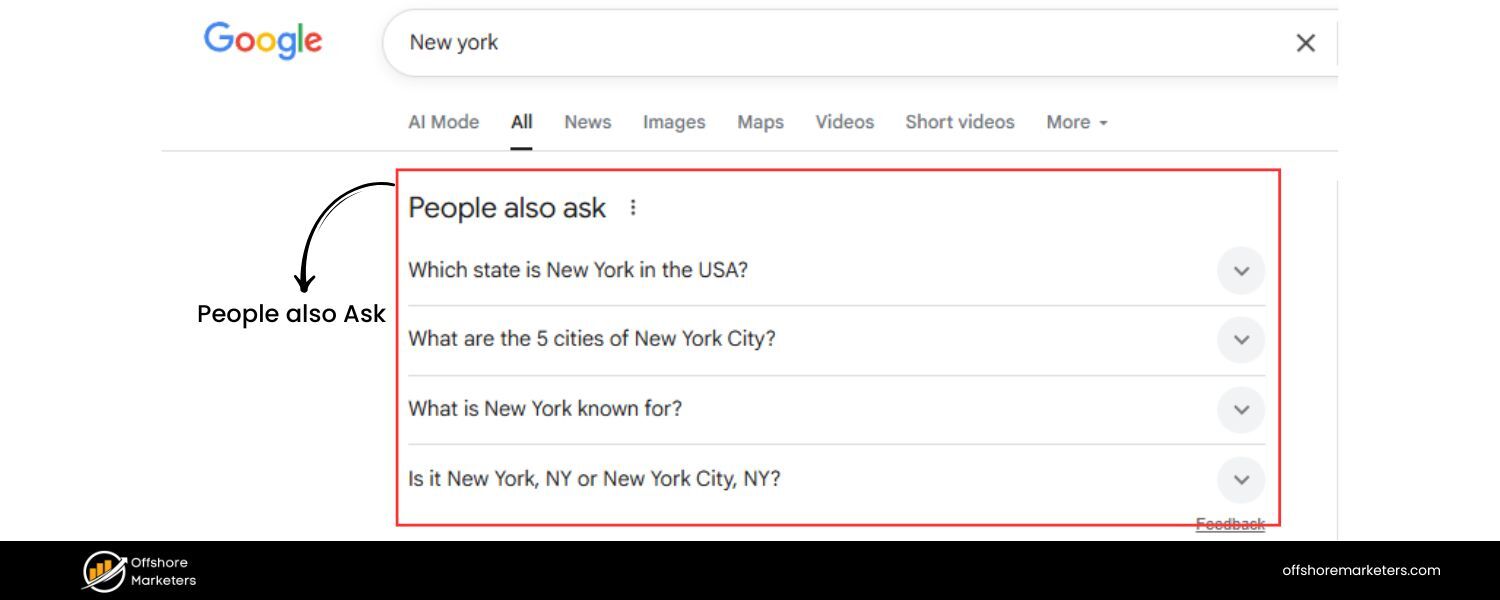
Google’s own suggestion features can hint at intent. When you start typing a keyword in Google’s search box, the Autocomplete suggestions often show popular continuations of that query.
These suggestions can reflect different intents users commonly have.
For instance, type a product name and you might see suggestions like “[product] vs [competitor]” (commercial intent) or “[product] coupon” (transactional) or “[product] how to use” (informational).
This gives insight into what real users are interested in about that keyword.
Similarly, after searching, check the “People also ask” questions or the Related Searches at the bottom of Google.
If you search a broad term and see related searches that contain “best” or “price” or “how to…”, it clues you into the range of intents surrounding that topic.
For example, searching “drones” might show related searches “best drones 2025” (commercial), “drones for beginners” (informational/commercial), “drone laws in US” (informational), etc.
This can help you segment which content pieces to create around the topic “drones” to cover all intents.
5. Leverage Your Analytics and Search Console Data
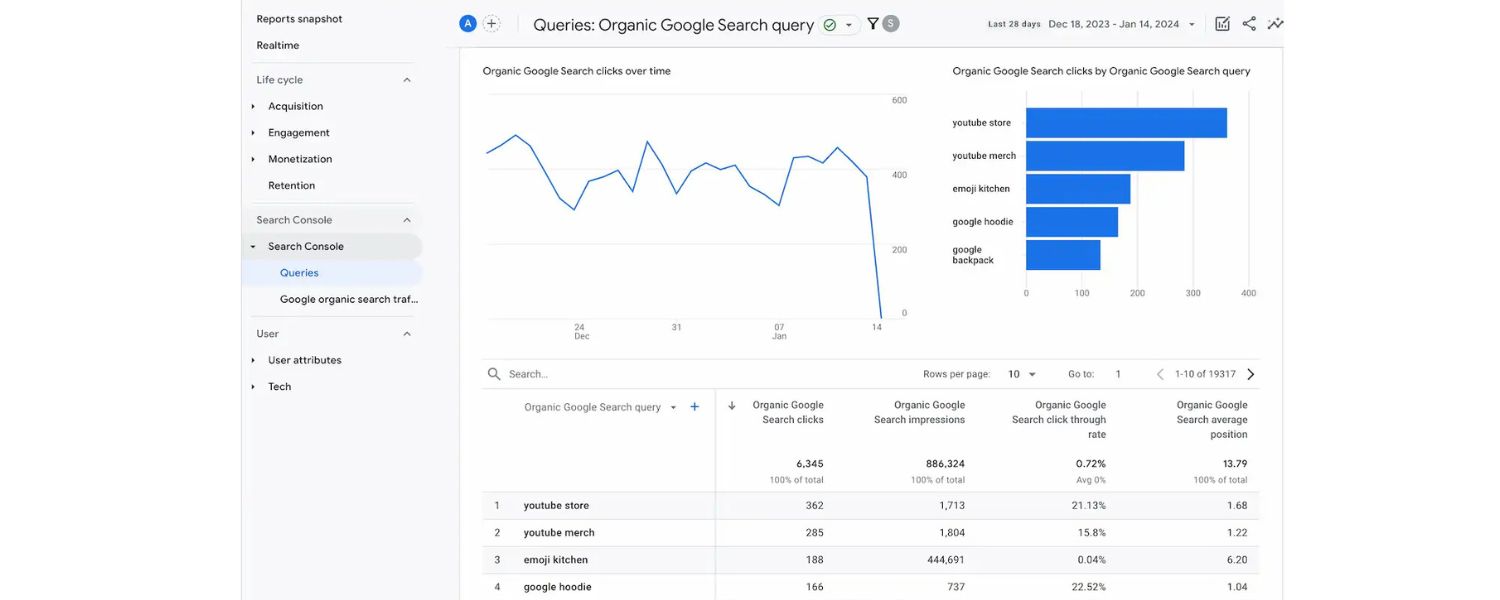
If your site already gets some search traffic, your own analytics can provide intent hints. Look at the queries your pages are currently ranking for (Google Search Console is great for this).
For each query, consider what the user likely wanted. Are they bouncing off that page quickly? If yes, maybe your page isn’t matching the intent of those queries, which is a sign of misalignment.
If a page has a high bounce rate or low time-on-page for a particular keyword, investigate if the content truly addresses that keyword’s intent.
For instance, if people find your blog via “buy [product]” but your page is a blog article, they might bounce because they wanted a product page.
On the flip side, you might discover keywords you didn’t realize you rank for, and then intentionally optimize for their intent.
For example, your article might unintentionally rank for a “vs” query – if so, maybe add a comparison section to better satisfy that searcher.
By using these methods (and combining them), you can confidently determine the intent behind your target keywords.
This research is a crucial first step before creating or optimizing content.
Now, let’s move on to how you can optimize and align your content with keyword intent to reap the benefits we discussed earlier.
Optimizing Your Content Strategy for Keyword Intent
Identifying search intent is half the battle, the other half is crafting content that aligns with that intent.
When your content exactly meets the needs of the searcher, not only do you please Google’s ranking algorithms, but you also delight users (leading to better engagement and conversion).
Here’s how to ensure your SEO and content strategy are laser-focused on intent:
1. Map Keywords to the Right Content Types
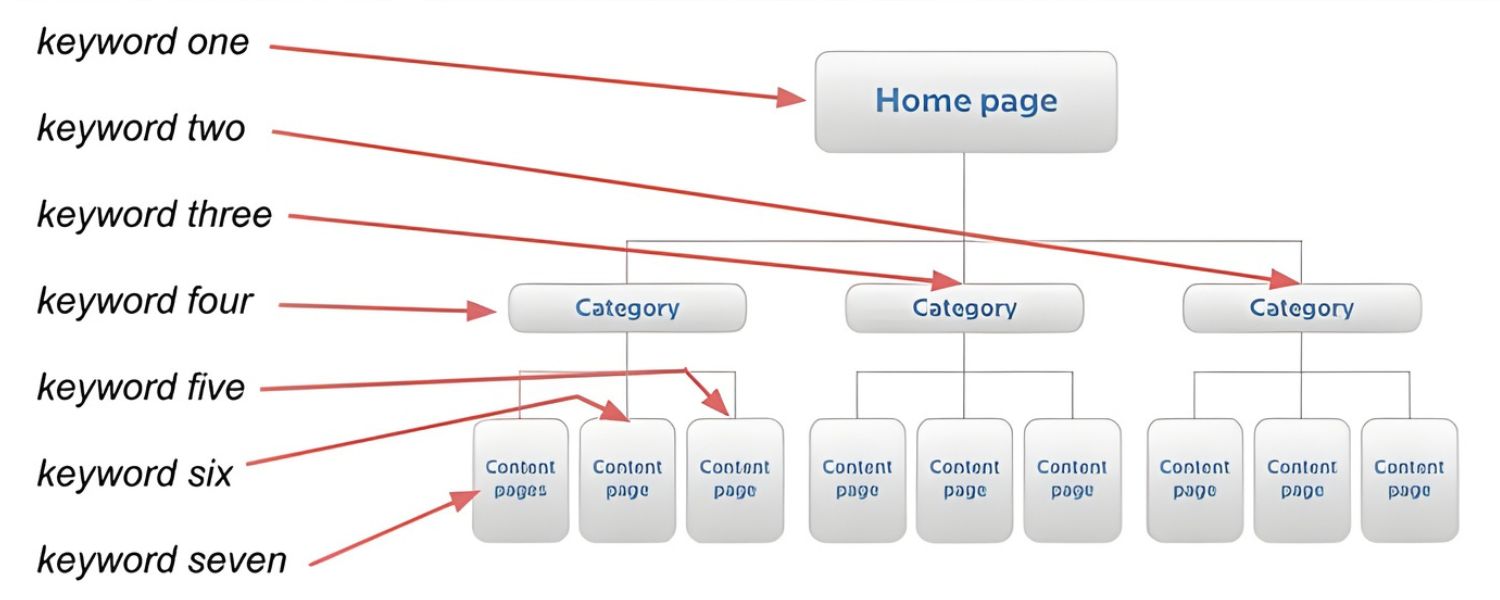
Start by taking all the important keywords you’re targeting and categorizing them by intent (as we’ve done above).
Then, assign each keyword or group of similar-intent keywords to a content type or page on your site.
Essentially, each keyword (or set of keywords with the same intent) should have a matching piece of content designed for that intent.
For example:
- If you identified “how to lose weight safely” as informational, map that to a comprehensive blog post or guide on that topic.
- If “best protein powder for muscle gain” is commercial intent, plan a “Top 10 Protein Powders for Muscle Gain” article or a comparison chart.
- If “Buy XYZ Protein Powder” is transactional, that should map to the product page or e-commerce page where someone can purchase XYZ Protein Powder.
- If “XYZ Nutrition official” is navigational (looking for your brand), ensure you have a strong homepage or landing page for that.
This process is sometimes called intent mapping or content mapping.
It ensures you have content that covers every stage of the user journey: from informational (awareness stage) to commercial (consideration stage) to transactional (decision stage), plus content that serves navigational queries for your brand.
It’s also a good way to spot gaps. If you have tons of informational blog posts but few conversion-focused pages, you might be missing out on transactional intent (and vice versa).
2. Optimize On-Page Elements to Reflect Intent
Once you have the right type of page for a keyword, make sure your on-page SEO elements align with that intent as well:
A. Title Tags and Meta Descriptions
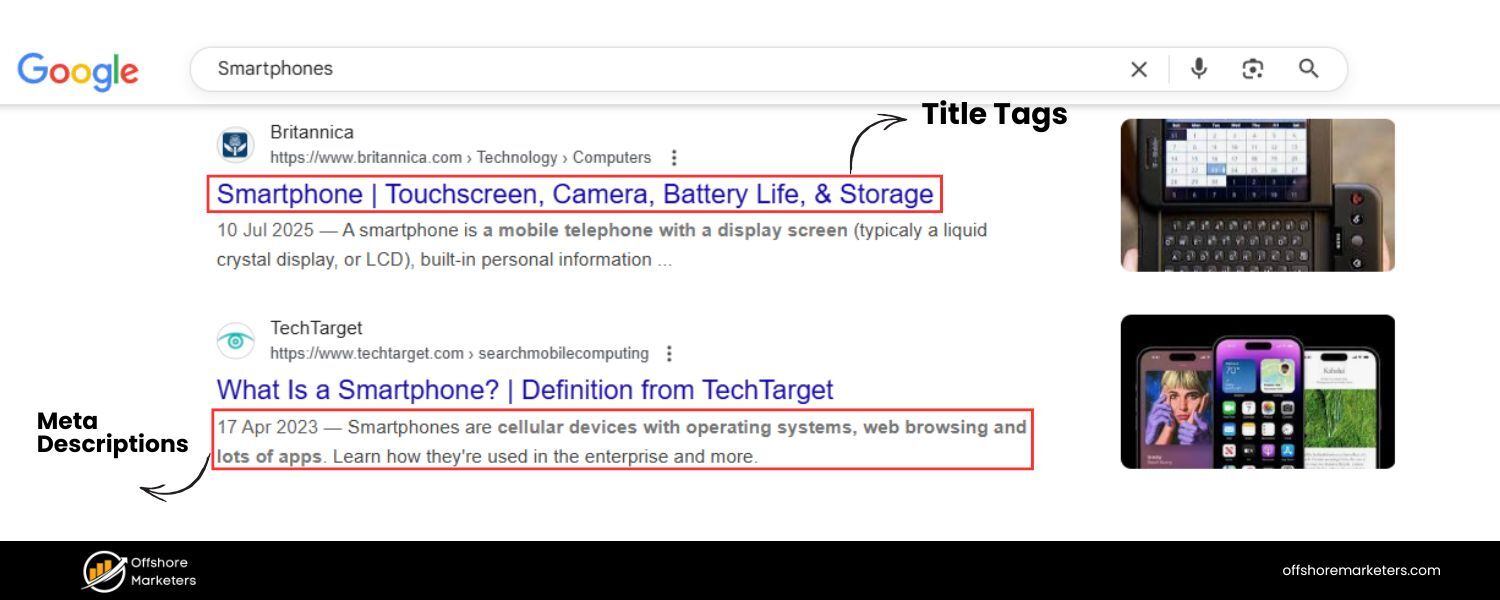
Use wording that matches the intent. For an informational article, your title might be “How to ” or a descriptive title that promises an answer.
For a transactional page, include action words and the product name (“Buy ___ Online | Free Shipping”). For commercial content, titles like “Best ___ in 2025” or “ vs ___: Which is Right for You?” signal that comparative intent.
By reflecting intent keywords in your title/meta, you’ll get a higher click-through rate from searchers because it directly speaks to their needs.
(Also, Google often bolds matching terms in the snippet, which catch the eye.)
B. Headings (H1, H2, H3)
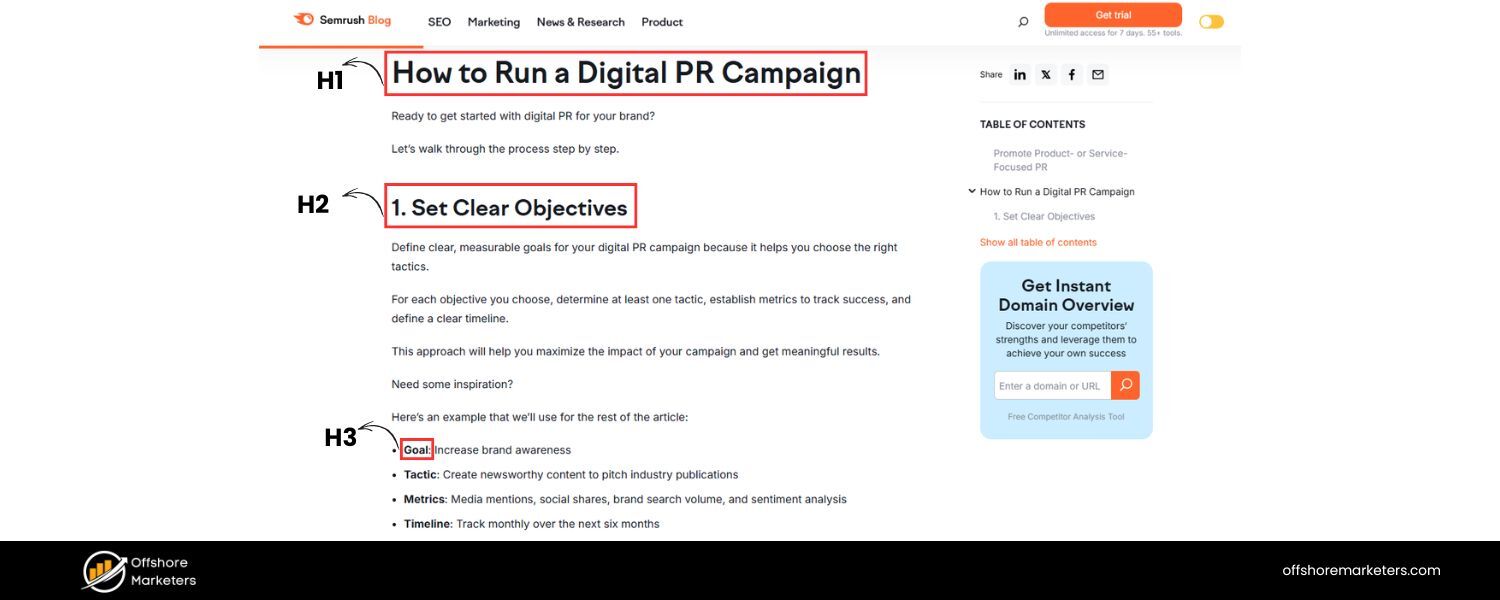
Structure your content to cover what an intent-user would want.
For a “how to” guide, step-by-step sections (H2: Step 1, Step 2, or key aspects of the process) are useful. For a “best X” list, each item might be an H2 or H3 with the product name, etc.
If people often have certain questions (check People Also Ask), consider making those questions your subheadings – this can help you rank for those as well and satisfy the query thoroughly.
C. Content Depth and Detail
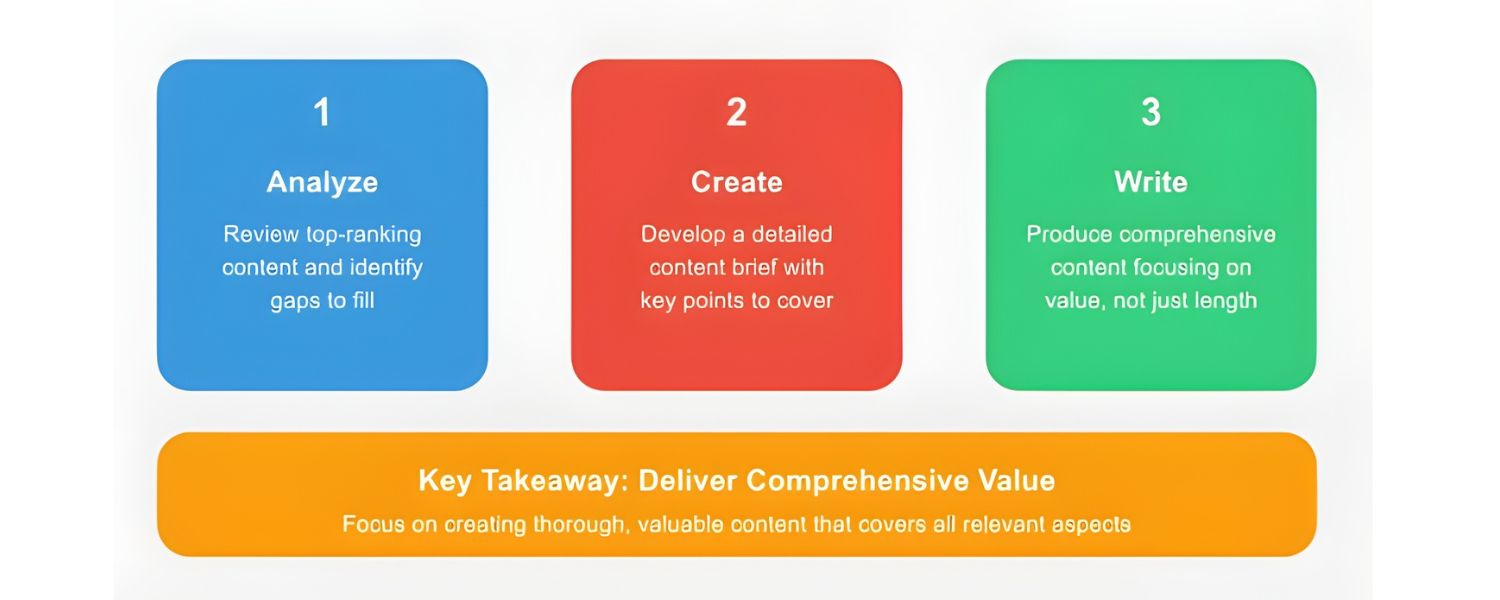
Adjust the depth of information to intent. An informational piece should be comprehensive and answer likely follow-up questions (because an info-seeker may be exploring broadly).
A commercial piece should focus on comparing options and giving recommendations.
A transactional page should actually minimize unnecessary content, the user doesn’t need a 2000-word essay on the product on the purchase page (they likely already decided); they need key details (specs, price, reviews) and a clear way to buy.
In fact, too much content on a transactional page can distract or confuse. So, match the depth to the intent, deep and rich for info/commercial, concise and action-oriented for transactional, straightforward and brand-centered for navigational.
D. Calls to Action (CTA) and Next Steps
Think about what you want the user to do after consuming the content, and make sure that aligns with their intent.
For informational pages, the next step might be a gentle CTA like “Learn more about [related topic]” or an invitation to subscribe/download a guide (since they’re not buying yet).
For commercial pages, a great CTA could be “Check price on [Product]” or “Start Free Trial” or “See our full review of [top choice]” – something that nudges them closer to decision.
For transactional pages, the CTA is the purchase or signup button itself – make it prominent, above the fold, and easy to complete.
If you satisfy someone’s informational intent and they’re ready to move to the next stage, having internal links or CTA buttons to more commercial content or product pages is key (this is internal linking for user journey, which also benefits SEO by distributing link equity and guiding crawl).
E. Multimedia and Format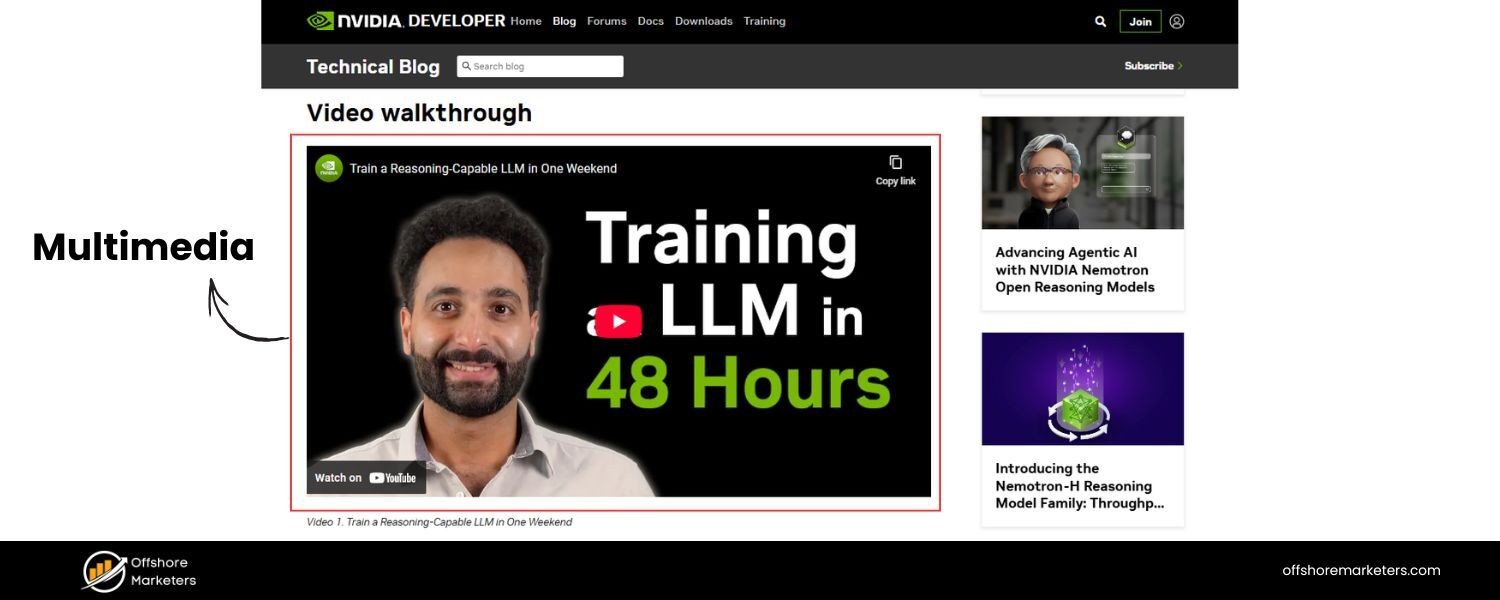
Use formats that best serve the intent. Informational content can benefit from images, diagrams, or videos (e.g., a tutorial video embedded in a “how to” article).
Commercial content might include comparison tables, star ratings, product images, etc.
Transactional pages should have clear product images, maybe a demo video or screenshot if software, but keep media lean to not slow down the purchase process.
If the intent is local or navigational, embedding a Google Map or providing a quick link is helpful.
The goal is to present information in the form the user would find most useful and digestible given their intent.
3. Content Examples for Each Intent Type
To really cement the concept, here are content ideas tailor-made for each intent category:
A. For Informational Keywords
– Long-form “How-To Guides” (e.g., “How to Optimize Your Website Speed – Step by Step”).
– Educational blog posts addressing “What is ___” or “Why ___ happens”.
– Tutorial videos or infographics explaining a concept visually.
– Checklists or cheatsheets (if the query is something like “tips for ___” – you can create a downloadable checklist).
Goal:
Provide value, answer the question fully, and perhaps gently introduce how your product/service relates to the topic (without heavy selling).
B. For Navigational Keywords
– Homepage optimized with clear brand messaging (for “[Brand] official site”).
– Specific landing pages like a Login page, Contact page, Pricing page, About page (depending on what people search for with your brand).
Ensure these pages are easily accessible and indexed.– Support/FAQ pages for “[Brand] support” queries.– If applicable, dedicated pages for products or features that people often search directly (e.g. if you have a feature name that’s known).
Goal:
Get the user to the desired destination on your site as quickly as possible.
C. For Commercial Keywords
– “Best of” list articles (e.g., “10 Best Laptops for Graphic Design in 2025”).
– Product/service comparison posts (e.g., “XYZ vs ABC: Which CRM is Better for Small Business?”).
– Detailed reviews or case studies of individual products (especially if queries include “review”).
– Buyer’s guides (“Ultimate Guide to Choosing a __”), combining education with product suggestions.
– Category round-ups (“Top 5 Alternatives to [Leading Brand]”).
Goal:
Help the user decide and subtly guide them toward a favorable decision (e.g., highlighting features of your product or an affiliate product you recommend).
Include evidence, data, or testimonials to build trust. Strong internal links from these pages to your product or signup pages can then channel the user to transact when they’re convinced.
D. For Transactional Keywords
– Product pages or Service pages (with clear “Buy” or “Sign Up” options).
– Checkout or Signup funnel pages (if it’s a multi-step signup, ensure the entry page is optimized for the keyword, like “Free Trial – [Product]”).
– Landing pages for ads (often, you might have PPC landing pages that you can also optimize for organic if they’re relevant).
– Special offer or coupon pages if you want to capture those “discount [product]” searches, sometimes a simple page saying “Get 20% off [Product] – limited time offer” can both rank (if optimized well) and convert.
Goal:
Make it extremely easy for the user to complete the intended action.
Minimize distractions, ensure the page loads fast, and that the call-to-action is front and center.
If any information is needed to instill confidence (e.g., “Free shipping, 30-day return policy” or security badges), include those in a subtle way.
Remember, page experience matters too – especially for transactional pages, factors like page speed, mobile friendliness, and user-friendly design can make or break a conversion.
Google’s algorithms also indirectly reward good UX (through signals like bounce rate, time on site, Core Web Vitals, etc.), so optimizing intent isn’t just content, it’s also delivering it in a user-friendly way.
4. Don’t Forget Internal Linking and Site Structure
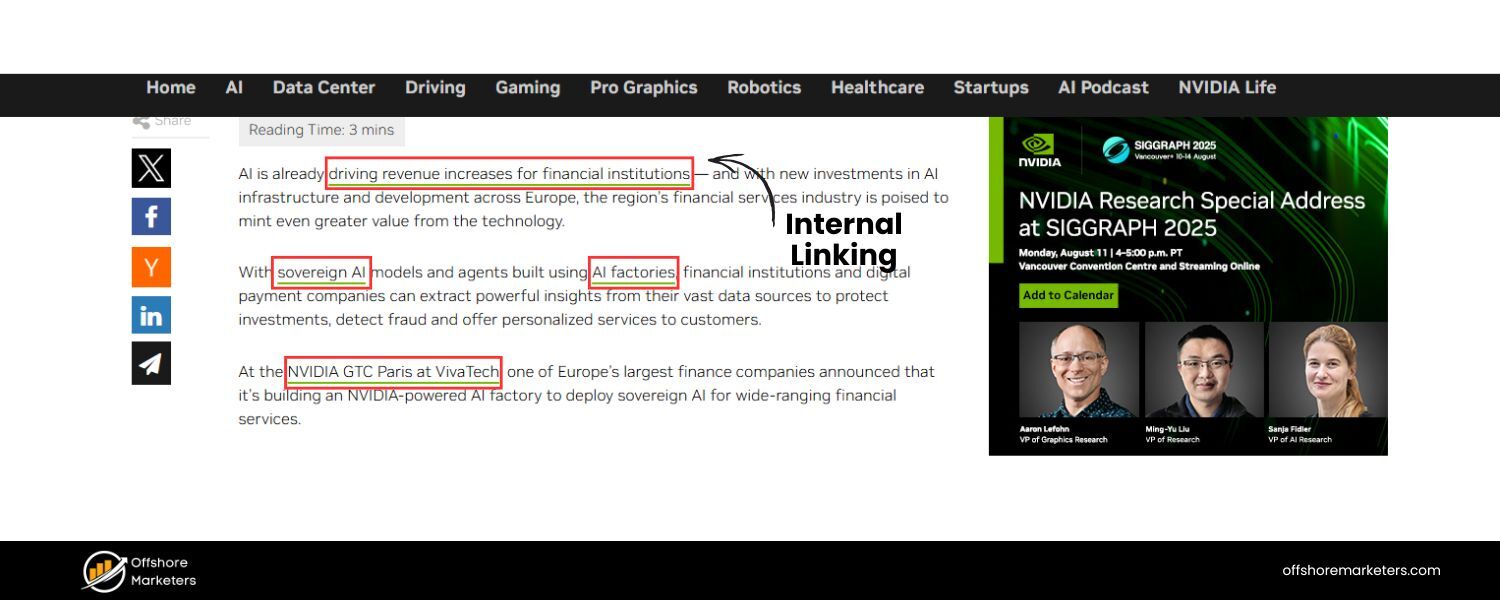
We touched on internal linking – this is important not just for SEO but for guiding users along the journey.
Think of your content pieces as part of a funnel:
A. An informational article can naturally link to a commercial page (“After learning the basics of X, you might be interested in our roundup of the best X tools…”).
B. A commercial comparison can link to transactional pages (“Ready to try one of these tools? Sign up for a free trial of [Your Tool] here.”).
C. Transactional pages can link to info if needed (e.g., “Not sure which plan to pick? See our buyer’s guide.”) – though usually minimal linking out from a checkout page, but a product page might link to spec sheets or FAQs.
This not only helps users get more info if they need it, but also helps search engines understand the relationship of your pages and distribute authority.
Strategic internal linking can improve your rankings for those pages by providing context and link equity.
For example, if you have 5 blog posts about various subtopics and all link to your “Best Tools for X” page with relevant anchor text, it signals to Google that the “Best Tools for X” page is authoritative for that topic (and it will likely rank better).
Make sure your site navigation or menu also caters to different intents.
Perhaps have sections like “Blog” (which is mostly informational content), “Resources/Guides” (commercial guides, etc.), and “Products” or “Shop” (transactional).
Clear labels can even catch some navigational queries (like if someone searches “[Your Site] blog”, they might see a sitelink to your blog).
5. Update and Improve Content to Match Changing Intent
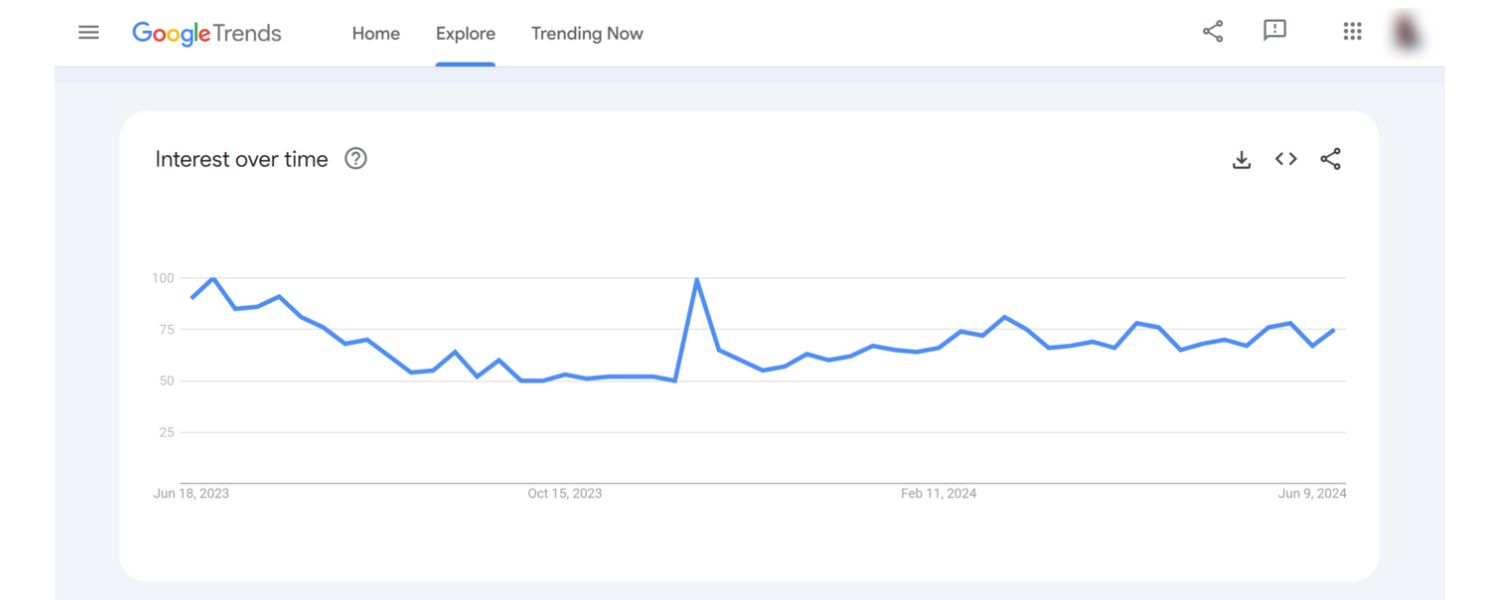
Search intent isn’t static. The same keyword can shift intent over time as user behavior changes or as Google interprets it differently.
For instance, a term like “Zoom” pre-2020 might have been largely navigational (people looking for the Zoom app download).
In 2020, it might have gained more informational intent (“how to use Zoom” queries spiked). Google adapts the SERP accordingly.
Likewise, seasonality can affect intent (e.g., “tax filing” searches in tax season become more transactional – people looking to actually file – whereas off-season they might be informational).
It’s wise to periodically audit your content performance. If a page that used to do well drops in ranking, check if the intent of the top results changed.
Perhaps new types of content are ranking. That might mean you need to refresh your page or even create a new page to meet that intent.
For example, if you had a transactional page ranking but Google started favoring a “top 10” style post, you might need to add some content or sections to your page, or create a separate comparison piece and link them.
Also, as your business offerings grow, you might need new pages for new transactional intents, or new blog articles for emerging informational queries.
Keep an eye on Search Console for new queries your site is getting impressions for, do they indicate a content gap?
6. E-A-T and Intent
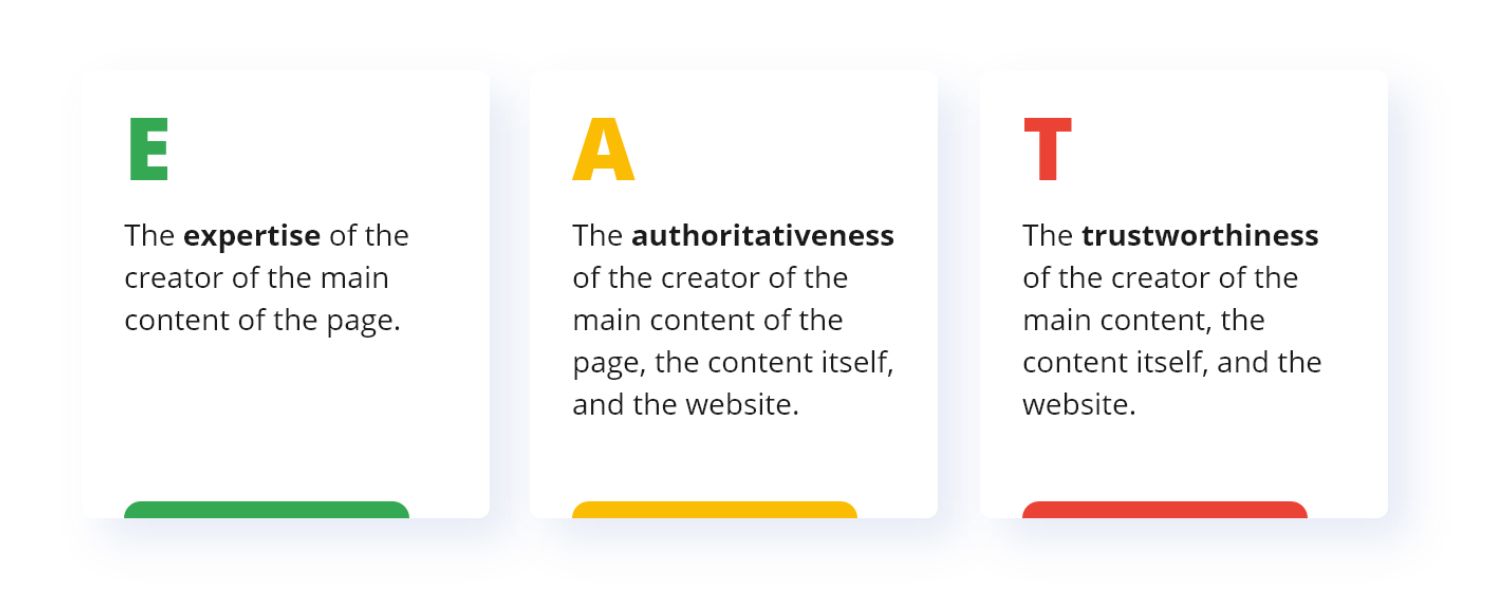
Google emphasizes E-A-T (Experience, Expertise, Authoritativeness, Trustworthiness) especially for Your Money Your Life (YMYL) topics.
Matching intent is part of providing a good experience, but also ensure that for queries where trust matters (health, finance info), you demonstrate expertise (cite sources, have expert authors, etc.).
If the intent is informational on a sensitive topic, fulfilling it isn’t just about answers, but accurate and trustworthy answers.
This will indirectly help SEO as Google’s quality raters and algorithms assess content quality.
So, align content quality and credibility with the intent as well (especially critical for informational intent on YMYL topics, and for commercial/transactional, ensure user trust via reviews, security seals, etc.).
Conclusion: Leverage Keyword Intent for SEO Success
In 2025 and beyond, keyword intent is at the heart of effective SEO strategy. It’s not enough to find high-volume keywords and stuff them into pages.
You need to deeply understand why your audience is searching for those terms and serve them the content that meets that intent.
By doing so, you create a positive feedback loop: users are satisfied with your content, they stay longer and convert, search engines notice the positive engagement, and your rankings improve further.
To recap, always start your content planning with intent analysis. Create or optimize pages specifically for informational, navigational, commercial, or transactional purposes as needed.
Use the tools and techniques discussed, from manual SERP analysis to advanced SEO toolkits, to classify intents accurately.
Then, deliver exactly what the searcher is looking for (and a bit more). If you can be the result that best answers the user’s query, Google will reward you with higher visibility.
Remember, the true measure of SEO success isn’t just traffic, it’s relevant traffic that takes action.
Keyword intent is the bridge between attracting visitors and converting customers.
By aligning your SEO efforts with search intent, you ensure that the right people find the right pages on your site at the right time in their journey.
Now it’s your turn:
Apply these insights to your own website.
Start by reviewing your top keywords and pages, are they aligned adequately with intent? Where can you better address what users are looking for?
Often, minor tweaks (like changing a title, adding a section, or splitting content into two focused pages) can yield significant gains in engagement and rankings.
In an era where search algorithms are increasingly sophisticated, with AI and natural language understanding, focusing on user intent is non-negotiable.
The old tricks won’t work; genuine relevance and user satisfaction are the SEO “hacks” of today. Optimize for intent, and you optimize for both users and search engines.
Lastly, keep learning and monitoring. Intent can evolve, and new types of searches (voice queries, conversational queries to AI assistants, etc.) are emerging.
Stay updated on search trends and continue refining your content to match the needs of your audience.
By mastering keyword intent, you’ll not only boost your SEO performance but also provide a better experience for your audience, and that’s a win-win that will sustain your success for the long haul.
Ready to put keyword intent into action? Start by analysing your own site’s keywords or content gaps.
Pick one high-potential keyword and ask, “What exactly is the searcher looking for?” – then make sure your content delivers it.
Over time, you’ll build an intent-optimised content portfolio that drives qualified traffic and conversions consistently.
Good luck, and let’s dominate those SERPs by giving searchers what they want!

.png)
Shopify SEO: Guide to Ranking Your Store and Driving Sales
Most Shopify store owners set up their store, list their...

Content Marketing : Definitive Guide to Strategy, Content Types, and Measurable ROI
Content marketing generates 3x more leads than outbound marketing at...

Above the Fold: Guide to Conversions, Rankings and Faster Pages
Above the Fold in 2026: The Complete Guide to Conversions,...

Off-Page SEO Checklist: Guide to Building Real Authority
Most websites spend months creating great content, only to wonder...

What Is Keyword Bidding? The Complete Strategy Guide for Smarter Ad Spend
Most advertisers believe the highest bid wins the auction. It...
What Is Google Trends? The 2026 Marketer’s Complete Guide
If you are not already pulling weekly insights from Google...
If you want a growth partner who will get to know every aspect of your business and treat your budget like their own — we are the right fit.
.png)


.png)
.png)
.png)
.png)
.png)
.png)
2026 ALL RIGHTS RESERVED MADE IN INDIA
