
Keyword Optimization: To Boost Your SEO Performance
August 20, 2025
Introduction
If you’ve ever wondered why some websites soar to the top of Google while others barely get seen, one key reason is effective keyword optimization.
As a marketing expert with 25 years of experience, I’ve watched SEO trends come and go, but one thing remains constant: you need to research the right keywords and use them wisely in your content to increase visibility.
In fact, strategically optimizing for relevant search terms helps your content rank higher on search engine results pages (SERPs), and the top 3 organic results capture over 68% of all clicks.
In this comprehensive guide, we’ll explore how to find high-value keywords, incorporate them naturally into your website, and leverage the latest tools and best practices (as of 2024 and beyond) to outrank your competition. By the end, you’ll know exactly how to optimize keywords to boost your SEO performance and drive more organic traffic to your site.
What Is Keyword Optimization? (Definition & Basics)
Keyword optimization is the process of improving a webpage’s content to make it more relevant to specific search queries. In simple terms, it means using the right keywords in the right places and in the right way throughout your site content. This practice bridges the gap between what users search for and the information your website provides.
It’s not the same as initial keyword research (which is about finding and analyzing potential keywords); rather, optimization is about taking those target terms and strategically weaving them into your site’s pages so that search engines understand your content and rank it for the appropriate queries.
Some key aspects of keyword optimization include:
Relevance
Choosing keywords that closely match your content’s topic and the search intent of your audience (more on intent later). The goal is to satisfy what the searcher is looking for when they type that keyword. If your page is highly relevant, Google views it as more likely to answer the query.
Placement
Incorporating keywords into critical parts of your page such as the title tag, headings, meta description, URL, image alt text, and naturally throughout the body content. Proper placement signals search engines about the page’s subject.
Avoiding Over-Optimization
While using keywords is important, stuffing them (excessively repeating the same word or phrase) is against Google’s guidelines. The content should read naturally for humans. Google’s algorithms are smart enough to understand variations and synonyms of your keywords, so you don’t need to force an unnatural repetition of exact terms.
In essence, keyword optimization is about making your content highly relevant and useful for the search terms you target, without resorting to spammy tactics. Next, we’ll discuss why this process is so critical for SEO success.
Why Is Keyword Optimization Important?
Optimizing your keywords is a cornerstone of any successful SEO strategy. Here’s why it matters so much:
1. Higher Search Visibility
By aligning your pages with the terms people are actively searching for, you signal to search engines that your content matches those queries. This dramatically improves your chances of ranking well.
And ranking matters—a recent 2025 study showed that the #1 organic result gets about 40% of clicks, and the top 3 results together get nearly 69% of all clicks. If you’re not optimizing for relevant keywords, you’re missing out on the majority of potential traffic.
2. Better Audience Targeting
Keyword optimization isn’t just for search engines; it’s fundamentally about understanding your audience’s language and needs. By researching what words and phrases your potential customers use, then crafting content around those terms, you ensure you’re providing the information people actually want.
The result is a better user experience. Visitors feel like “This site speaks my language and has what I’m looking for,” which in turn builds trust and credibility. Satisfied users are more likely to convert into leads or customers.
3. Competitive Edge
In many industries, your competitors are vying for the same popular keywords. Effective optimization can help you outrank competitors for those valuable search terms. Moreover, identifying niche or long-tail keywords (which competitors may have overlooked) can open up new avenues for traffic.
Each optimized page is an opportunity to capture searchers that might otherwise land on a competitor’s site. Over time, consistently well-optimized content can establish your site as an authority in your field.
4. Maximize ROI of Content
High-quality content takes time and resources to produce. Keyword optimizing that content ensures it reaches the widest relevant audience possible. Rather than writing blog posts or product pages that nobody finds, you’ll be creating content that attracts organic traffic month after month.
This makes your content marketing more cost-effective. It also helps you discover which topics and terms actually drive results (so you can focus on what works).
In short, keyword optimization helps search engines and users see your content as valuable and relevant. It boosts your visibility, draws in targeted traffic, and sets the foundation for achieving your business goals online (be it more readers, sign-ups, or sales).
Pro Tip:
Think beyond just rankings. Ultimately, the goal is to meet user needs. Google rewards content that is helpful, reliable, and people-first. When you optimize, always ask: “Does this addition of a keyword make the content more useful or just more search-engine focused?” Aim for usefulness, and the rankings will follow.
Step 1: Find the Right Keywords (Keyword Research Fundamentals)
Effective keyword optimization starts before you ever tweak a page – it begins with choosing the right keywords to target. Optimizing for the wrong keywords (ones that are irrelevant to your business or too competitive to rank for) can be a wasted effort. Here’s how to ensure you’re picking the best keywords from the start:
1. Brainstorm and Research Keywords
Begin by listing topics related to your business, products, or content. Put yourself in your audience’s shoes – what would they search for? For example, if you run a running shoe store, obvious terms might be “running shoes,” “best running sneakers,” “men’s running shoes,” etc.
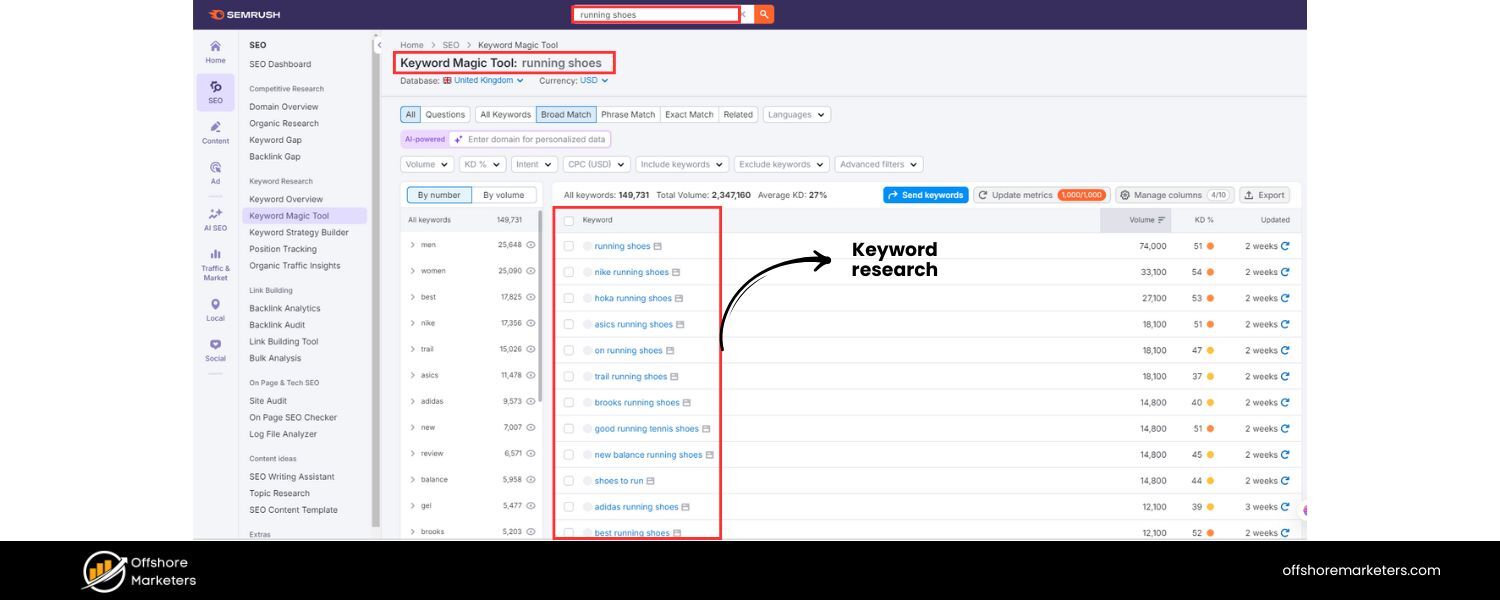
Then, expand this list using keyword research tools. Tools like Google’s Keyword Planner (free with a Google Ads account) can suggest related keywords and show search volumes.
Professional SEO tools such as Semrush, Ahrefs, Moz, or cognitiveSEO offer even deeper insights – including search volume, keyword difficulty scores, and related term suggestions. These tools can uncover not only popular “head” terms but also more specific queries.
A. Use a mix of tools
For instance, Google Keyword Planner might reveal how often people search your term each month and suggest variants, while Ahrefs/Semrush can show how competitive the term is and even estimate total traffic potential (by analyzing what top-ranking pages get). Using multiple sources ensures you don’t miss valuable keywords.
B. Long-Tail vs Short-Tail
Be sure to include a mix of short-tail keywords and long-tail keywords. Short-tail (or “head”) keywords are usually one or two words and very broad (e.g. “running shoes”). They tend to have high search volume but also high competition. Long-tail keywords are longer, more specific phrases (e.g. “best trail running shoes for flat feet”).
Each long-tail term has lower volume, but collectively long-tails make up a large portion of searches, and they often indicate a searcher who is closer to a specific need or purchase.
They also typically have lower competition, making them easier to rank for and often higher-converting (since the intent is clearer). Targeting a variety of long-tail queries can help you capture niche traffic that big competitors might overlook.
2. Evaluate Keyword Metrics
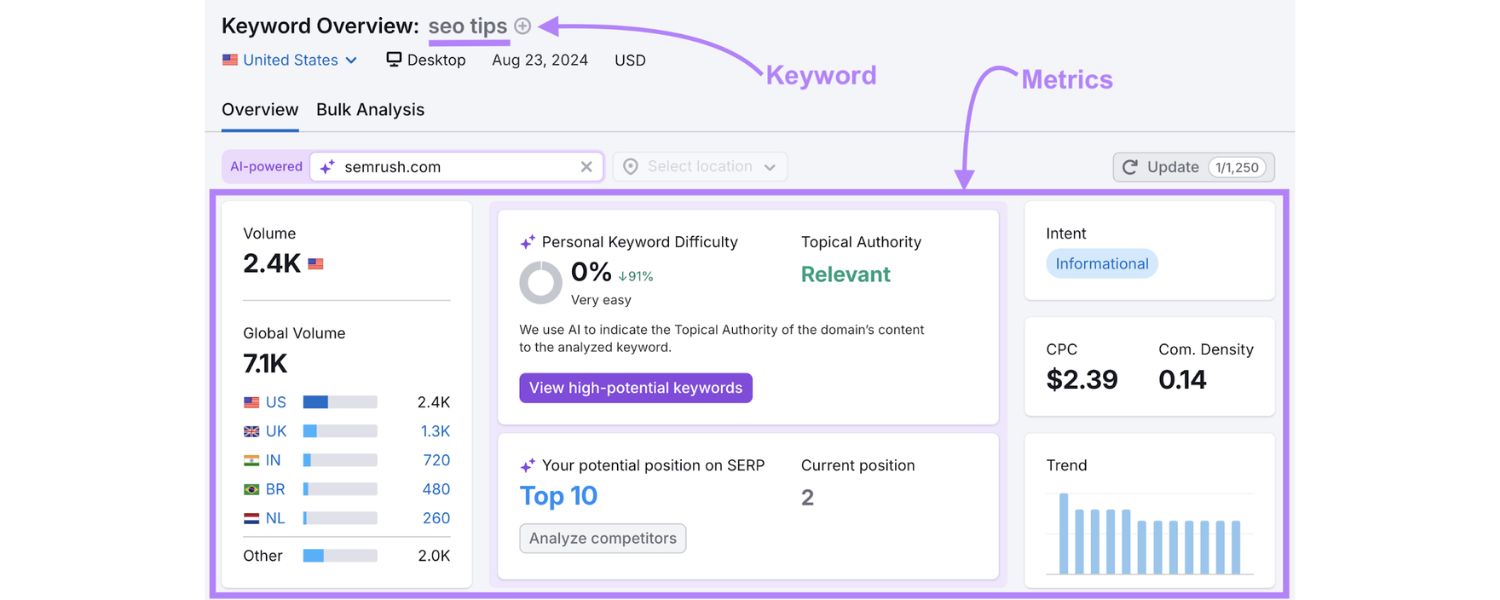
Not all keywords are equally valuable. Once you have candidate keywords, evaluate them on key metrics:
A. Search Volume
How many people search for this term (typically measured monthly)? A higher volume means more potential traffic, but don’t be blinded by volume alone. Sometimes a lower-volume keyword that’s highly relevant to your offerings is more valuable than a high-volume one that’s only loosely related.
Also, note that some searches yield fewer clicks than their volume suggests (for example, if Google shows a direct answer or many ads, fewer people may click results).
B. Traffic Potential
A more holistic metric than raw volume is traffic potential. This considers that ranking for one keyword often means you’ll rank for a bunch of related keywords too. SEO pros estimate traffic potential by looking at the top-ranking page for a keyword and seeing how much total traffic that page gets from all keywords.
If the top page gets, say, 5,000 visits a month (even if the keyword’s own search volume is 500), that indicates a broad topic where a well-optimized page can pull traffic from many queries. Some SEO tools provide a “traffic potential” number for this.
C. Keyword Difficulty (Competition)
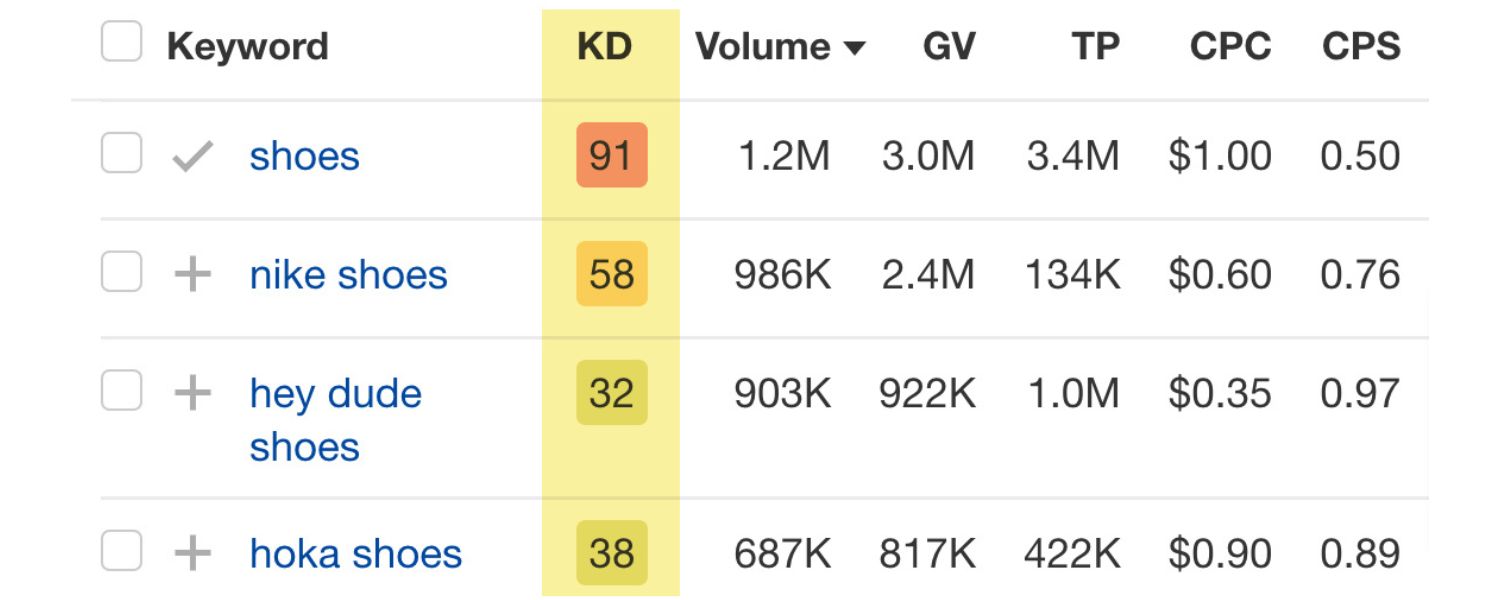
Gauge how hard it might be to rank for a term. Tools often provide a keyword difficulty score which usually factors in the authority and number of sites currently ranking on page 1. For example, if all the top results for a keyword are from very high-authority domains, breaking in will be challenging.
A quick manual check is to search the keyword and see what comes up: Are they big brands? Niche sites? Does the content match what you would create? A high difficulty isn’t a total no-go, but you may need a very strong page (or lots of site authority) to compete. It’s often wise to target a mix of difficulty levels – some “low-hanging fruit” (easy wins) and some stretch targets.
D. Relevance & Value
Most importantly, consider the relevance and business value of the keyword. Ask yourself: If I attract visitors with this search term, are they likely to become customers, subscribers, or achieve some goal that matters to me? For example, a photography blog might get lots of traffic by ranking for a celebrity’s name (high volume, maybe not too hard), but those visitors probably won’t care about your photography tips.
On the other hand, a lower-volume term like “best DSLR camera for beginners” is highly relevant and could lead to conversions (like affiliate sales or email signups). Some marketers even score keywords by “business potential”, how likely the searcher is to need your product or services. Focus your optimization efforts on terms with clear value to your business.
3. Analyze Search Intent
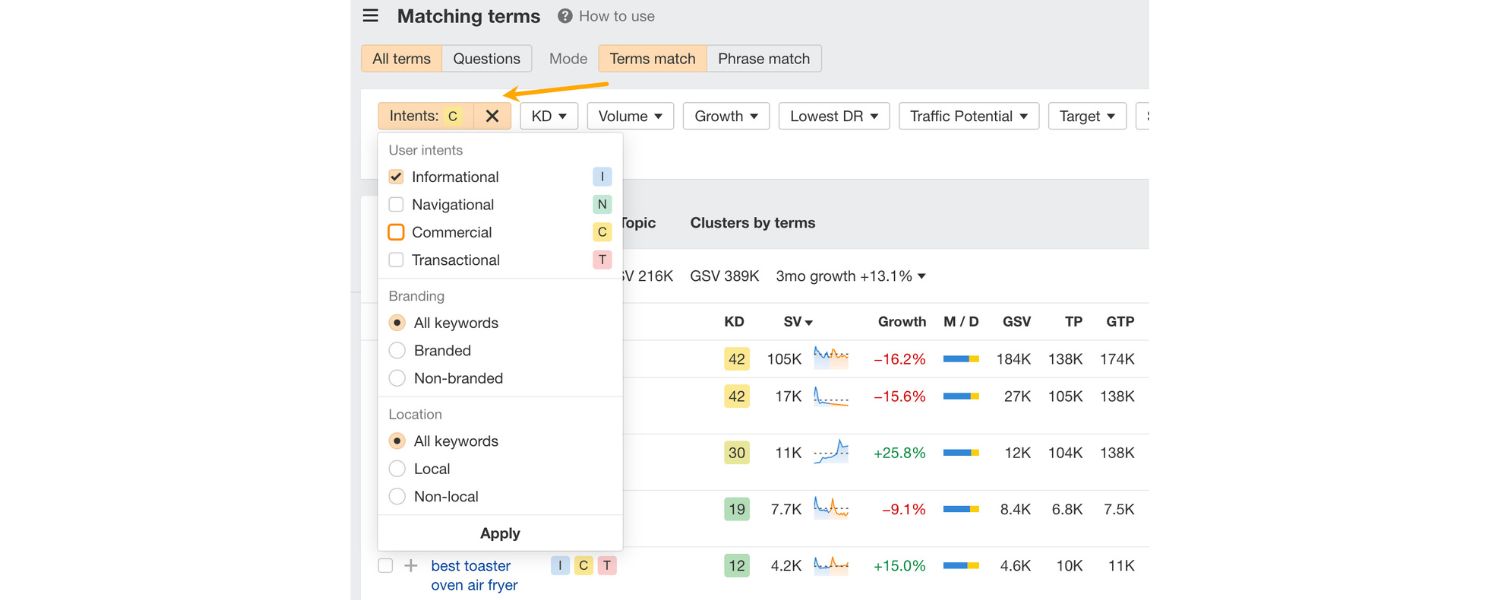
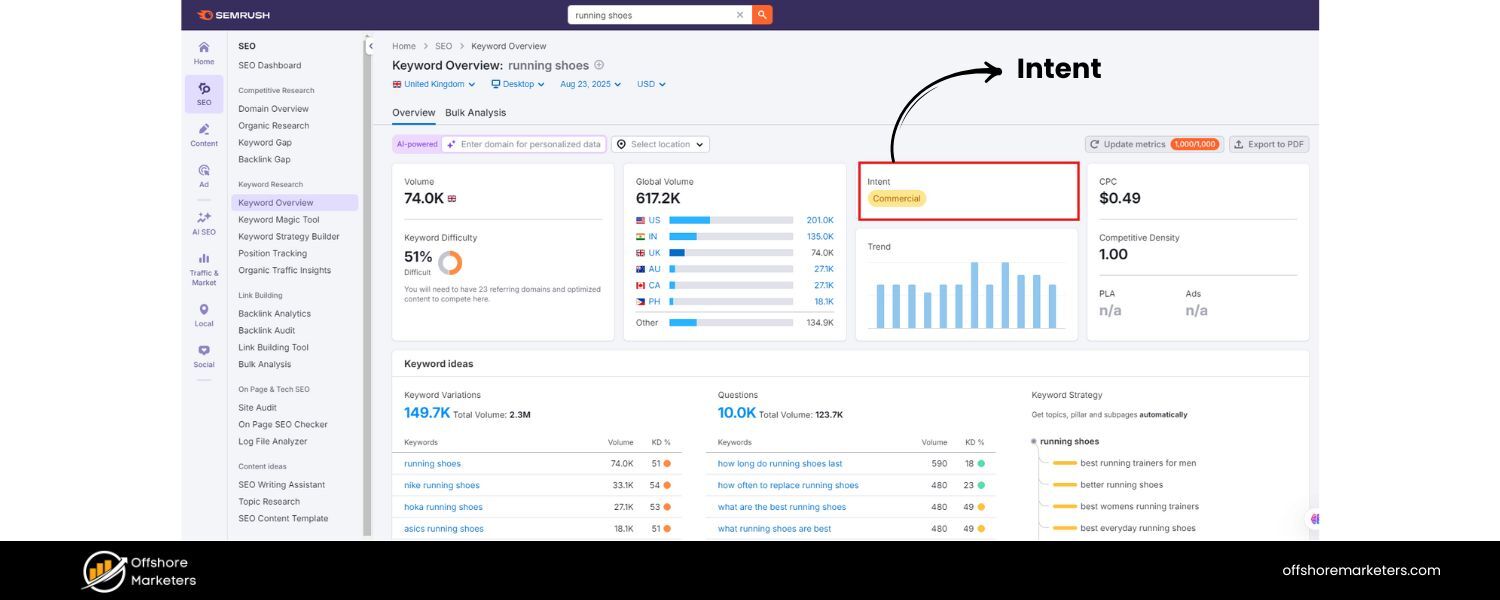
Before finalizing a keyword to target, make sure you understand the search intent behind it. Search intent means what is the user really looking to do or find with that query (are they researching, looking to buy something, seeking a specific site?).
Generally, intents are categorized as: informational (looking to learn), commercial investigation (researching products or solutions), transactional (ready to buy or act), or navigational (seeking a specific website). For each keyword on your list, Google it and study the results – this is the best way to gauge intent.
A. Look at the content type of top results
Are they blog posts, product pages, category pages, videos? Google tries to serve the format people want. If you search your keyword and all the top results are in-depth articles, that tells you an article is likely what searchers want (not a product page.
For example, a query like “best running shoes 2025” will mostly return blog-style review lists (informational/commercial intent), whereas “buy Nike Pegasus size 10” will show e-commerce product listings (transactional intent). Align your content type with what’s ranking.
B. Note the content format and angle
For informational queries, are the top pages mostly “How-to” guides, listicles (e.g. “10 Tips…”), comparisons, Q&A format, etc.? For instance, many “how to” queries demand step-by-step tutorials, whereas “best” queries often yield list posts (top 10 lists).
Also observe if there’s a common angle: e.g., do titles frequently mention “…for beginners” or “…in 2025” or other themes? This can hint at what users specifically want (freshness, level of detail, etc.). While you should add your unique spin, understanding the prevailing intent prevents you from missing the mark. You might have the most well-optimized page, but if it doesn’t satisfy the searcher’s intent, it won’t rank well.
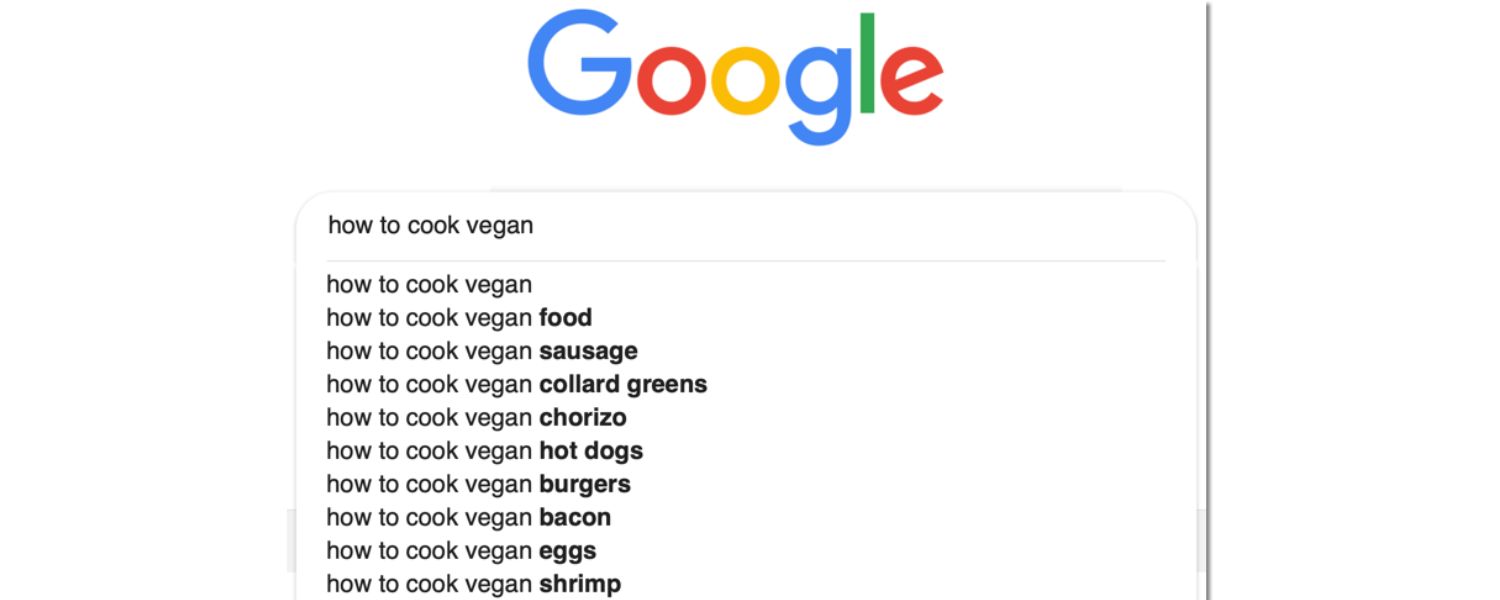
C. Check for People Also Ask questions or related searches on Google
These can reveal subtopics and common questions users have around your keyword. They’re great clues for what to cover in your content. For example, searching “email marketing strategy” might show “People also ask: How do I improve email open rates?
How often should you send marketing emails?” – such questions could be sections in your article. Covering these related queries can improve your relevance and even help you snag a featured snippet (more on snippets later).
By the end of this research phase, you should have a mapped list of target keywords – ideally grouped by topic and intent – that you want to optimize for. You’ll know for each keyword what kind of content you need to create or tweak, and you’ll have an idea of priority (based on relevance and potential).
Step 2: Organize and Map Your Keywords (Clustering & Keyword Mapping)
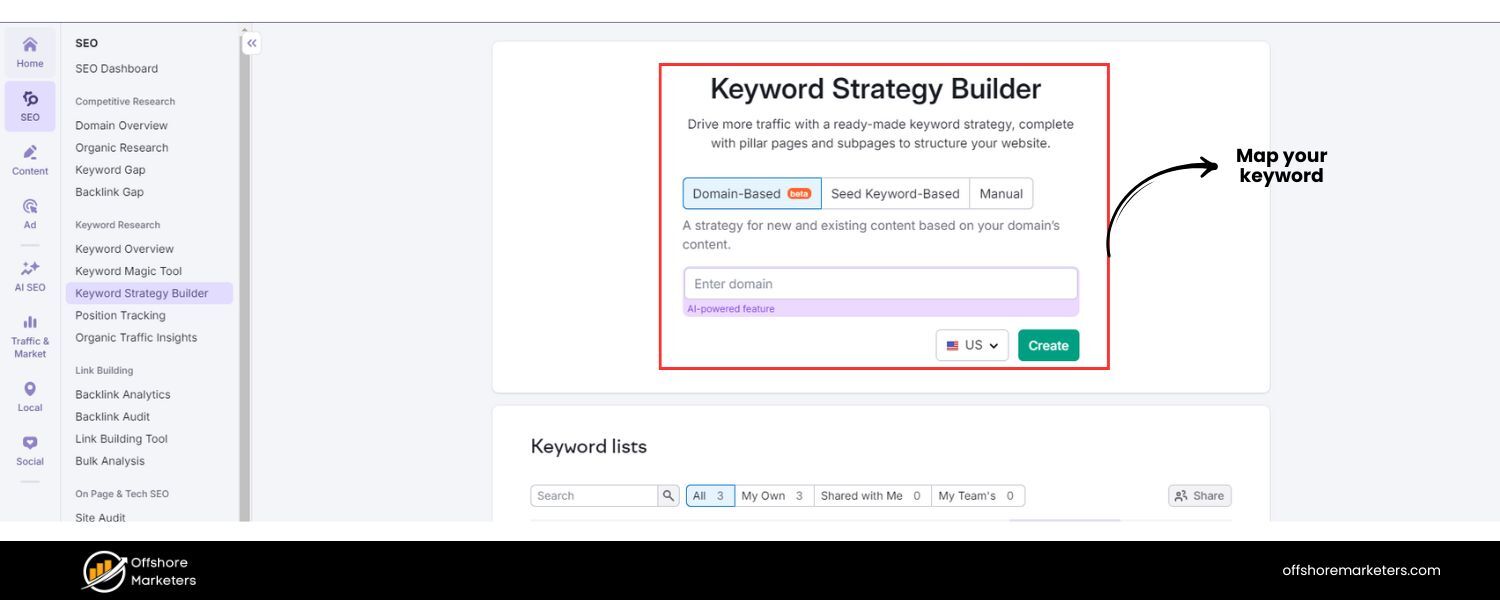
Once you have a solid set of keywords, the next step is to organize them strategically across your site. You don’t want to just randomly sprinkle keywords around; instead, use a deliberate approach so that each page targets a clear set of terms. Two useful techniques here are keyword clustering and keyword mapping:
A. Keyword Clustering:
This means grouping similar or closely related keywords into clusters that can be addressed by a single piece of content.Remember, people might search for the same thing in different ways. For example, let’s say your primary keyword is “email marketing tips.” Related variants might include “email marketing best practices,” “improving email campaign performance,” “how to do email marketing,” etc.
Rather than create separate pages for each minor variation (which could be thin and compete with each other), it often makes sense to cluster them and target them all with one comprehensive page.
Google’s sophisticated language understanding can often rank one page for hundreds of related terms if the content is thorough. Clustering helps you cover a topic broadly, avoid duplicate content, and provide a better resource for users.
Example: A keyword research tool clustering related terms for “curtains” (showing groups like “rod”, “blackout”, “panel”, etc.), which helps identify how multiple queries can be covered by one broader topic.
B. Keyword Mapping:
This is the practice of assigning specific target keywords or clusters to particular pages on your site. In other words, you create a “keyword map” that says Page A will target cluster X, Page B targets cluster Y, etc.
The benefit here is twofold: First, it ensures you don’t have multiple pages unknowingly targeting the same keyword, which can result in your own pages competing against each other (known as keyword cannibalization). Second, it reveals content gaps – topics that have keyword interest but you have no page addressing them (so you might decide to create new content).
You can do this mapping in a simple spreadsheet or use templates. Include the primary keyword for each page and a few secondary keywords from the cluster. Also note the search intent and any content notes (e.g., “Page X – target keyword: running shoes for flat feet; intent: “best” list article; format: list of top products”). This way, when you go to optimize that page, you have a clear focus.
Organizing keywords in this manner is especially important as your website grows. It’s like building a blueprint: each page has its defined role. For example, on an e-commerce site, you might map broad category keywords to category pages (e.g., “men’s running shoes” → Men’s Shoes category), while more specific informational keywords map to blog articles (“how to choose running shoes” → a guide on your blog).
Planning this out prevents overlap and helps you internallly link pages logically (since related pages in a cluster can link to each other, signaling topical relevance).
Lastly, note that clustering and mapping isn’t a one-time deal. Over time, search trends change and your site might evolve. Revisit your keyword map periodically. If you find two pages are targeting extremely similar terms, consider consolidating or differentiating them.
If new high-value keywords emerge, decide where they fit in your site’s structure – do you update an existing page or create a new one? Keyword optimization is an ongoing process, and good organization makes that process much easier to manage.
Step 3: Create High-Quality, Intent-Focused Content
With your target keywords in hand and an understanding of intent, it’s time to either create new content or refine existing content to satisfy the searcher’s needs. Google has made it abundantly clear that quality matters. They want to rank content that is helpful, credible, and relevant – not pages that just repeat a keyword over and over. Here’s how to ensure your content delivers:
A. Match the Search Intent and Topic Scope:
The first rule is give searchers what they want. Review your keyword’s intent analysis and make sure your content angle aligns. If people search “how to train a puppy,” they likely want a step-by-step guide covering the process from housebreaking to basic commands – so provide exactly that. In your outline, cover all major subtopics a user would expect.
A great approach is to look at the top-ranking pages and identify common themes or questions they all address (since those pages have effectively “proven” what users want).
You can use a tool or manual method: for example, Ahrefs’ Content Gap tool can extract keywords that multiple top pages rank for, hinting at subtopics you should include. By covering those points, you make your page more comprehensive and useful. At the same time, find your unique angle or value-add – something new, better, or different from competitors.
This could be including updated 2024/2025 data, expert quotes, case studies from your 25 years of experience, or better visuals. Your content should stand out as the most thorough and useful resource on the topic. That not only pleases readers but also encourages other sites to link to you (improving your rankings further).
B. Ensure Content is Well-Structured and Easy to Read:
Even the best information can fail if presented poorly. Organize your content with a clear hierarchy: use descriptive headings and subheadings (H2, H3, etc.) to break up sections.
This not only helps readers scan and find what they need, but search engines also use headings to understand context. Each section of your article should start with a concise subhead that tells what it’s about (and if appropriate, incorporates a keyword or related term).
Use bullet points or numbered lists for steps, tips, or lists of items, like we’re doing here – as they are easier to digest than long paragraphs. Keep paragraphs short (around 3-5 sentences) for readability. Also consider adding visuals (images, diagrams, videos) if they help explain the content. For example, infographics or screenshots can make a how-to guide much clearer.
C. Write Naturally, Optimize Gradually:
When drafting content, focus on quality writing first. Cover the topic fully in a way that’s engaging to your audience. Afterward, go back and optimize for your keywords. This involves checking that you’ve mentioned your primary keyword in key places (more on those specific places in the next section) and sprinkling in secondary keywords or synonyms where they make sense.
Use variations and related phrases so the content doesn’t feel repetitive – this also helps you capture latent semantic indexing (LSI) keywords and longer phrases people might search. For instance, if the primary keyword is “healthy smoothie recipes,” naturally you might also include terms like “nutritious shakes,” “breakfast smoothies,” or specific ingredient names.
Modern search algorithms understand context, so covering related terms improves your relevance. Just ensure any keyword usage flows in the sentence. If a phrase feels awkward, reword it – never sacrifice readability for the exact keyword. A good test is to read the content aloud; if it sounds odd or keyword-stuffed, revise it.
D. Demonstrate E-E-A-T (Experience, Expertise, Authoritativeness, Trustworthiness):
In 2024 and beyond, Google’s quality guidelines emphasize E-E-A-T. This means content that reflects personal Experience and formal Expertise, is presented in an Authoritative way, and comes from a Trustworthy source.
To boost E-E-A-T: mention your credentials or experience where relevant (e.g., I’ve noted my 25-year marketing background in this guide’s intro), cite reputable sources to back up facts (just like we’re doing with these external citations to authoritative sites), and ensure your content is accurate and up-to-date. If you have customer examples or case studies, include them to show real-world success.
Even things like a clean site design, proper grammar, and an up-to-date author bio can contribute to perceived trustworthiness. While E-E-A-T is not a direct “ranking factor” like a meta tag, it influences how both users and quality evaluators perceive your site, which can indirectly affect rankings.
Above all, focus on providing value. Keyword optimization is not about tricking Google – it’s about helping Google find and understand the value you offer to users. When you create content that genuinely answers questions or solves problems, you’ll naturally incorporate relevant terms and satisfy searchers.
This human-centered approach is exactly what Google’s algorithm advancements (like the Helpful Content Update) are rewarding.
Step 4: On-Page Optimization Best Practices (Using Keywords in the Right Places)
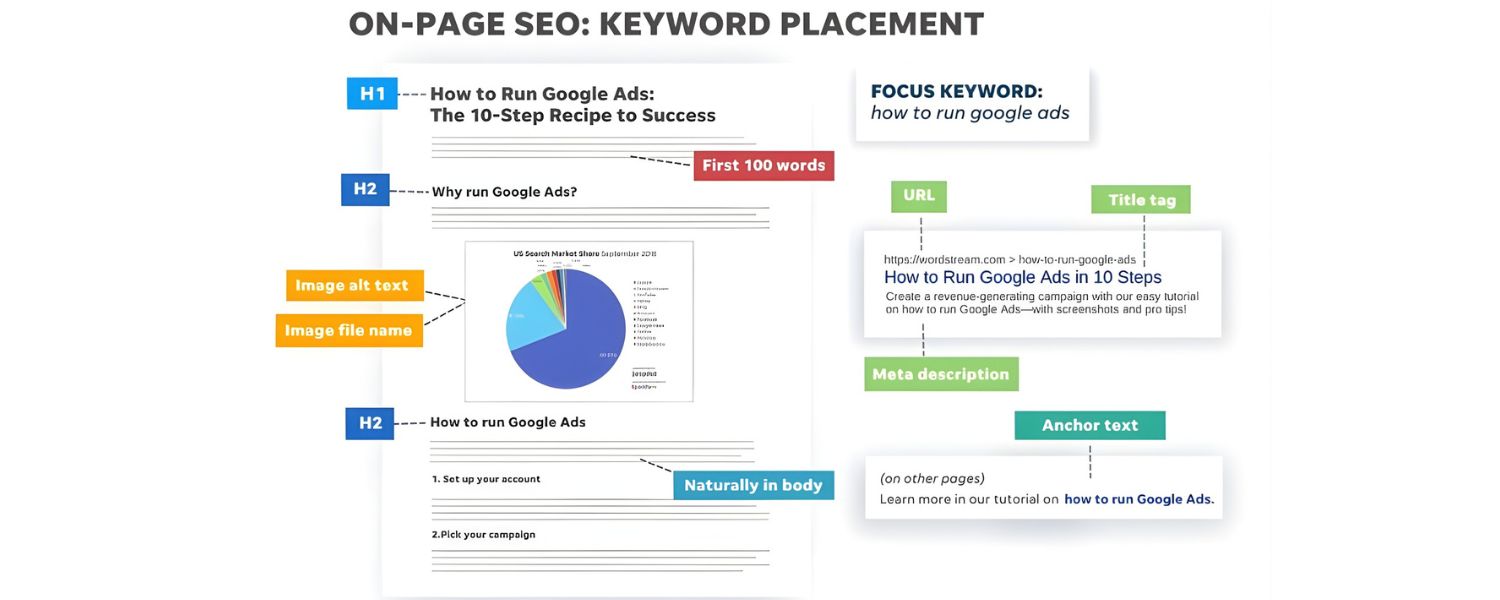
Now let’s get into the practical tactics of placing your target keywords on the page. On-page SEO is where keyword optimization really meets your site’s HTML and content. Here’s a checklist of the most critical on-page elements to optimize, along with best practices for each:
1. Title Tag (Meta Title)
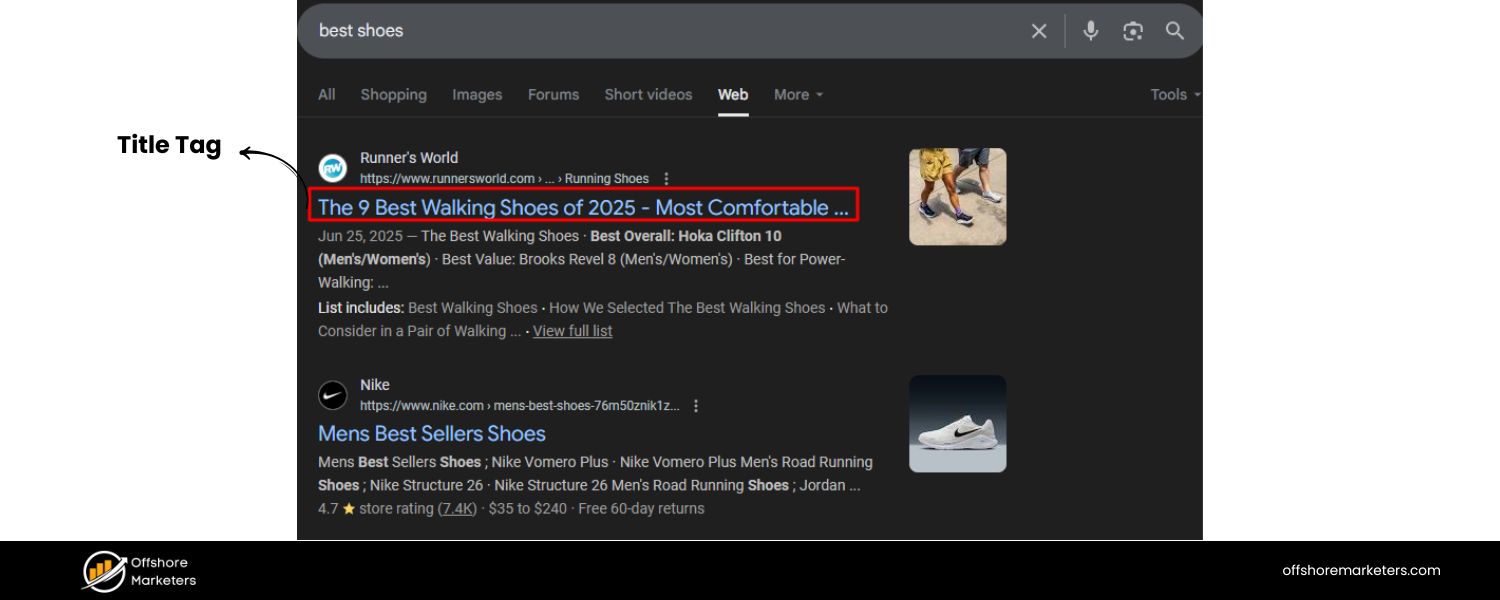
The title tag is arguably the single most important on-page element for SEO. This is the clickable headline that appears on Google’s results page for your site. It should clearly and concisely include your primary keyword (preferably towards the beginning, as it may carry a bit more weight).
For example, if your main keyword is “email marketing strategy,” a good title might be “Email Marketing Strategy: 10 Tips to Boost Engagement in 2025.”
This has the keyword right up front and also adds a compelling angle. Aim for around 50–60 characters so it doesn’t get cut off in results. But also remember to make it attractive to humans – a higher ranking is futile if no one clicks your link. Include a bit of benefit or hook (“10 Tips to Boost Engagement” gives a reason to click).
Google sometimes rewrites title tags if it thinks it can do better, but your best bet is to write a unique, relevant title that accurately describes the page. Title tags that are duplicate or vague hurt your optimization efforts.
2. Meta Description
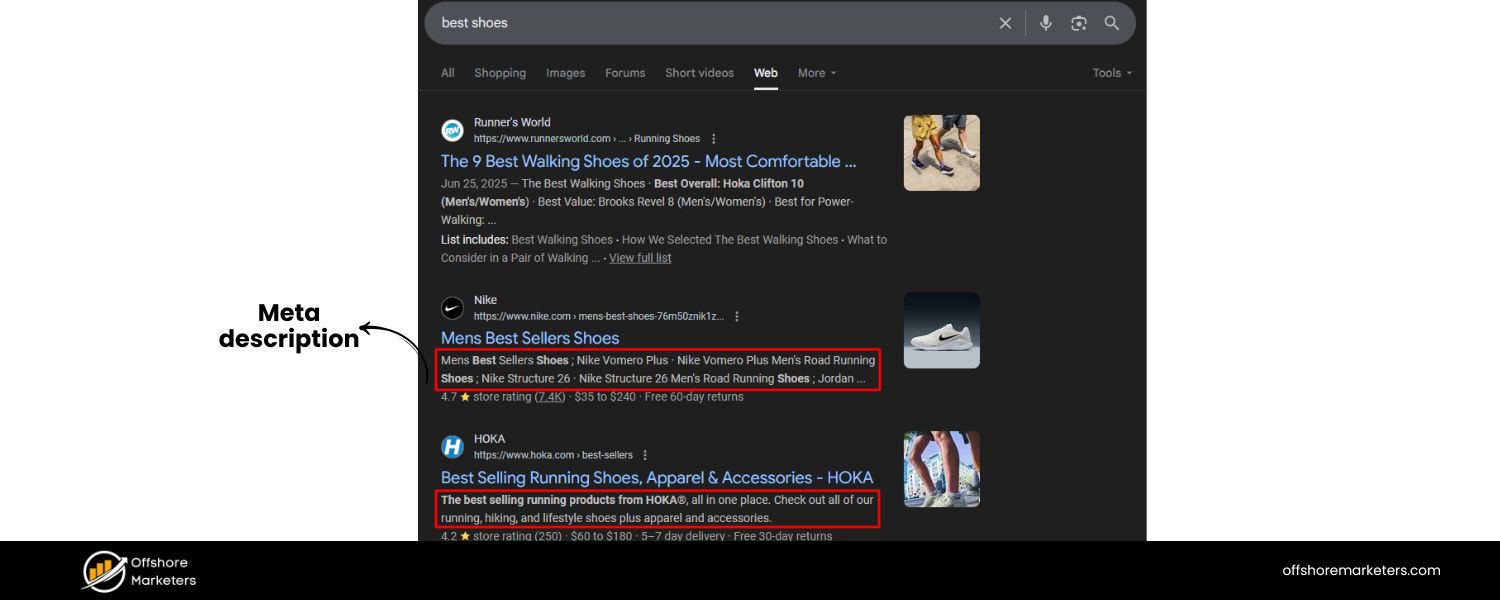
While meta descriptions (the snippet of text under the title in search results) do not directly influence rankings, they are important for click-through rate. A well-written meta description can improve your CTR, which is a positive user signal.
Include your primary keyword or a close variation in the description (Google will bold matching terms, drawing the searcher’s eye) and summarize the page’s content in an enticing way. Think of it as a mini advertisement for your page: highlight a benefit or answer the user’s query promise.
For example: “Learn how to craft an email marketing strategy that gets results – from building your list to optimizing send times. Data-backed tips inside.” This addresses what the user wants and teases that there’s valuable content. Keep it around 150 characters or less.
Every page should have a unique meta description to avoid duplication. Bonus tip: Sometimes examining the ads that appear for your keyword can inspire good phrasing for descriptions, since advertisers intentionally write text to get clicks.
Use an active, inviting tone (e.g., “Learn how,” “Discover,” “Boost your…”) and consider including a call-to-action. Remember, even if Google doesn’t always show your exact meta description (they sometimes generate their own snippet), it’s still worth optimizing as a baseline.
3. URL Structure
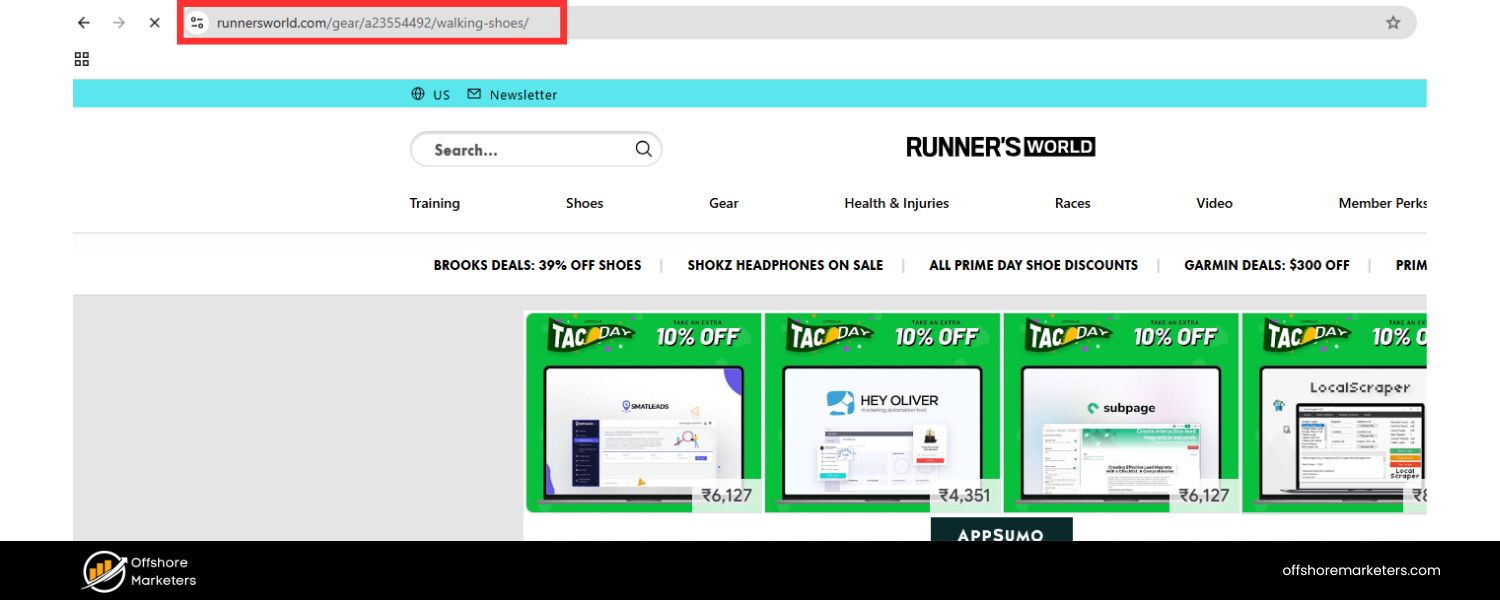
Create short, descriptive, and user-friendly URLs that include your target keyword (if it fits naturally). For instance, an article about email marketing strategies might live at . This is much clearer than a generic or messy URL like yourdomain.com/blog/12345?post=987. A readable URL helps users (and search engines) understand the page topic at a glance.
It can also show up in search results, reinforcing relevance.Avoid very long URLs or those stuffed with multiple keywords – that looks spammy. Also, use hyphens to separate words, not underscores. Google has stated not to obsess too much over minor URL differences (changing URL structure for SEO alone can be risky if not handled properly with redirects), but for new pages, it’s a smart practice to craft a good URL from the start.
The rule of thumb: simple is better. As an example from Google’s own SEO guide: use /how-to-peel-a-banana instead of /how-to-peel-a-banana-like-a-monkey-the-right-way-10-2022. The shorter URL is clean and contains the core keyword “peel a banana.”
4. Headings (H1, H2, H3, etc.)
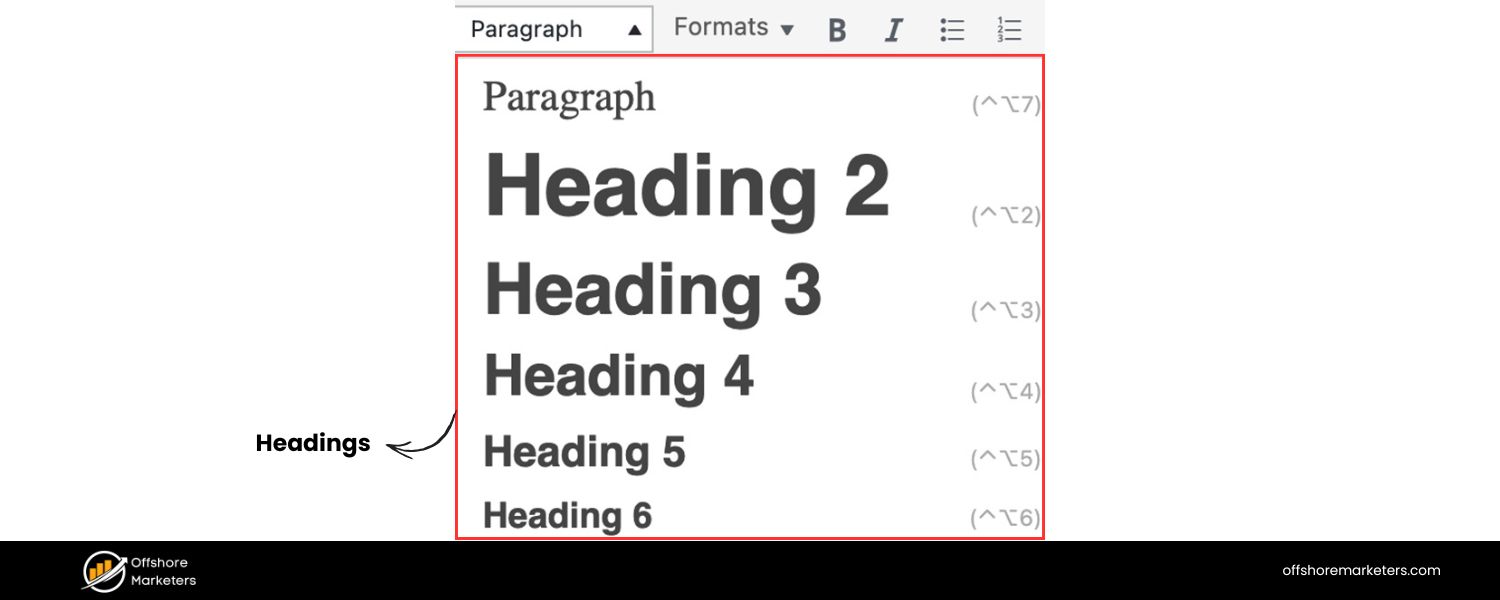
Use your H1 heading as the on-page title that visitors see, it should generally mirror or complement your title tag (often it’s acceptable for H1 and meta title to be the same or very close).
Include the main keyword in the H1 if possible, but make sure it reads well. Subsequent subheadings (H2s, H3s) should break the content into sections, each covering a subtopic or aspect of the main topic. It’s good to work in secondary keywords or related terms into some of these subheadings, as long as it accurately reflects the section content.
For example, if one section of your email marketing article is about building an email list, an H2 could be “Building a High-Quality Email List” (even better if your research showed a term like “build email list fast” – you might phrase it to include that). Proper use of headings not only improves readability but also provides semantic structure that search engine crawlers use to understand the hierarchy of your content.
Don’t use headings just for styling; use them to outline your content’s logic. Also, avoid too many H1s on one page (typically one H1 is enough). Use H2–H6 in descending order of importance. A well-structured page might look like: one H1 (title), a few H2s for main sections, under each H2 maybe some H3s for sub-points.
This hierarchy makes your page skimmable, readers can jump to sections of interest (and you could even add an internal table of contents for long articles, using anchor links).
5. Body Content Optimization
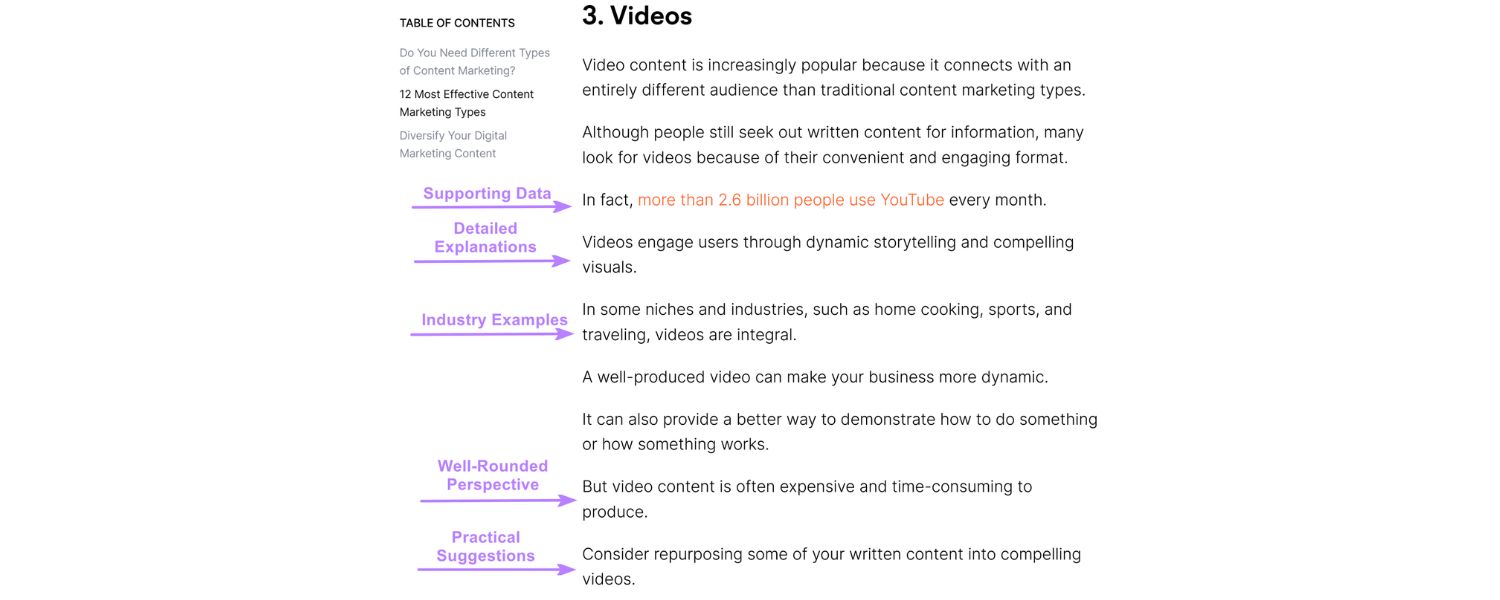
In the main text, ensure your primary keyword appears in the first paragraph or at least early on, as well as naturally throughout the content. Early placement can help confirm to Google what the page is about (and it often coincides with good writing, introducing your topic at the outset).
Throughout the article, use your keywords in a way that feels organic. You might aim to include the exact primary keyword a few times (depending on length of content), and use lots of synonyms and related phrases. For example, for “keyword optimization,” related phrases could be “keyword targeting,” “on-page SEO for keywords,” “optimize for search terms,” etc.
ou can find such terms via research (LSI keyword tools, or just seeing what words the top pages use frequently). By diversifying your language, you cover more ground semantically, which can improve your relevance for long-tail queries without keyword stuffing.
Also, answer any specific questions you found in your research directly in the content. A direct answer written in a clear, succinct way might even get picked up as a featured snippet. For instance, if a section of your content asks “What is keyword stuffing?” you could follow with a concise definition: “Keyword stuffing is the practice of excessively repeating keywords in content to try to game rankings. It creates a bad user experience and is against Google’s spam policies.” This not only educates your reader but also could be snippet-worthy for that question.
6. Images and Alt Text
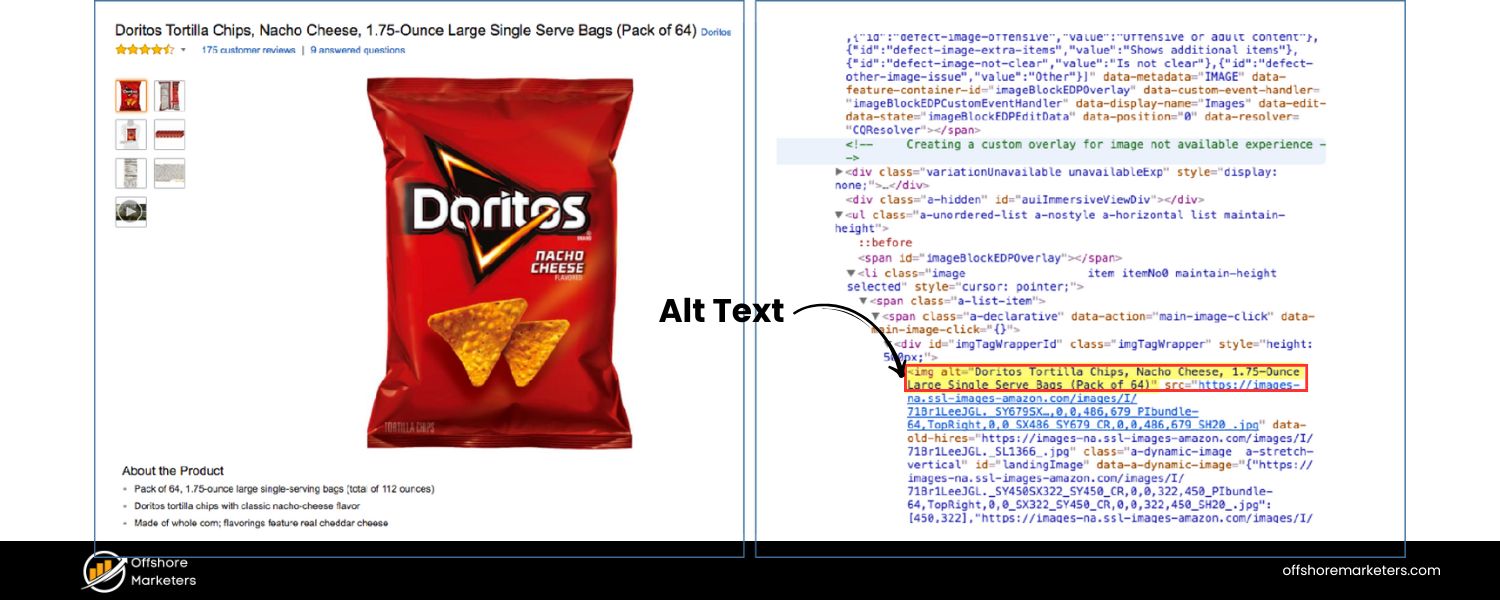
Incorporating images is great, but make sure to optimize your images so they assist your SEO rather than hinder it. First, use relevant, high-quality images that add value (like charts, examples, or illustrations of concepts). Then, give them descriptive file names and alt text. The alt text is used by screen readers for accessibility, and search engines also crawl it to understand the image content.
For example, instead of image123.png, use a filename like email-newsletter-signup-form.png. And the alt attribute could be “Screenshot of an email newsletter signup form”. If your image is purely decorative, alt text can be brief or empty, but if it conveys content, describe it. It’s good to include a keyword in alt text if it’s highly relevant to the image (don’t force it).Google uses image information (including alt tags and surrounding text) to help understand the page and also to rank in Google Images.
Optimized images can thus bring in visitors via image search as well. Additionally, compress images to reasonable sizes for faster loading (page speed is another factor in SEO). Contextualize images with nearby text – mention what the image is showing in the caption or the paragraph above/below it.
This reinforces relevance. Example: if you include a chart of “email open rates by day of week,” talk about it in text so Google connects that image to email marketing content. Lastly, host images on your domain if possible and use modern formats (JPEG, PNG, or WebP). Proper image optimization is part of keyword optimization because it signals what your page is about through multiple channels (not just text).
7. Internal Linking
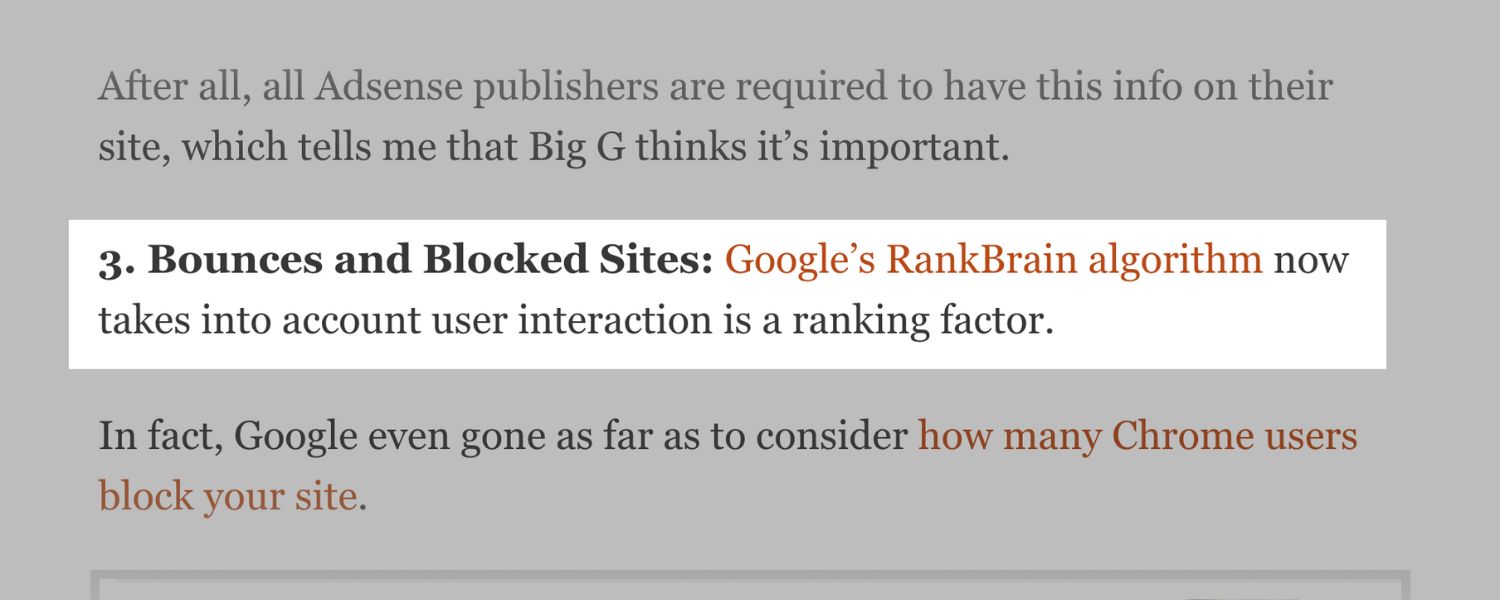
Link to other relevant pages on your site using descriptive anchor text. For instance, in a blog post about keyword optimization, you might link the text “technical SEO checklist” to a page on your site about technical SEO (if you have one). Internal links help spread link equity around your site and also help search engines discover your pages.
More importantly, from a keyword standpoint, the anchor text gives Google context about the linked page’s content. If dozens of pages on your site all link to your “Email Marketing Guide” using that phrase, it reinforces to Google that the target page is indeed about email marketing.Just ensure your internal links are natural and useful (don’t force an unrelated link just to stuff a keyword). A good practice is to have a section in each blog post for “related resources” or to naturally reference other articles when it makes sense, like we do when citing sources.
Also, link out to authoritative external sources when appropriate (as we have been doing throughout this guide). Some people worry that external links may lead users away, but citing authoritative sources enhances your credibility.
Google can trace these connections, and linking to high-quality sources on statistics or definitions can contribute to your page’s trustworthiness. Outbound links won’t directly boost your rank, but they create a richer user experience and can indirectly help by associating your content with other trusted content (and possibly encouraging those sites to notice you).
Both internal and external links help Google understand the context and can improve E-A-T perception. Just make sure any external link is to a site you trust, and add rel=“nofollow” or rel=“sponsored” if it’s a user-generated link or a sponsored/reference link to avoid any association with low-quality sites.
8. Featured Snippets & Structured Data
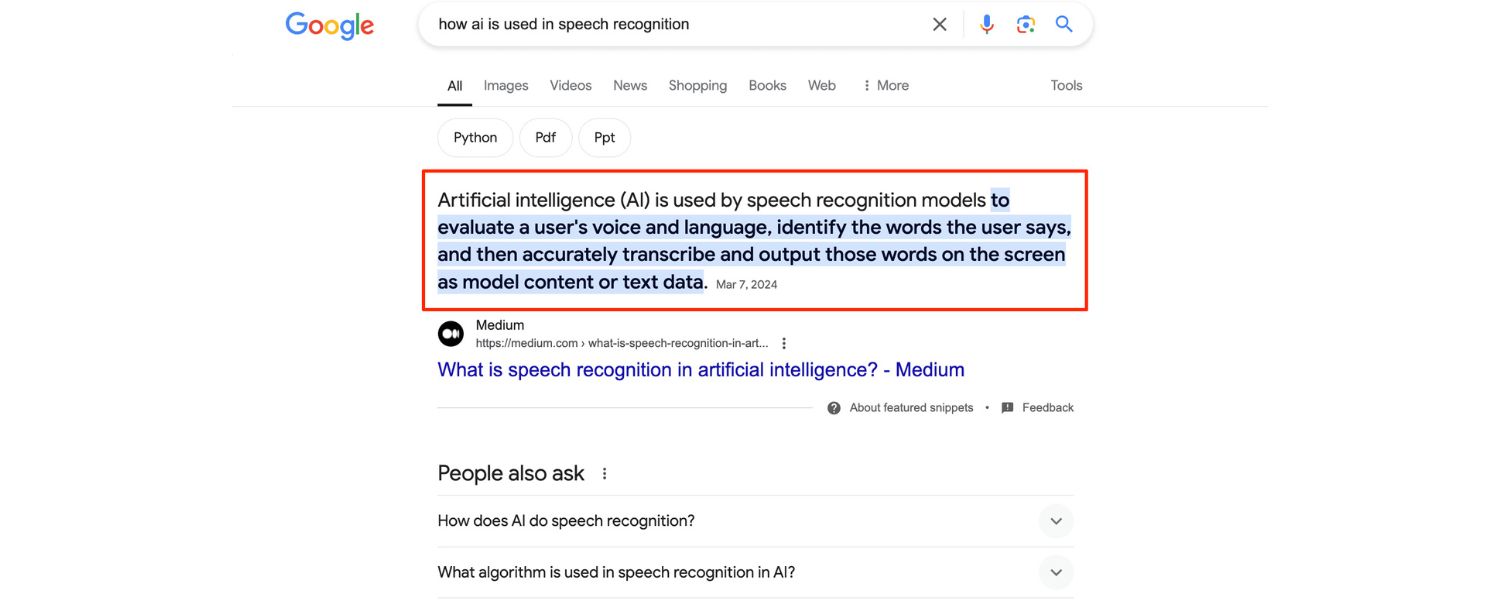
If the keywords you target tend to trigger featured snippets (the answer boxes at the top of Google results), optimize your content to capture those.Featured snippets often come in forms like paragraphs (definitions), lists (steps or top items), or tables. To win a snippet, format an answer to the implicit question clearly and succinctly. For example, if targeting “steps to change a tire,” you might have a brief intro and then a numbered list of steps right after, increasing the chance Google grabs your list for a snippet.
Also use headings that correspond to common questions (e.g., an H2 that says “How to Change a Tire Step-by-Step” could precede the list). Provide the answer immediately below the heading or question in a concise way (about 40-60 words for a paragraph answer is a common sweet spot).
We did this earlier with the keyword stuffing definition. Additionally, structured data (Schema markup) can be added to your HTML to give Google explicit info about your content. For instance, FAQPage schema can be added if you have a Q&A section, this can make your result eligible for a rich result expanding FAQs.
Article schema, HowTo schema, Recipe schema, etc., all exist for different content types. While using schema markup might not directly improve rankings, it can enhance your appearance in SERPs (e.g., star ratings, images, or an accordion of FAQs under your listing). These rich results can significantly boost your CTR because your result is more eye-catching. If you have content suited for it (events, recipes, reviews, FAQs), investing a bit of time to add schema is worthwhile.Google provides documentation on various schema types and their required properties. There are also tools like Google’s Rich Results Test to check your implementation. In short, use snippet optimization and schema to optimize beyond just text – optimize how your result displays on the search page.
By following the above on-page optimization best practices, you’re covering all the bases: telling Google exactly what your page is about, and making it appealing for users who find it. It’s like dressing your content for success in the SEO “interview.”
Remember, on-page SEO and keyword optimization go hand-in-hand, great content without optimization might not get noticed, and optimization without great content won’t hold rankings. You need both working together.
Step 5: Monitor Performance and Continually Improve
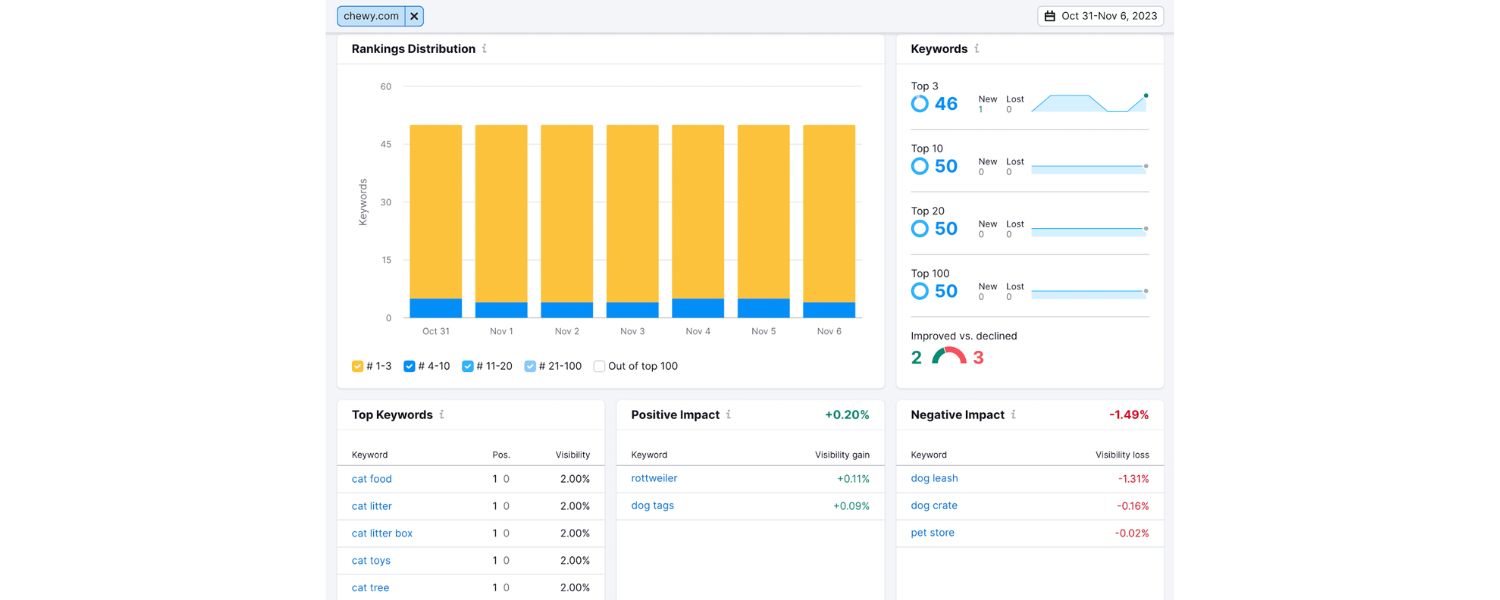
After implementing keyword optimization across your pages, the work isn’t completely over. SEO is an ongoing process, and it’s important to track how your optimized pages are performing and adjust as needed. Here’s how to stay on top of it:
1. Use Analytics and Search Console
Google Analytics (or another analytics platform) will show you how your organic traffic is trending and which pages are getting visits. More specifically, Google Search Console is a free tool that’s invaluable for keyword optimization. It shows the exact queries that are bringing people to your pages, along with impressions, clicks, click-through rate, and average position.
Review the Search Console Performance reports for your site. You might discover that a page is ranking for keywords you didn’t intentionally target, if they’re relevant, consider tweaking the content to better address those queries.
Or you might see a keyword you did target is getting impressions but low CTR; that could indicate your title or description isn’t compelling enough for that term, so you could rewrite it (perhaps the wording isn’t matching the user intent closely). Search Console also alerts you to any technical issues that might affect indexing.
2. Measure Rankings and Traffic Progress
Many SEO tools allow rank tracking – you input your target keywords and they report how your pages rank over time. This can be useful to see if your optimization efforts are paying off (are your positions improving for those keywords?). Keep in mind that rankings can fluctuate due to personalization and algorithm changes, so look at trends over weeks and months, not day-to-day jumps.
If after a reasonable time (say 2-3 months) a page isn’t ranking in the ballpark you expected, it’s time to troubleshoot: Is the keyword too competitive? Does the page truly satisfy the intent? Can you improve the content depth or freshness? Sometimes building a few quality backlinks to the page can give it the boost it needs, especially if the on-page factors are all solid.
In fact, once your on-page optimization is done, off-page factors like backlinks become critical for moving up in competitive SERPs. Promoting your content through outreach or social media can help attract those links. As an expert tip: try to get links from reputable sites with anchor text related to your keywords, it’s not fully under your control, but it can further reinforce relevance.
3. Keep Content Fresh and Updated
Over time, the information on your page can become outdated or competitors might create something better. Periodically audit your high-performing pages (perhaps every 6-12 months).
Update any outdated references (e.g., change “2024” to “2025” if the year matters, update old statistics with newer data). Add new insights you’ve gained. This signals to Google that the content is being maintained (they do favor fresh content, especially for topics where freshness matters).
Also, if you notice in Search Console that there are new popular queries related to your topic (for example, suddenly people are searching a new phrase a lot and your page is getting impressions for it), edit your content to cover that if relevant. These refreshes can protect and improve your rankings over time.
4. Watch the Competition
SEO is a dynamic landscape. Keep an eye on the pages that outrank you for your target keywords. Analyze what they’re doing, Do they have a more thorough section on something you barely mentioned? Is their page speed better? Do they have a lot of backlinks you might try to earn as well? There’s much to learn from competitors. Also, track if new competitors enter the scene.
Set Google Alerts or use tools to notify you of new content on the topics you care about.The goal is to ensure your content remains the best answer out there. If a competitor publishes “The Ultimate Guide to X” and it’s truly excellent, you should consider how to make yours even more comprehensive or uniquely valuable to stay on top.
5. Avoid Complacency and Black-Hat Tricks
It might be tempting to think “my page is #1, I’m done.” But rankings can slip if you don’t continuously earn that spot. Always be looking for ways to improve user engagement on your pages – for example, if people are bouncing quickly, maybe add a video or make the intro punchier.
Also, steer clear of any “black hat” shortcuts (like hidden text, cloaking, or PBN link schemes). Not only do these violate guidelines, they can get your site penalized and all that optimization work undone.
It’s not worth it. Stick to the people-first approach that Google advocates. One of Google’s own tips is to take a “self-assessment” of your content: would you consider it trustworthy, written by an expert, better than others?. If you can confidently say yes, you’re on the right track.
In summary, monitor, adjust, and iterate. Keyword optimization isn’t a one-and-done checklist; it’s an ongoing cycle of improvement. The web evolves, user behavior shifts, and search engines update algorithms frequently. By staying proactive – analyzing data and refining your SEO strategy, you’ll ensure your content keeps ranking well and driving results for the long term.
Keyword Optimization for PPC (Brief Note)
It’s worth mentioning that keyword optimization isn’t just for SEO, it’s equally crucial in the realm of pay-per-click (PPC) advertising like Google Ads. While the end goal is different (paid ads versus organic rankings), many principles overlap, and you can gain synergy by optimizing across both.
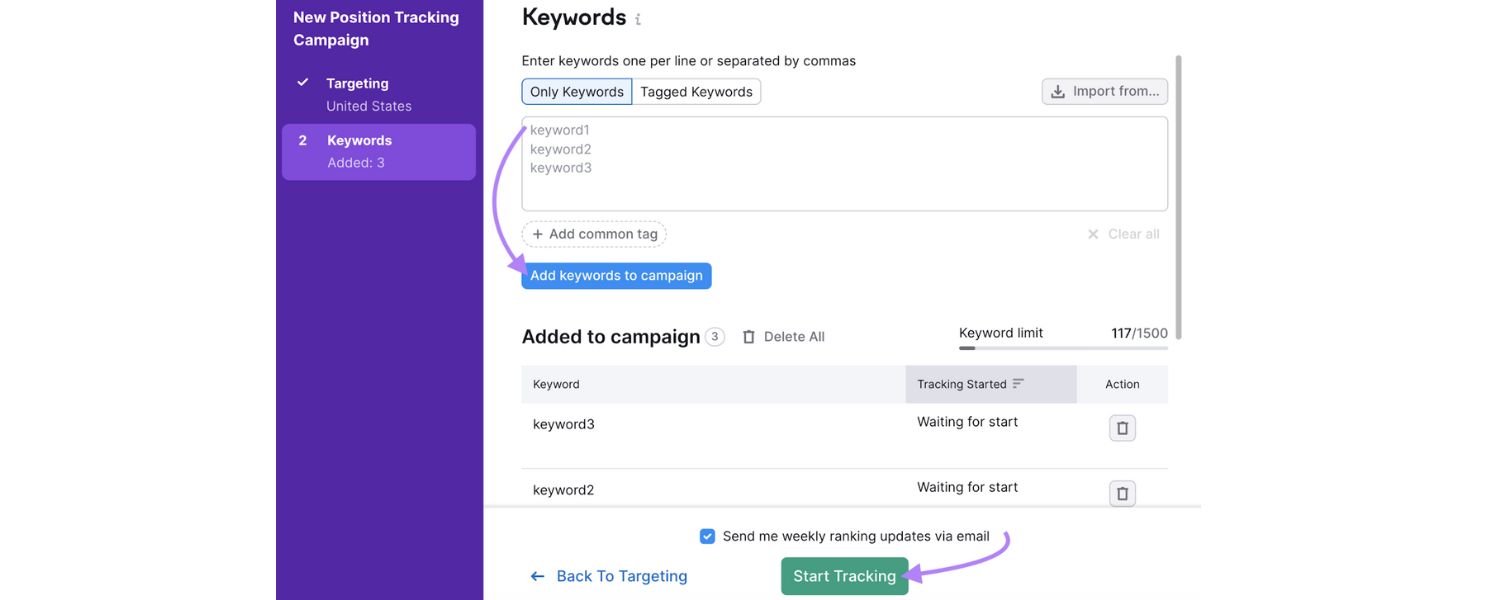
In PPC, optimizing your keyword list can improve your ad performance and lower costs. After doing keyword research, you’ll add keywords to your campaigns that you want your ads to show for. But the work doesn’t stop there:
1. Use Keyword Planner for PPC
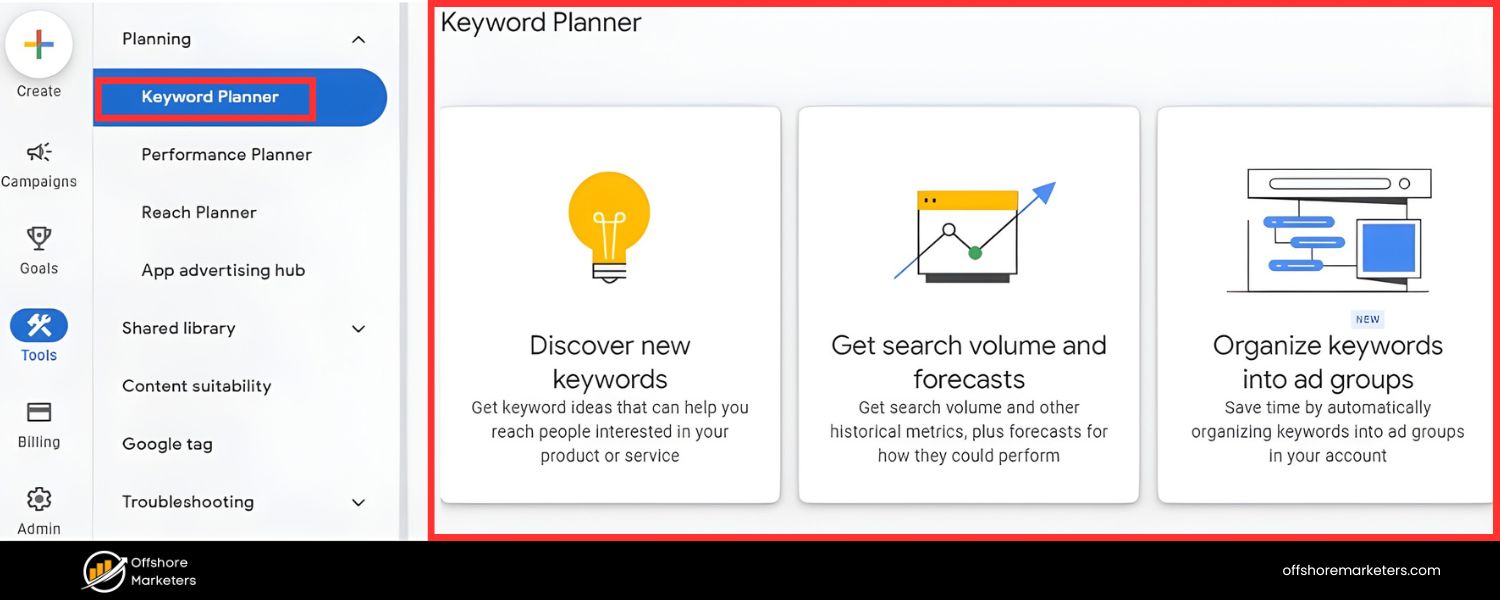
Google’s Keyword Planner is designed with advertisers in mind. It not only suggests keywords but also provides traffic forecasts and cost (CPC) estimates for those terms.
For example, it might show that “buy running shoes online” has X searches, high competition, and an estimated bid of $1.50 for a top-of-page ad. Use this data to choose keywords that fit your budget and target audience. You might prioritize keywords with a balance of decent volume and moderate CPC.
Planner can also inspire new ideas (e.g., it might suggest “discount running shoes” or “trail running shoes” if you input “running shoes”).
2. Refine with Match Types
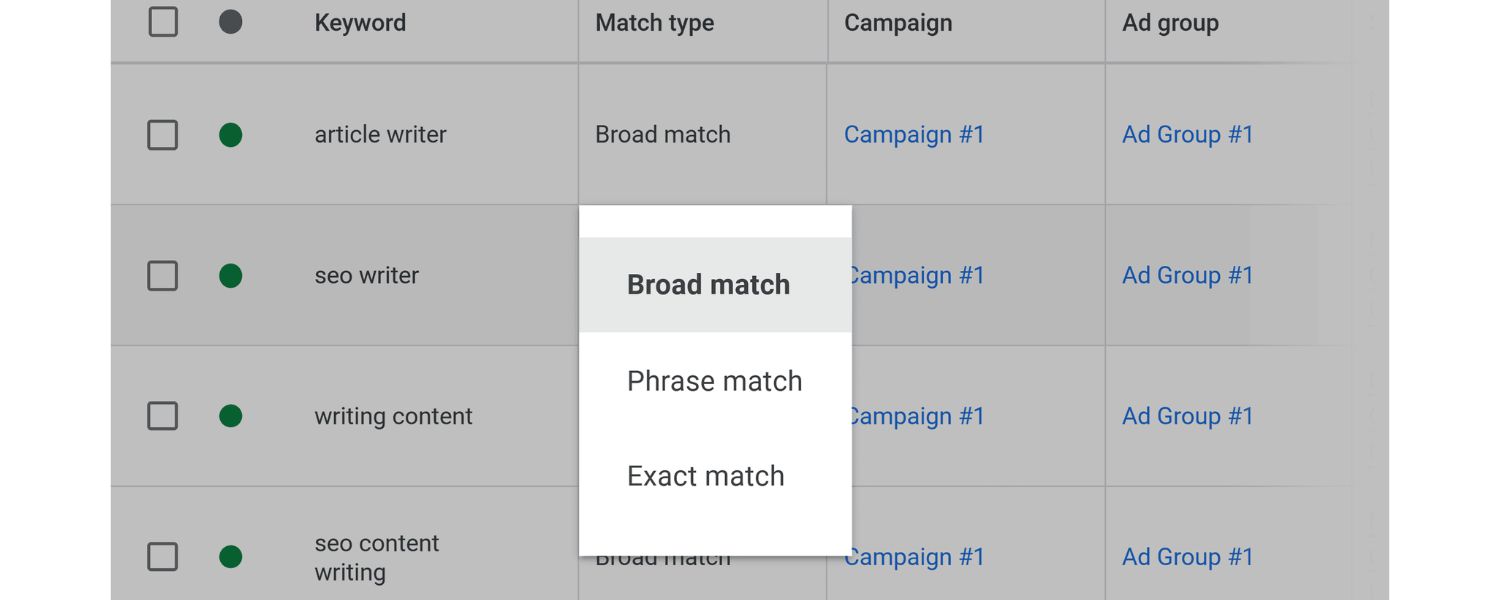
In Google Ads, you can specify match types for your keywords to control how broad or exact the matching is. For instance, Exact Match means your ad shows only when the query is almost exactly your keyword (with close variations), whereas Phrase Match allows your keyword to be part of a longer query, and Broad Match is the default that matches to related queries as well.
Optimizing keywords in PPC often involves adjusting these match types. A common approach is to start with a mix of phrase and exact for tighter control, then possibly broaden later for scale.
For example, you might add [men’s running shoes] as an exact match to catch that specific query, and “men’s running shoes” as a phrase match to catch queries like “best men’s running shoes 2025”. Using match types properly prevents your ads from showing on too broad terms that might waste budget.
3. Add Negative Keywords
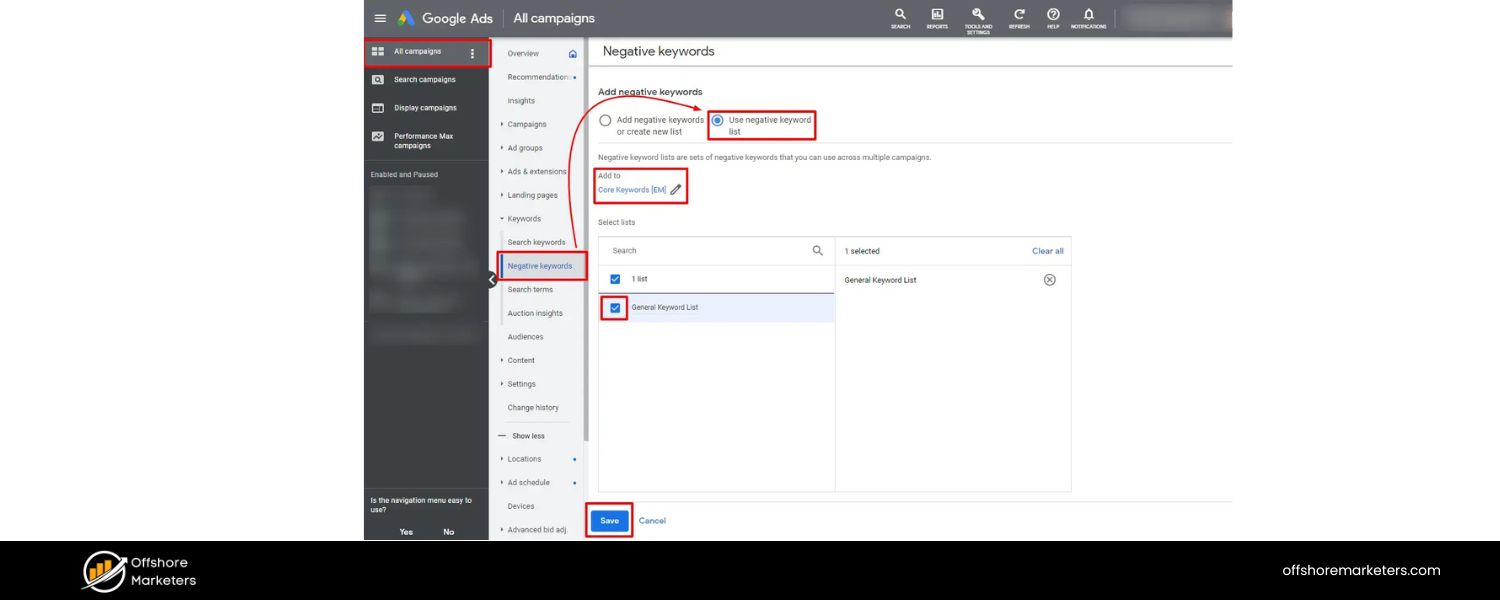
Negative keywords are terms for which you do not want your ads to appear. Adding negatives is a form of optimization that can dramatically improve your campaign’s click-through rate and cost efficiency.
For example, if you sell premium running shoes, you might add “free” or “cheap” as negative keywords, so your ads won’t show to users searching for free or ultra-low-cost options (who likely won’t convert for you). In the earlier Google Ads example, a running shoe store that sells only men’s shoes would add “women” and “girls” as negatives, to avoid paying for clicks from those searches.
Review your Search Terms Report in Google Ads – it shows the actual searches that triggered your ads. You’ll often find some irrelevant ones; add those as negatives promptly.
4. Optimize Bids and Quality Score
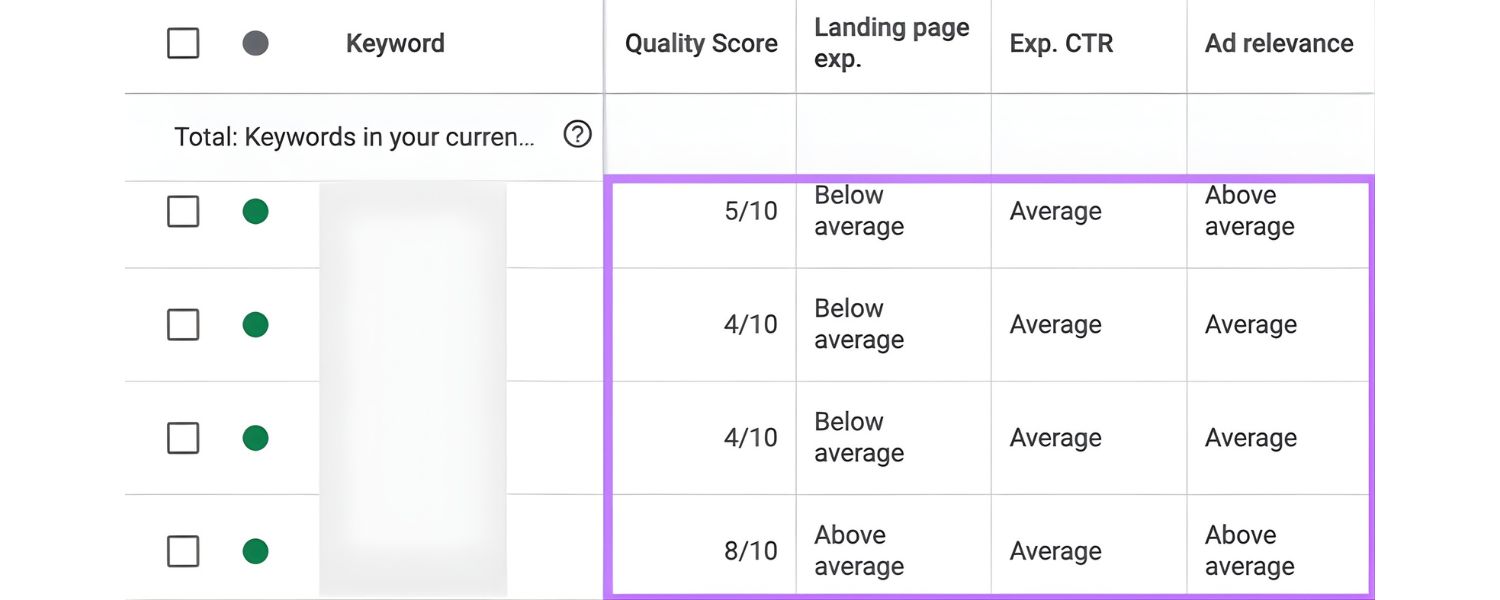
Google Ads has a concept of Quality Score which is partly influenced by keyword relevance (among other factors like ad CTR and landing page experience). Ensuring your ad copy uses the keyword and that your landing page is optimized for that keyword (sound familiar? just like SEO landing page optimization) will improve relevancy, potentially raising Quality Score and lowering your cost-per-click.
Use Google’s Smart Bidding strategies if appropriate, Smart Bidding uses AI to automatically set bids to maximize conversions or target ROAS, and it will allocate more budget to keywords that perform well. Essentially, Google’s system learns which keywords convert and bids up on those. You can aid this by providing conversion data and setting appropriate targets.
The bottom line: whether for organic SEO or paid search ads, optimizing keywords is about ensuring you’re bidding on or ranking for the terms that actually matter to your goals, and not wasting effort (or money) on those that don’t.
In practice, your SEO keyword research can inform your PPC keywords and vice versa. For example, you might test new keywords via PPC to see if they convert before investing in SEO content for them. Or use PPC data to find high-converting long-tail terms to target organically.
Both disciplines value relevance, and at the heart is understanding what phrases your customers use. So, apply the lessons of keyword optimization across all search marketing efforts for maximum benefit.
FAQ: Common Questions about Keyword Optimization
Q1: How many keywords should I target on a single page?
There’s no hard rule for an exact number of keywords per page. A good practice is to have one primary keyword that defines the main topic of the page, and then a handful (perhaps 2-5) of closely related secondary keywords or phrases.
These secondary keywords often naturally fit if they are true variations or subtopics. In reality, a well-optimized page can rank for dozens or even hundreds of long-tail keyword variations – not because you intentionally stuff them all in, but because by covering the topic in depth, those phrases naturally occur.
Focus on covering the topic comprehensively rather than worrying about a quota of keywords. Avoid trying to target unrelated keywords on the same page; if you find a page is trying to answer two very different queries (say “email marketing tips” and “social media marketing tips”), that’s a sign you might need separate content for each. Keep each page tightly focused.
Remember, quality over quantity, it’s better to fully satisfy one primary search intent than to half-satisfy two intents on one page.
Q2: Are meta keywords still relevant?
No – you do not need to use the tag at all. Years ago, meta keywords were used by search engines to gauge what a page is about, but this tag has been completely ignored by Google for years now. In fact, publicly Google has stated they do not use the keywords meta tag for ranking at all.
Other major engines like Bing don’t use it for ranking either. Instead of an obsolete meta keywords tag, focus on the techniques we discussed: putting keywords in title, headings, alt text, and content where it counts. Those are the signals that matter.
(Note: There is one exception, if you’re doing SEO for YouTube videos or certain app stores, they have their own “tag” or keyword fields that matter in those specific search algorithms. But for traditional website SEO, meta keywords are defunct.)
Q3: What exactly is keyword stuffing and how do I avoid it?
Keyword stuffing means overusing keywords (or related phrases) in an unnatural way with the intent to manipulate rankings. It often involves repeating the same word excessively or listing a bunch of keywords in a row (often out of context).
For example: “Our running shoes store sells running shoes for cheap running shoes prices on all kinds of running shoes.” This sentence is painfully stuffed. Keyword stuffing leads to a poor reading experience and is explicitly against Google’s spam policies.
To avoid it, write for the user first. Use your keyword where it makes logical sense, typically you’ll mention the main topic in the intro, a few times in body, maybe in conclusion – but always in flowing sentences. Vary your language. If you hear yourself using the exact phrase in every other sentence, that’s a red flag.
Also avoid hidden text or tags just to insert keywords (like putting a bunch of extra keywords in the page background color or off-screen, Google can detect these tricks). A good rule of thumb: if your page reads awkwardly or like a string of search terms, you’ve gone too far.
Modern SEO is about balance – relevant keywords, yes, but supported by synonyms and natural language. When in doubt, have someone else read the page; if it sounds weird to them, edit it. Quality content that reads naturally will always win out over artificially keyword-dense content in the long run.
Q4: Should I focus on singular or plural keywords (e.g., “shoe” vs “shoes”)?
In most cases, Google understands singular and plural forms as very closely related. Their algorithms will often return similar results for a singular vs. plural query, especially if user intent is the same.
That said, there can be subtle differences: plural might indicate shopping (e.g., “running shoes” implying someone wants to see selection of shoes), whereas singular could sometimes be part of a phrase or idiom (e.g., “running shoe” might appear in a question like “what is the best running shoe brand?”).
As a best practice, use the form that is grammatically correct and fits how people talk about that topic. If both forms are common, you can naturally use both in your content (maybe one in the title and the other in the first heading, etc.). But you generally don’t need separate pages for singular vs plural.
Optimize one page for the keyword concept and Google will usually rank it for both forms. If you’re unsure, do a Google search for each form and see if the results differ meaningfully. If they’re essentially the same, one page will do.
If they differ (maybe singular returns more informational results and plural returns shopping pages), then tailor your content to the dominant intent. Also note, for long-tail combinations the distinction is even less critical (e.g., “best shoe for marathon” vs “best shoes for marathon” – Google will treat them virtually the same). So, don’t overthink singular vs plural – cover the topic and you’ll naturally cover both.
Q5: How long should my content be for good keyword optimization?
There is no magic word count for SEO. Google doesn’t have a minimum or maximum length that’s ideal. The key is depth and completeness relative to the topic. Some queries can be answered in 500 words; others might need 2,500 words. A popular saying is “content should be like a woman’s skirt: long enough to cover the subject but short enough to keep it interesting.”
In SEO terms, longer content tends to rank well not because of length per se, but because longer articles often naturally cover a topic in more detail (hitting more relevant keywords, covering more subtopics). Several studies (from 2020 and earlier) have noted higher word counts correlating with higher rankings, but correlation isn’t causation. If you make a piece longer just by adding fluff, it won’t help. Instead, research what a comprehensive answer requires.
For example, if all the top-ranking pages for “how to bake sourdough bread” are 2,000+ word tutorials with step-by-step photos, a 300-word answer likely won’t cut it. Aim to be at least as useful and thorough as what’s out there. It’s fine to have a mix of lengths on your site too, a concise FAQ page might be short but still valuable. One thing to avoid is “thin” content: pages with very little text or substance, which often don’t rank at all.
If a page is inherently short (like a product page with specs), consider adding more useful info (user reviews, Q&A, etc.) to enrich it. In summary, focus on quality and completeness. Use as many words as needed to fully address the search intent, and no more. If that means a long-form article, great. If it means a crisp, direct answer, that’s fine too.
Q6: How do I keep up with changes in SEO related to keywords?
SEO is constantly evolving, algorithms update, new features like AI snippets appear, and search behavior shifts. To stay current on keyword best practices, make a habit of continuous learning. Follow reputable SEO blogs and Google Search Central updates.
Google often announces major changes (like the move towards mobile-first indexing or new guidelines on AI-generated content) on their blog or Twitter via officials like @searchliaison. Participating in SEO communities (like forums or Q&A sites) can also help you hear about what’s changing. Additionally,utilise various SEO tools, as many offer features that alert you to ranking changes or new keywords your site appearsp for.
Embrace new technology, for example, voice search has grown with the popularity of digital assistants, which means more conversational queries (you might optimize by adding an FAQ section addressing those). In 2024-2025, one big topic is the rise of AI in search, like Google’s AI-generated answers (SGE, Search Generative Experience) or Bing’s AI chat.
While it’s still early, the consensus is that focusing on authoritative, well-structured content is the best preparation, since these AI overviews often draw from sites with strong expertise and clear data. Implementing structured data (schema) can also future-proof you for any rich result changes.
Ultimately, keep your fundamentals strong (as covered in this guide) and layer on new tactics as they emerge. SEO isn’t a one-time checklist but a journey of refinement. If you stay user-focused and continue to optimize based on data, you’ll be able to adapt to changes that come your way.
Conclusion and Next Steps
Keyword optimization is both an art and a science. It requires understanding your audience’s language and intent, crafting high-quality content that speaks to that, and then meticulously fine-tuning all the on-page elements to communicate relevance to search engines.
By following the steps in this guide, from thorough keyword research and smart keyword mapping to on-page SEO best practices and ongoing optimization, you’re positioning your site to rank higher, attract more qualified traffic, and ultimately achieve your marketing goals.
Keep in mind that SEO success doesn’t happen overnight. It’s the result of consistent effort, monitoring, and improvement. The good news is that every tweak and improvement you make can have a cumulative impact. As you publish optimized, valuable content, you’ll likely see your search rankings climb, your click-through rates improve, and your users engage more with your site.
Now it’s time to put this into action. Start by auditing your own website’s content: Do you have target keywords identified for each key page? Are those keywords reflected in the titles, headings, and body text appropriately? Can you enhance any pages that are underperforming with additional sections or updated info?
Use the tips here as a checklist and you may uncover quick wins (like fixing a title tag) as well as bigger projects (like creating a new piece of content to fill a gap). Prioritize the changes that will impact high-value pages first.
Lastly, remember that keyword optimization works best as part of a holistic SEO strategy. Technical SEO (site speed, mobile-friendliness, crawlability), great user experience, and quality link building all play roles in your overall rankings.
But everything starts with keywords, they’re the bridge between what people are searching for and what you offer. Mastering keyword optimization means you’re building that bridge strongly from the very beginning.
Call to Action:
Ready to dominate the search results with better keyword optimization? Don’t just stop at reading about it, take the next step. Conduct a fresh keyword research session for your top content, apply these optimization techniques, and watch your SEO metrics improve.
If you need further guidance or a professional audit of your site’s SEO, consider reaching out to an SEO expert or agency (after all, with 25 years in marketing, I’ve helped countless businesses boost their rankings!). The sooner you optimize your keywords, the faster you’ll climb those rankings and surpass your competitors. Happy optimizing, and see you on page one!

Why Roseville Startups are Choosing Offshore Marketers to Scale Smarter
Roseville is no longer just a quiet suburb of Sacramento;...

What Is PPC? A Practical Guide to Pay‑Per‑Click Advertising
Pay‑per‑click (PPC) is the “pay only when someone clicks” branch...

Google Search Issues Affecting Results in Some Regions
Google has confirmed a problem with one of its data...

Keyword Counts Dropped After Google’s num=100 Change
In September 2025, Google stopped supporting the &num=100 parameter. This...

Image SEO: Optimize Images for Higher Rankings & Traffic
Introduction Images make your website more engaging, but they can...


.png)
.png)
.png)
.png)
.png)

2024 ALL RIGHTS RESERVED MADE IN INDIA
.png)