
Keyword Stuffing in SEO: Why It Hurts Rankings & How to Fix
September 5, 2025
Introduction
In my 25 years of marketing and SEO experience, I’ve seen search engine tactics come and go. One such tactic, keyword stuffing, was once a quick-fix trick to rank higher in search results.
It might be tempting to cram your webpage full of a particular keyword, thinking it will boost your Google rankings. But the reality is that keyword stuffing now does far more harm than good.
In this comprehensive guide, we’ll explain what keyword stuffing means, why it can actually sink your SEO performance, and how to optimize your content the right way instead.
By the end, you’ll know how to use keywords effectively without spamming your pages, keeping both search engines and your readers happy.
What Is Keyword Stuffing?
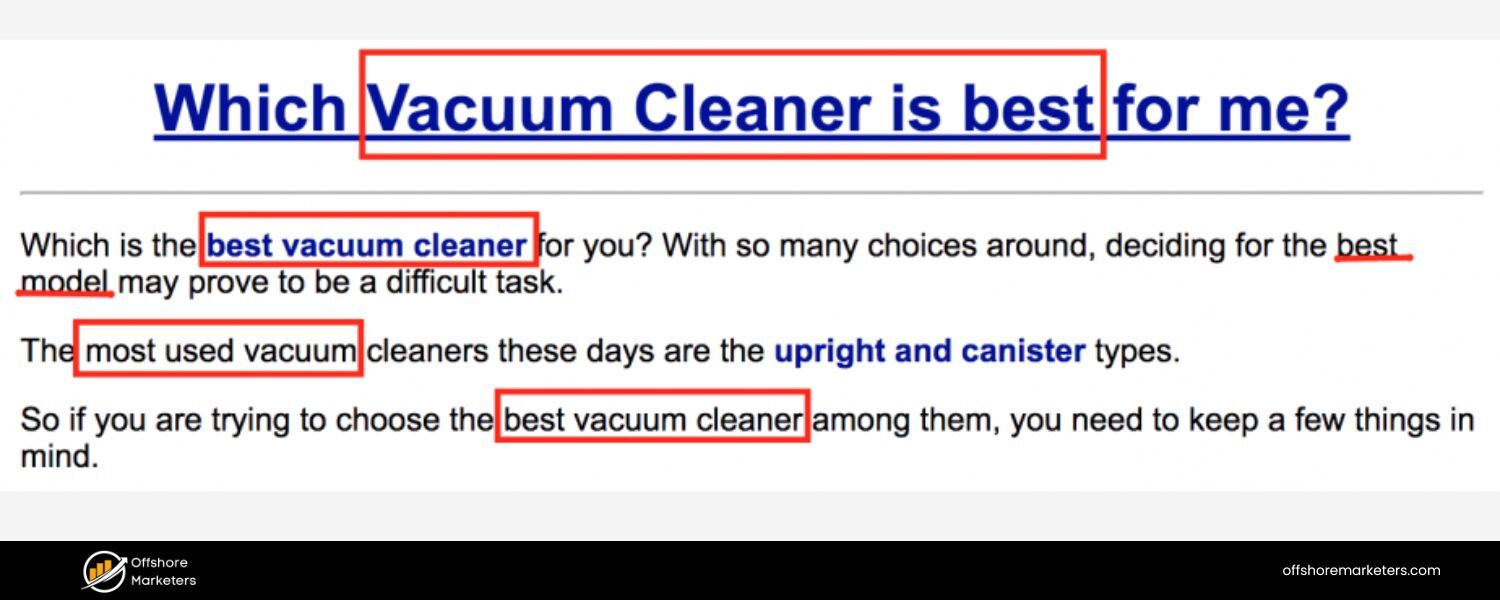
Keyword stuffing is the practice of overusing keywords on a webpage in an attempt to manipulate search rankings.
In simple terms, it means loading a page with the same words or phrases over and over (sometimes even in places users can’t see) to try to trick search engines into ranking the page higher.
This tactic is considered a form of search engine spam (also known as “spamdexing”) and is firmly against Google’s and Bing’s webmaster guidelines.
Google’s definition: “Keyword stuffing refers to the practice of filling a web page with keywords or numbers in an attempt to manipulate rankings in Google Search results”.
Often these keywords appear unnaturally or out of context in the text. In other words, the content is written for search engines at the expense of human readability.
Examples of Keyword Stuffing
Keyword stuffing can be visible or hidden:
1. Visible keyword stuffing
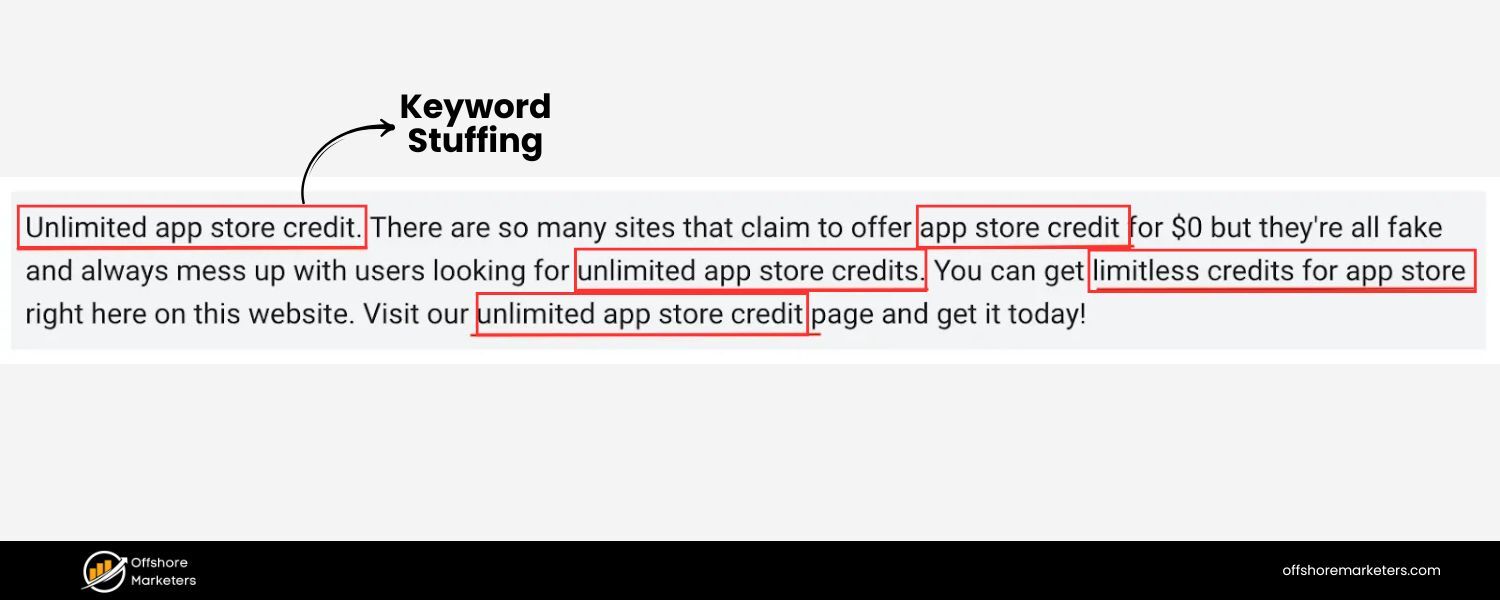
This is when the over-optimization is obvious to anyone reading the page. For example, a product description might read: “Our store sells the best coffee pods on the market.
These coffee pods are the cheapest coffee pods you’ll find, and our customers love our coffee pods!” – Here the phrase “coffee pods” is repeated unnaturally in an attempt to rank for that term.
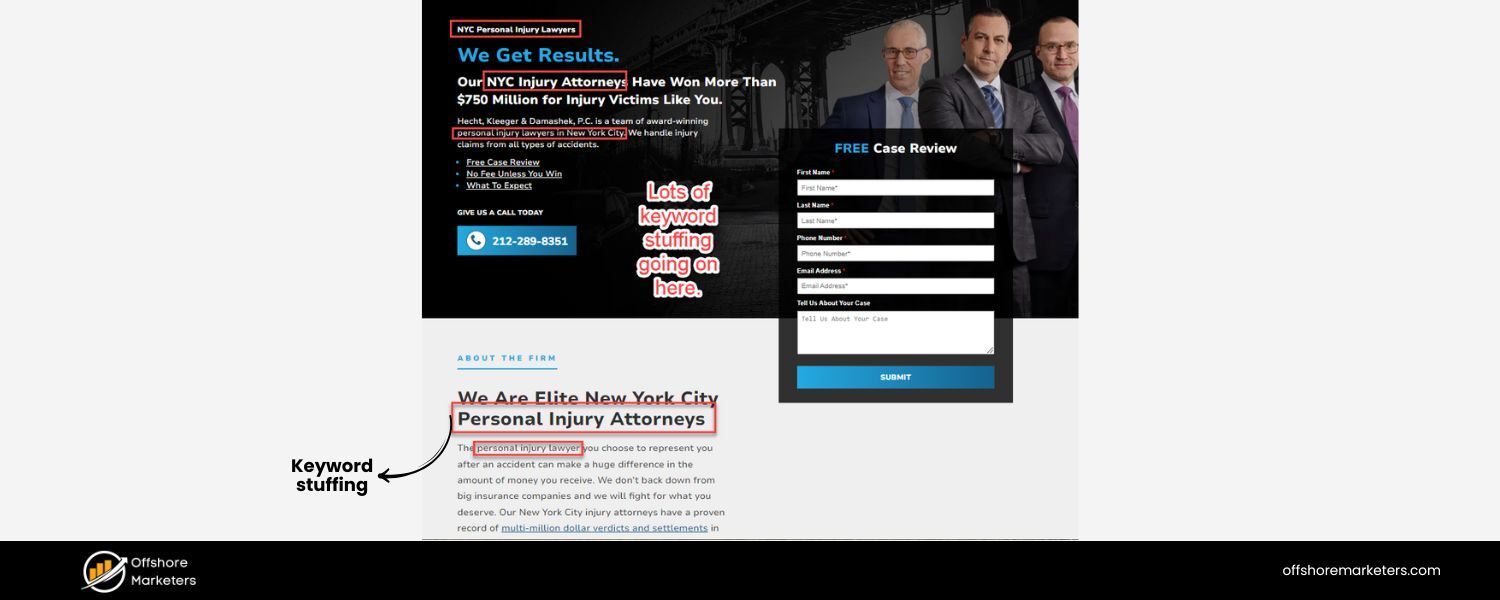
The text sounds awkward and spammy. Another form of visible stuffing is adding blocks of irrelevant keywords (e.g. listing dozens of cities or phrases unrelated to the actual content) just to attract search traffic.
Similarly, if every blog post on your site is peppered with the exact same keyword in every other sentence, that’s a red flag for keyword stuffing.
2. Hidden keyword stuffing

In this case, the site owner tries to hide the excessive keywords from users, while still letting search engines crawl them.
Common tactics include: making the text the same color as the background (so it’s invisible to readers), hiding keyword-laden text behind images or off-screen with CSS, or stuffing keywords into meta tags and alt text where users don’t typically see them.
For instance, a page might have a footer full of invisible text like “cheap shoes cheap shoes cheap shoes” or an image with alt attribute “cheap shoes, cheap sneakers, cheap boots…” purely to cram in keywords.
Even though visitors don’t notice these, search engine crawlers will, and so will Google’s spam algorithms.
Key takeaway: It’s normal and expected to use your target keywords in your content. But when keywords are forced in excessively or out of context, it crosses into “stuffing” territory and becomes counterproductive. Next, let’s see why this practice is not just frowned upon, but actively harmful to your SEO.
Why Is Keyword Stuffing Bad for SEO?
In the early days of SEO (late 1990s and early 2000s), stuffing a page with keywords could actually boost your rankings. Back then, search algorithms were much simpler – they largely looked at keyword frequency to decide relevance.
Unfortunately (and predictably), webmasters abused this, creating gibberish pages filled with repeated terms to game the system.
Google caught on and started cracking down as far back as 2003 with major algorithm updates to reduce the impact of keyword stuffing.
Fast forward to today, and keyword stuffing is not only ineffective, but it can actively hurt your site’s rankings. Here are the main reasons why keyword stuffing is a big no-no in modern SEO:
1. Violation of Search Engine Guidelines (Risk of Penalties)
Google explicitly lists keyword stuffing as a spam policy violation. Sites that engage in it can be penalized, meaning your pages may be ranked much lower, or even completely removed from search results.
The same goes for Bing: their webmaster guidelines warn that using overly repetitive keywords “with the sole intent of artificially inflating rankings” can lead to demotion or delisting of your site.
In short, if you keyword-stuff, you’re inviting Google’s wrath. No traffic is worth getting your site banned. It’s just not worth the risk.
2. Poor User Experience
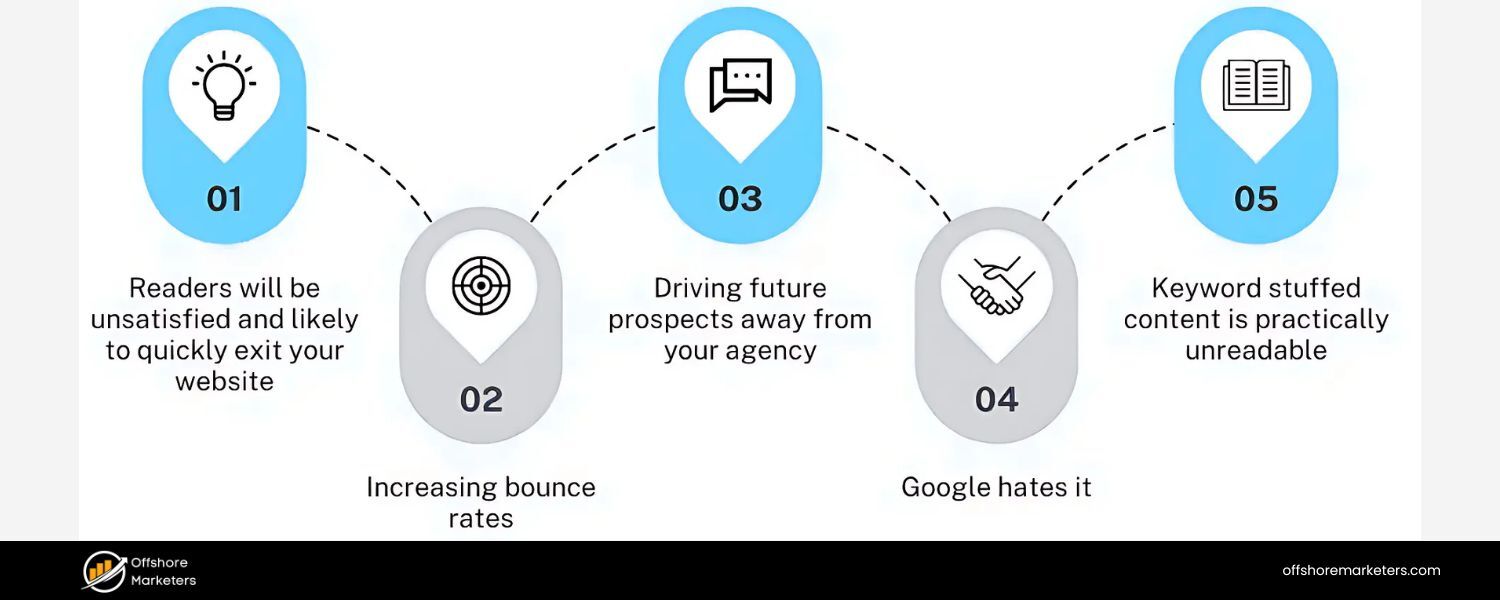
Content that is stuffed with keywords is usually hard to read and off-putting to real people. It comes across as nonsense or salesy gibberish rather than helpful information.
Readers will struggle to get value from such content and likely leave immediately. This means high bounce rates and low engagement, signals that search engines interpret as your page being low quality or irrelevant.
Google’s algorithms increasingly factor in user behavior (like pogo-sticking or quickly bouncing back to search results) as a quality indicator.
If visitors are turned off by your repetitive, keyword-laden copy, your SEO will suffer. After all, search engines want to show content that satisfies users; keyword stuffing does the opposite.
3. Damage to Your Brand and Credibility
From a marketing perspective, imagine the impression a keyword-stuffed page leaves on a visitor. It looks unprofessional and spammy. Users might think your brand is trying to “cheat” its way to relevance or, worse, that you don’t actually know what you’re talking about.
This erodes trust and can tarnish your brand reputation. A page full of awkward, repetitive phrases can make your business seem amateurish. Credibility is hard to earn and easy to lose, and stuffing keywords into your content is a quick way to lose it.
4. No Real SEO Benefit (Outdated Tactic)
Perhaps the most important point: keyword stuffing does not improve your rankings anymore. Modern search engines are far more sophisticated, they use semantic analysis, natural language processing, and hundreds of ranking factors to assess a page’s relevance.
Simply repeating a keyword 100 times has zero positive effect; in fact, Google’s algorithms like Panda (which targets low-quality content) neutralize this tactic.
Google has stated that “search engines now prioritize understanding context and user intent over keyword density”. High-quality pages that address a topic comprehensively will outrank a page that just mindlessly repeats the keyword.
There are zero benefits to keyword stuffing today, only serious drawbacks. Your content won’t rank better; if anything, it will rank worse.
In summary, keyword stuffing is an outdated, spammy practice that undermines both your SEO and your user experience.
Google and other engines have gotten extremely good at detecting it and will respond by either algorithmically downgrading your page or issuing a manual penalty.
And even if a stuffed page slips through the cracks temporarily, real users will be turned off, nullifying any short-term gains. It’s truly a lose-lose tactic.
How to Avoid Keyword Stuffing (Best Practices for Keyword Optimization)
At this point, it’s clear that keyword stuffing is a dead end. So how do you optimize your content for search engines without resorting to spam? The answer lies in proper keyword usage and a focus on quality. Here are some expert tips to avoid keyword stuffing and still rank well:
1. Focus on a Primary Keyword (Plus a Few Secondary Ones) Per Page
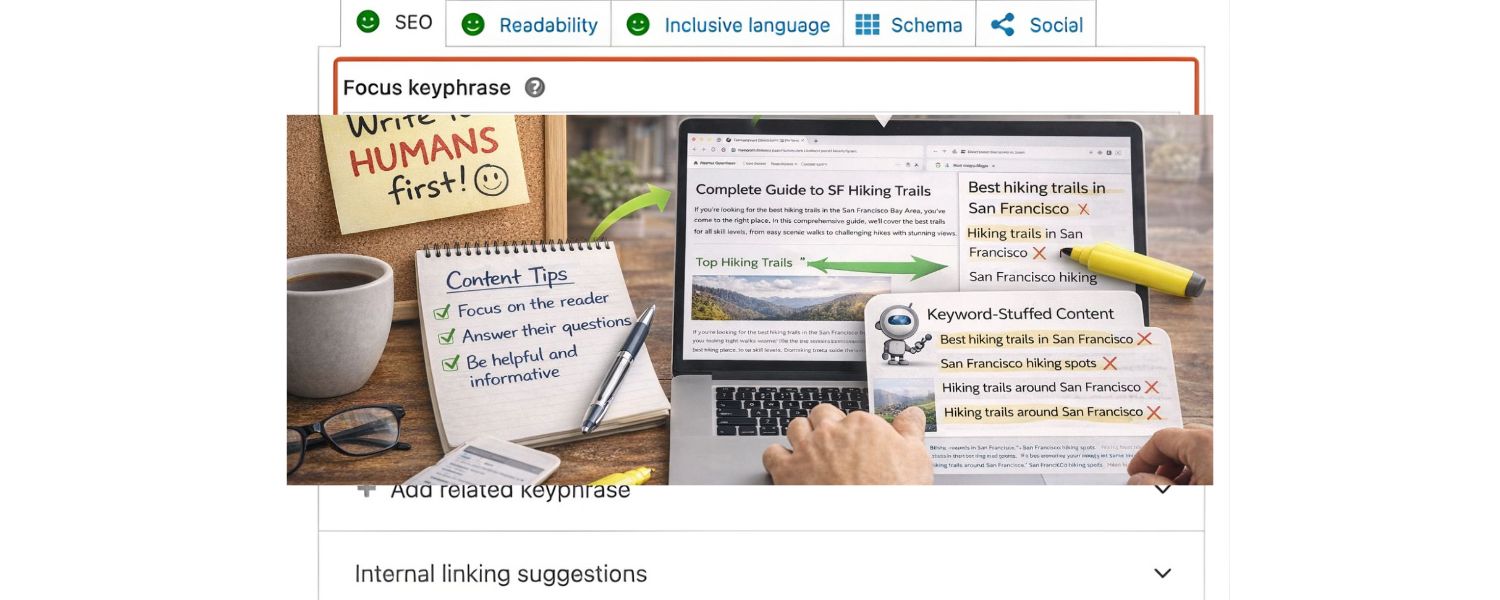
Don’t try to target dozens of different search terms on one page. It’s much more effective to choose a focus for each page.
Pick one primary keyword that best represents the page’s topic, and then a handful (maybe 2–5) of closely related secondary keywords or phrases. This keeps your content focused and makes it easier to naturally incorporate keywords without overdoing it.
For example, if you’re writing a blog post about email marketing tips, your primary keyword might be “email marketing tips.” Related secondary terms could be “improve email open rates,” “email campaign best practices,” etc.
By concentrating on a tight cluster of relevant terms, you’ll naturally cover the topic in depth without feeling the need to shoehorn in every possible keyword.
Remember, a single well-focused page that thoroughly answers one topic is better than a catch-all page stuffed with every keyword under the sun.
2. Write for Humans First, Search Engines Second

This mantra has become almost cliché in SEO circles – because it’s true. Always craft your content to serve the reader’s needs before anything else. If you prioritize providing value to the reader, you’ll automatically steer clear of most keyword stuffing pitfalls.
A good test is to read your content aloud to yourself (or use a text-to-speech tool). Do the sentences flow naturally? Or do they sound like a robot spewing search terms? Reading aloud will quickly highlight any awkward, repetitive use of keywords that disrupts the flow.
If you cringe while reading a sentence because it’s packed with the same keyword five times, that’s a sentence to rewrite. You can also ask a colleague or friend to review the piece – a fresh pair of eyes can spot clunky keyword use that you might miss.
Writing for humans also means keeping your content informative, useful, and on-topic. Don’t drag in unrelated topics or filler just to mention a trendy keyword.
Google’s own guidance says: “Focus on creating useful, information-rich content that uses keywords appropriately and in context.”
If you do that, you’ll naturally include relevant terms in a way that makes sense to readers. Your keywords should serve the content, not stick out from it.
3. Use Synonyms and Related Keywords (Don’t Repeat the Same Phrase)
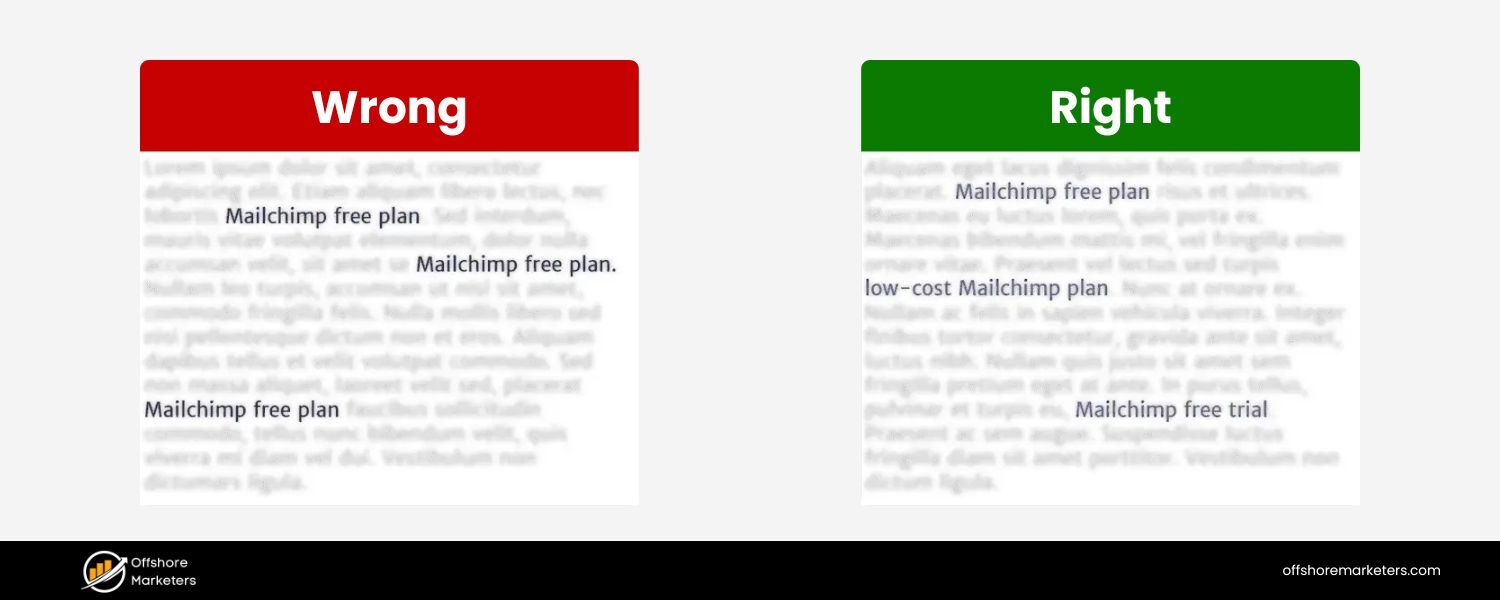
One smart way to avoid over-repetition is to leverage synonyms, variations, and long-tail keywords that relate to your main topic. Search engines have become very adept at understanding context and equivalent terms.
In fact, Google’s algorithm (and NLP models like BERT) can recognize that, say, “buy cheap sneakers” is contextually related to “affordable shoes.” You don’t need to use the exact same phrasing every time.
Using different wording can actually improve your SEO by casting a wider net of relevant terms and making your content read more naturally.
For example, instead of repeating “best laptop 2025” incessantly, you might also say “top laptops for 2025,” “best notebooks this year,” or “top-rated 2025 laptops.”
This way, you’re still targeting the core concept but not hammering the reader (and Google) with one exact phrase. Secondary keywords, synonyms, and long-tail variations enrich your content and provide extra context to search engines.
They also indicate that you’re covering the topic comprehensively. In fact, using related terms can help you rank for those variations and even land in “People also ask” results for related questions.
Bottom line: If it feels like you’re saying the exact same words repeatedly, mix it up! You’ll avoid stuffing while also appealing to a broader range of search queries. It’s a win-win for readability and SEO.
4. Optimize Key Page Elements (But Keep Them Natural)
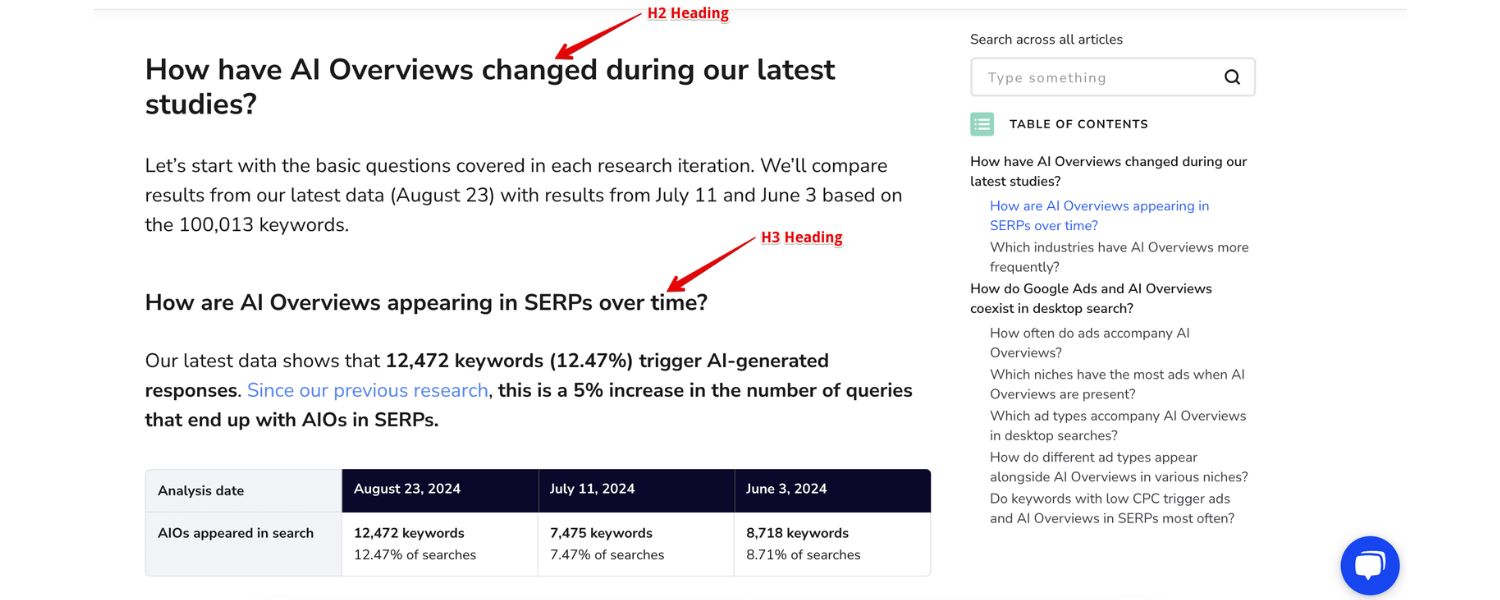
Strategic placement of keywords is far more important than raw frequency. Make sure you use your primary keyword in the key elements that search engines pay attention to – typically: the title tag, the page header (H1), the URL, the meta description, and within the first paragraph of your content.
These are high-impact spots where a keyword usage signals clearly what your page is about. Similarly, include relevant keywords in your subheadings (H2, H3, etc.) where it makes sense, as well as in image alt text and anchor text for internal links, if relevant.
For example, an optimized blog post about email marketing might have:
A. Title tag/H1: “10 Email Marketing Tips to Boost Engagement in 2025” (contains “email marketing tips”)
B. URL: …/email-marketing-tips-2025
C. First sentence: “Email marketing tips in 2025 focus heavily on personalization…”
D. Subheads: “Tip 1: Craft compelling subject lines,” “Tip 2: Segment your audience,” etc. (Maybe one subhead or the introduction contains the phrase “email marketing strategy”).
By doing this, you’ve signaled your main keyword to Google in all the right places without needing to plaster it in every line of the body text. Importantly, ensure these placements still read naturally.
Your title, headers, and meta description should be written for humans to entice them to click, not just to impress the algorithm. If you can seamlessly fit the keyword in, great – if not, use a close variation.
For instance, an overly stuffed title like “Email Marketing Tips, Email Marketing Best Practices, Email Marketing Guide” is counterproductive. One clear instance of the keyword is enough in a title.
Remember that optimizing page elements isn’t the same as stuffing. It’s about using keywords where they matter most.
When your target term is present in the title, URL, headings, and naturally throughout the text, search engines get a strong signal of relevance. There’s no need to go beyond that. Focus the rest of your energy on delivering value in the content itself.
5. Keep Your Keyword Density Natural (No Magic Number)

“Keyword density” – the percentage of times a keyword appears in your text – is an old-school concept, but people still ask about it. There is no strict optimal keyword density that guarantees high rankings.
Google doesn’t publish any such number, and modern SEO doesn’t boil down to a formula. The best guidance is simply: use your keyword where it makes sense, and don’t force it where it doesn’t.
That said, common sense can help. If your article is 1,000 words and your primary keyword appears 50 times, that’s 5% of the text – likely too high for it to read well.
On the other hand, if it only appears once or twice, you might not be signaling relevance clearly enough. Many SEO experts suggest that keeping primary keyword density in roughly the 2–5% range is a safe general guideline.
In practice, this means in a 1,000-word piece, the main keyword might show up around 10–20 times at most. But this is not a hard rule! Depending on the keyword and context, even 2% could be too much if the usage is unnatural (or 5% could be fine if it flows with the content).
The point is to monitor and adjust if needed: if you discover you used a certain phrase so often that the paragraph sounds monotonous, trim a few instances out or swap in some synonyms.
Tools like SEO plugins or content analysis software can calculate keyword density for you, but use that data as a warning signal, not an objective.
If the tool flags “keyword frequency too high,” review the content and see if it still reads smoothly. Aim for clarity and coherence above all.
In short, don’t obsess over hitting a particular density percentage – instead, obsess over whether your content is interesting and understandable. That is what will ultimately perform best.
6. Diversify Your Anchor Text and Backlinks
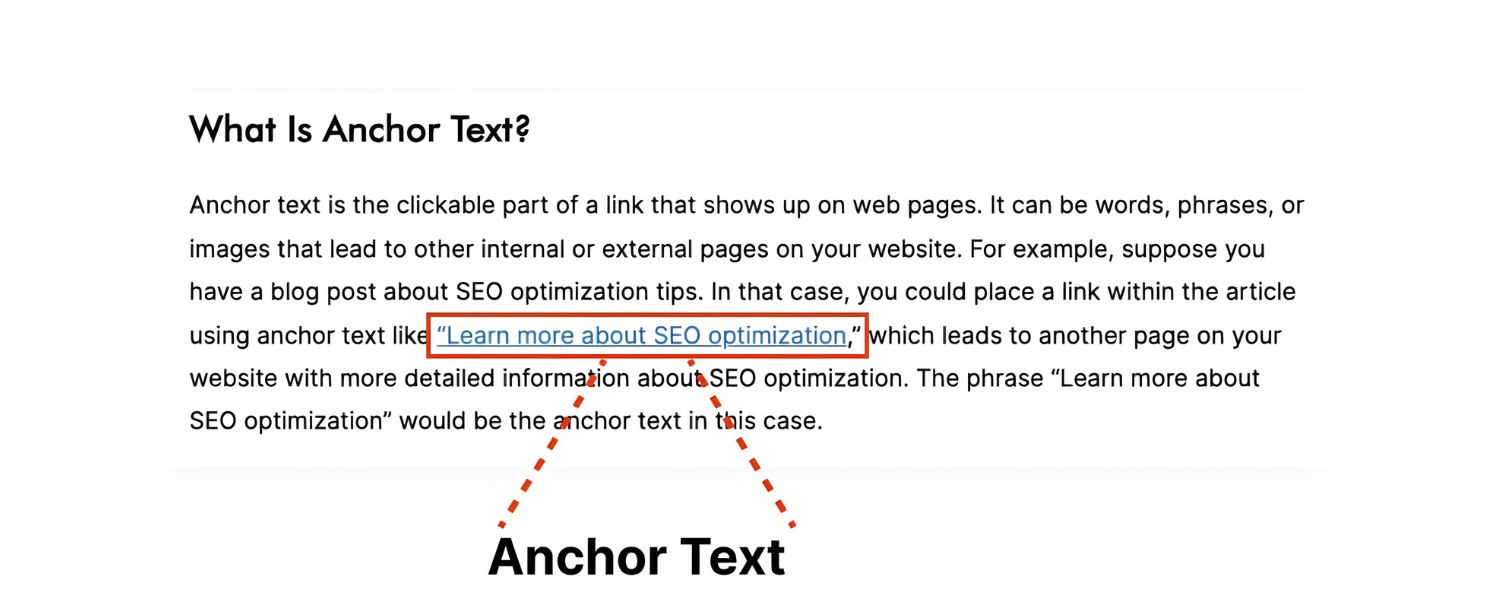
Keyword stuffing isn’t just about the on-page text; it can also happen with links. If you’re building backlinks or even internal links, be careful not to stuff your anchor text with the same keyword every time.
For example, say your target keyword is “online marketing services.” If you go and guest-post on 10 sites and make the anchor text of every link back to your site “online marketing services,” that starts to look spammy to Google.
Over-optimized anchor text was one of the things Google’s Penguin algorithm update targeted. A natural link profile will have a variety of anchor texts – some will be your brand name, some a generic “click here,” some a related phrase, and maybe a few exact-match keywords.
When adding internal links within your site, also apply this principle. Use descriptive anchor text, but don’t force the exact same keyword every time.
For instance, if you have a page about social media tips, it’s fine to sometimes link to it with the anchor “social media tips,” but you might also just say “learn more about improving your social media” as the link in another post.
The goal is to avoid looking like you’re trying to manipulate rankings with an unnatural link scheme.
In short: earn or build links that make sense for users, and keep the anchor text diverse and relevant. Not only will this avoid any “keyword stuffing” perception, it also usually improves click-through rates (because the link context is more meaningful).
Focus on quality backlinks from reputable sites, not on stuffing keywords into as many links as possible. One high-quality link with a natural anchor is worth far more than ten spammy links with exact keywords.
7. Continuously Audit Your Content for Clarity
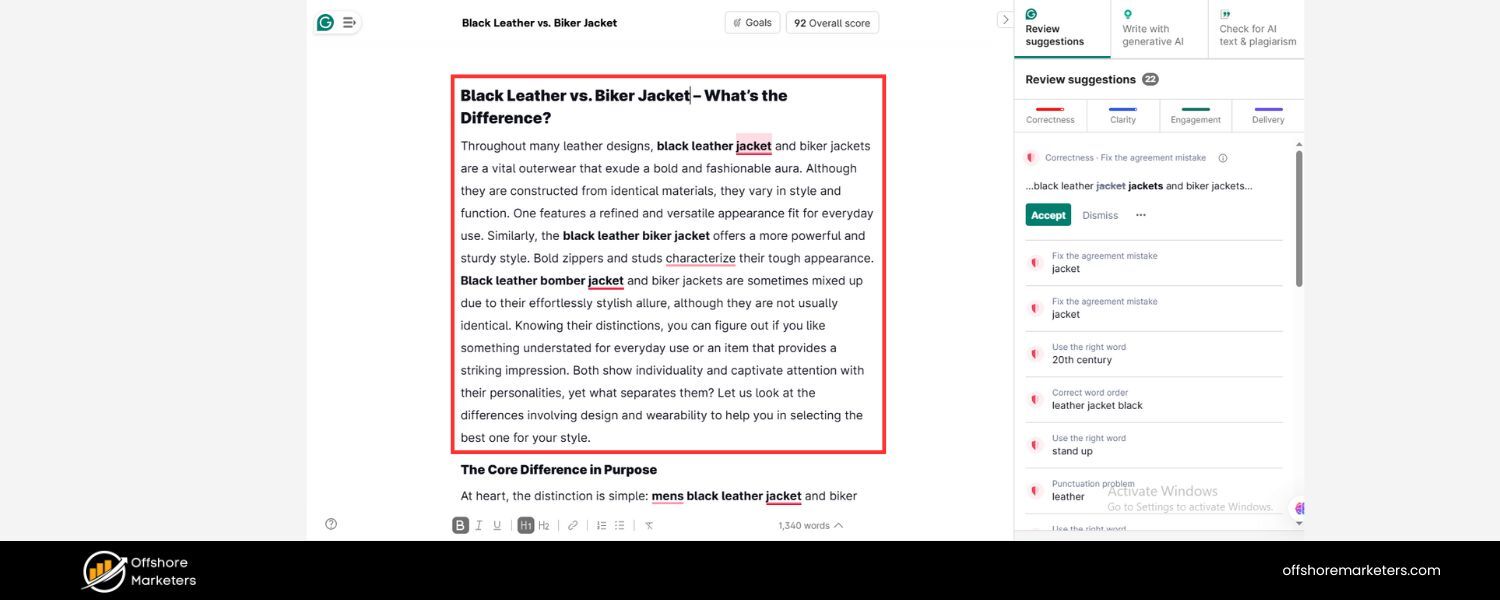
Even after writing, it’s good practice to double-check your content with fresh eyes or tools. We mentioned reading aloud and using synonyms, but also consider using a readability checker (like Hemingway or Grammarly) which can highlight convoluted sentences.
If a sentence is highlighted as hard to read, check if keyword overuse might be the culprit. Sometimes simplifying a sentence will naturally remove an extraneous keyword repetition.
Another tip is to use the “find” function (Ctrl+F) in your text editor to search for your primary keyword. If you see a huge cluster of instances all in one section, that section might need editing to spread things out.
Ideally, your keyword mentions should be spread logically through the piece – e.g., a couple in the intro, a few in the body where relevant, maybe one in the conclusion. If you find, say, 10 instances crammed into one paragraph, that’s a sign of potential stuffing.
Finally, ensure that every time you use the keyword, it’s actually adding meaning. Ask yourself: “Does this usage help the reader, or am I only putting it there for SEO?” If it’s the latter, you know what to do – rephrase or cut it.
By routinely auditing your content in this way, you’ll train yourself to naturally avoid keyword stuffing over time. It will become second nature to write in an optimized but reader-friendly manner.
FAQ: Common Questions About Keyword Stuffing
Q1: How do I know if I’ve accidentally engaged in keyword stuffing?
The best indicator is the readability of your content. If a paragraph sounds awkward or is annoyingly repetitive, you might be overusing a keyword.
Look at your page and ask, “Would this make sense to a reader, or am I just repeating myself?” You can also check metrics like keyword density – if one term accounts for an unnaturally high percentage of your text, that’s a red flag.
Tools and plugins can help flag high repetition, but your own judgment is crucial. Ultimately, if content reads unnaturally (or includes blocks of irrelevant terms), it’s likely veering into keyword stuffing territory. Keep it natural and on-topic.
Q2: Is there a “safe” keyword density or number of repetitions I should stick to?
There’s no single magic number endorsed by Google. As discussed above, a general informal guideline is to stay somewhere in a reasonable range (for many, around 2-5% density is considered safe) – but don’t treat that as a hard rule.
Every piece of content is different. A better approach is: use your primary keyword a few times where it matters most, include variations of it throughout, and then focus on delivering good information.
If you do this, you’ll likely end up with a “natural” frequency. The moment you find yourself adding a keyword just to hit some quota, stop – that’s when it can turn into stuffing. Remember, Google’s own advice is to use keywords appropriately and in context, not to hit a certain count.
Q3: Can Google actually penalize my site for keyword stuffing?
Yes. Keyword stuffing is explicitly against Google’s spam policies, and Google can respond in a couple of ways. Their algorithms might automatically detect the issue and rank your page lower (or skip it entirely for the intended keyword).
In more egregious cases, Google’s webspam team can apply a manual action (penalty) to your site. This could remove your page from search results until you fix the issue and submit a reconsideration request.
Bing can likewise reduce your visibility or remove your site if you violate their guidelines with tactics like stuffing. In short, stuffing keywords puts your rankings at serious risk. If you care about sustainable SEO, it’s vital to avoid crossing that line.
Q4: How many keywords should I target on a single page?
It’s generally best to have one primary target keyword (or phrase) per page, which represents the main topic, and a few closely related secondary keywords.
Think in terms of topics and subtopics, rather than trying to target 10 unrelated keywords with one article. For instance, if you have a page about “healthy smoothie recipes,” you can naturally also target “fruit smoothie recipe” or “easy breakfast smoothies” on that page as secondary terms.
But you wouldn’t try to also rank that same page for “best protein powder” – that would belong on a different page. By keeping each page tightly focused, you make optimization easier and avoid the temptation to overload it with too many different keywords.
Each page should answer a clear intent or question. As a bonus, this approach helps prevent keyword cannibalization (where multiple pages on your site compete for the same term). So, plan your keywords page by page, and always aim for depth over breadth in content.
Q5: If I remove excess keywords from my page, could my ranking drop because the page now has fewer keywords?
If those keywords were truly excessive and not adding value, removing or reducing them should only help your SEO in the long run.
Google does not require a certain frequency of a word – they are quite capable of understanding a page’s topic with moderate usage and synonyms. By cleaning up keyword-stuffed content, you’re improving readability and compliance with guidelines.
In many cases, pages have improved in ranking after editing out the fluff, because the content became more user-friendly and authoritative.
Google’s Search Liaison (Danny Sullivan) has even suggested that making your content more helpful (for example, removing text that was there just for SEO reasons) is viewed positively, not negatively, by Google’s algorithms.
So don’t be afraid that using a keyword 10 times instead of 30 will hurt you – if anything, 30 was likely hurting you more. Focus on satisfying the user intent; the rankings will follow.
Conclusion: Optimize Smarter, Not Harder
Keyword stuffing is a relic of a bygone SEO era. In today’s search landscape, quality trumps quantity when it comes to keyword usage.
Rather than cramming your pages with repetitive terms, aim to provide the best, most relevant content on the topic at hand. Use keywords thoughtfully – as guideposts to search engines – not as the content’s driving force.
If you’ve crafted a piece that genuinely helps readers, you’ll naturally include the right keywords in the right places without even trying too hard.
In the end, avoiding keyword stuffing isn’t just about dodging penalties; it’s about creating content that resonates with your audience. When you do that, both users and search algorithms win.
So take a strategic, user-first approach: conduct good keyword research, pick your targets wisely, write excellent content around those terms, and edit with a critical eye for any excesses.

Why Roseville Startups are Choosing Offshore Marketers to Scale Smarter
Roseville is no longer just a quiet suburb of Sacramento;...

What Is PPC? A Practical Guide to Pay‑Per‑Click Advertising
Pay‑per‑click (PPC) is the “pay only when someone clicks” branch...

Google Search Issues Affecting Results in Some Regions
Google has confirmed a problem with one of its data...

Keyword Counts Dropped After Google’s num=100 Change
In September 2025, Google stopped supporting the &num=100 parameter. This...

Image SEO: Optimize Images for Higher Rankings & Traffic
Introduction Images make your website more engaging, but they can...


.png)
.png)
.png)
.png)
.png)

2024 ALL RIGHTS RESERVED MADE IN INDIA
.png)